Center for Biosciences and Informatics, School of Fundamental Science and Technology Graduate School of Science and Technology, Keio University, Yokohama, Kanagawa 223-8522, Japan.
Faculty of Pharmaceutical Sciences, Sanyo-Onoda City University, Sanyo-Onoda, Yamaguchi 756-0884, Japan.
Int J Mol Sci. 2019 Jul 12;20(14):3439. doi: 10.3390/ijms20143439.
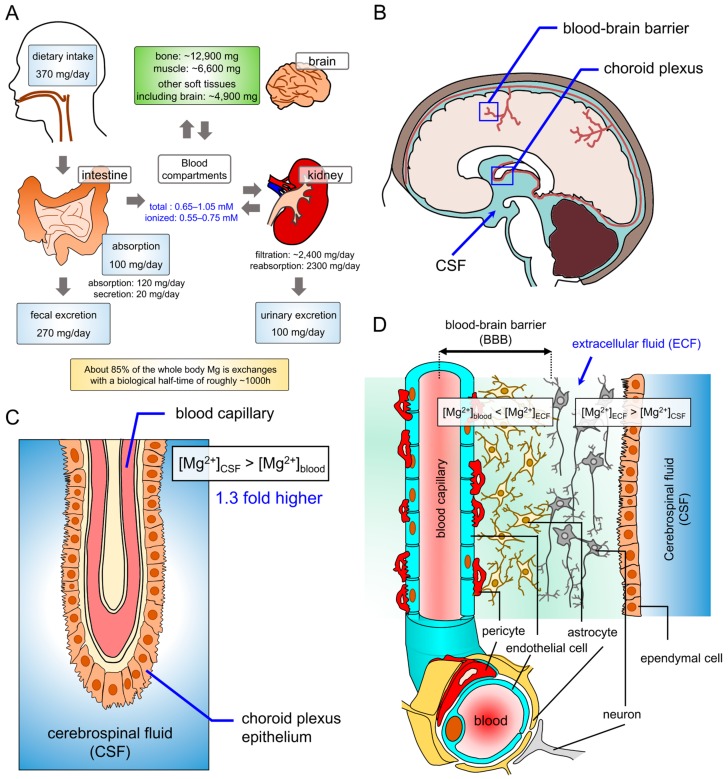
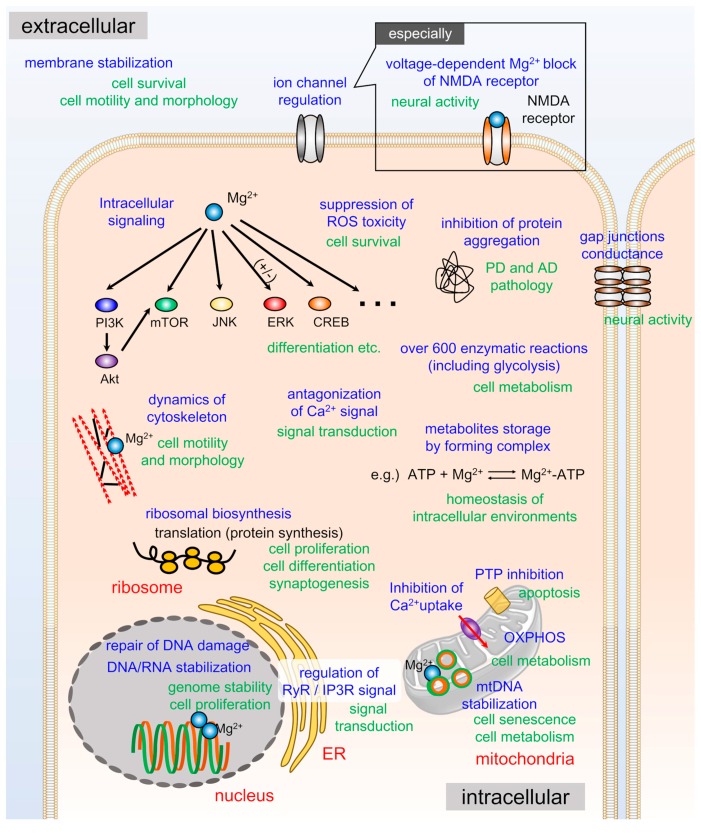
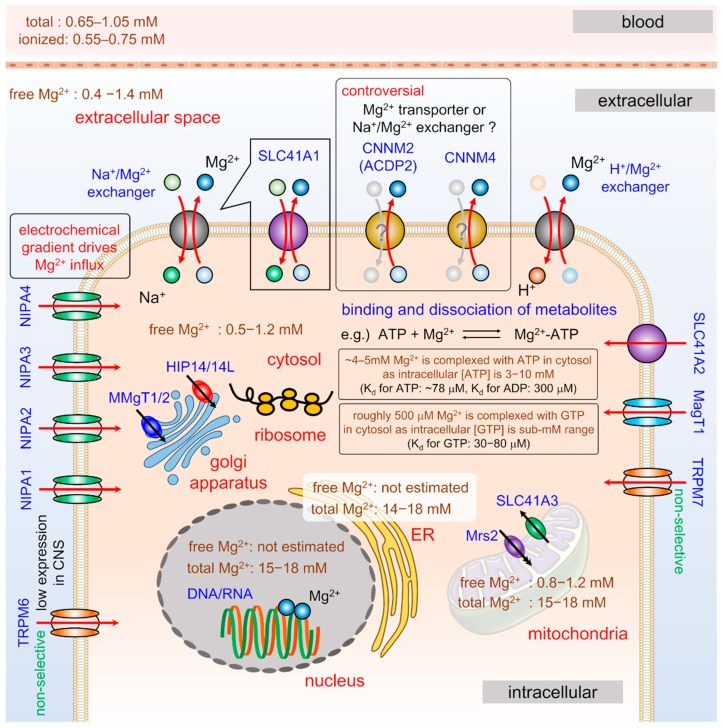
Magnesium (Mg) is the second most abundant cation in mammalian cells, and it is essential for numerous cellular processes including enzymatic reactions, ion channel functions, metabolic cycles, cellular signaling, and DNA/RNA stabilities. Because of the versatile and universal nature of Mg, the homeostasis of intracellular Mg is physiologically linked to growth, proliferation, differentiation, energy metabolism, and death of cells. On the cellular and tissue levels, maintaining Mg within optimal levels according to the biological context, such as cell types, developmental stages, extracellular environments, and pathophysiological conditions, is crucial for development, normal functions, and diseases. Hence, Mg is pathologically involved in cancers, diabetes, and neurodegenerative diseases, such as Parkinson's disease, Alzheimer's disease, and demyelination. In the research field regarding the roles and mechanisms of Mg regulation, numerous controversies caused by its versatility and complexity still exist. As Mg, at least, plays critical roles in neuronal development, healthy normal functions, and diseases, appropriate Mg supplementation exhibits neurotrophic effects in a majority of cases. Hence, the control of Mg homeostasis can be a candidate for therapeutic targets in neuronal diseases. In this review, recent results regarding the roles of intracellular Mg and its regulatory system in determining the cell phenotype, fate, and diseases in the nervous system are summarized, and an overview of the comprehensive roles of Mg is provided.
镁 (Mg) 是哺乳动物细胞中第二丰富的阳离子,对于许多细胞过程都至关重要,包括酶反应、离子通道功能、代谢循环、细胞信号转导以及 DNA/RNA 稳定性。由于 Mg 的多功能性和普遍性,细胞内 Mg 的稳态与细胞的生长、增殖、分化、能量代谢和死亡在生理上紧密相关。在细胞和组织水平上,根据生物背景(如细胞类型、发育阶段、细胞外环境和病理生理条件)维持 Mg 处于最佳水平对于发育、正常功能和疾病至关重要。因此,Mg 在癌症、糖尿病和神经退行性疾病(如帕金森病、阿尔茨海默病和脱髓鞘疾病)中存在病理性作用。在关于 Mg 调节作用和机制的研究领域中,由于其多功能性和复杂性,仍然存在许多争议。由于 Mg 至少在神经元发育、正常健康功能和疾病中发挥关键作用,因此适当的 Mg 补充在大多数情况下具有神经营养作用。因此,Mg 稳态的控制可以成为神经疾病治疗靶点的候选者。在这篇综述中,总结了细胞内 Mg 及其调节系统在决定神经系统中细胞表型、命运和疾病中的作用的最新结果,并概述了 Mg 的全面作用。