Menyhart Otília, Kakisaka Tatsuhiko, Pongor Lőrinc Sándor, Uetake Hiroyuki, Goel Ajay, Győrffy Balázs
2nd Department of Pediatrics, Semmelweis University, Tűzoltó utca 7-9, H-1094 Budapest, Hungary.
MTA TTK Lendület Cancer Biomarker Research Group, Institute of Enzymology, Hungarian Academy of Sciences, Magyar tudósok körútja 2., H-1117 Budapest, Hungary.
Cancers (Basel). 2019 Jul 14;11(7):983. doi: 10.3390/cancers11070983.
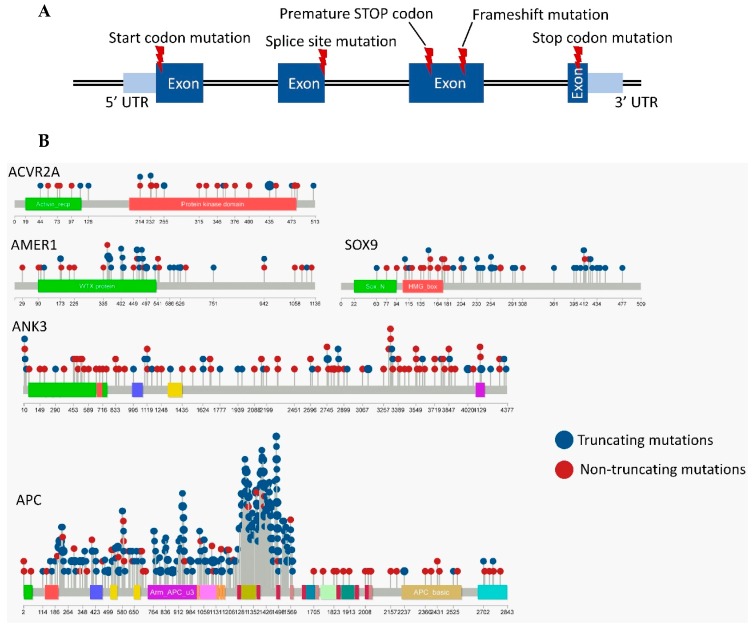
Numerous driver mutations have been identified in colorectal cancer (CRC), but their relevance to the development of targeted therapies remains elusive. The secondary effects of pathogenic driver mutations on downstream signaling pathways offer a potential approach for the identification of therapeutic targets. We aimed to identify differentially expressed genes as potential drug targets linked to driver mutations.
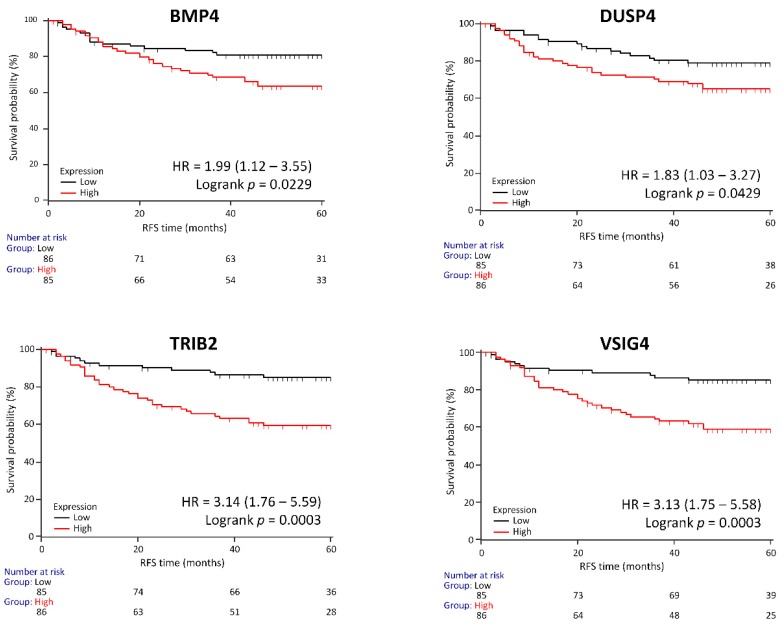
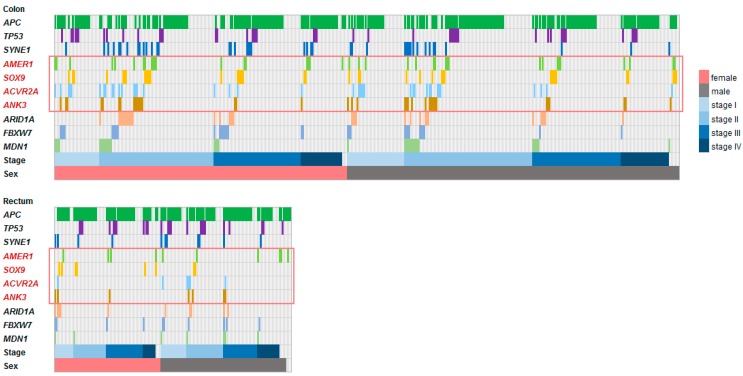
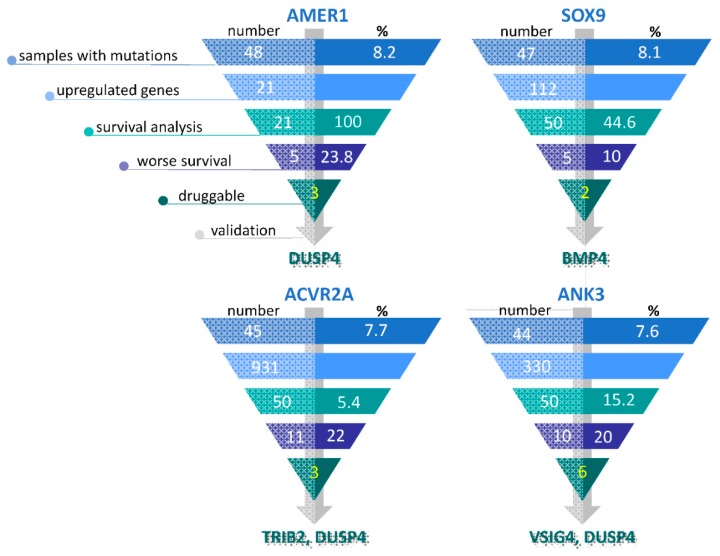
Somatic mutations and the gene expression data of 582 CRC patients were utilized, incorporating the mutational status of 39,916 and the expression levels of 20,500 genes. To uncover candidate targets, the expression levels of various genes in wild-type and mutant cases for the most frequent disruptive mutations were compared with a Mann-Whitney test. A survival analysis was performed in 2100 patients with transcriptomic gene expression data. Up-regulated genes associated with worse survival were filtered for potentially actionable targets. The most significant hits were validated in an independent set of 171 CRC patients.
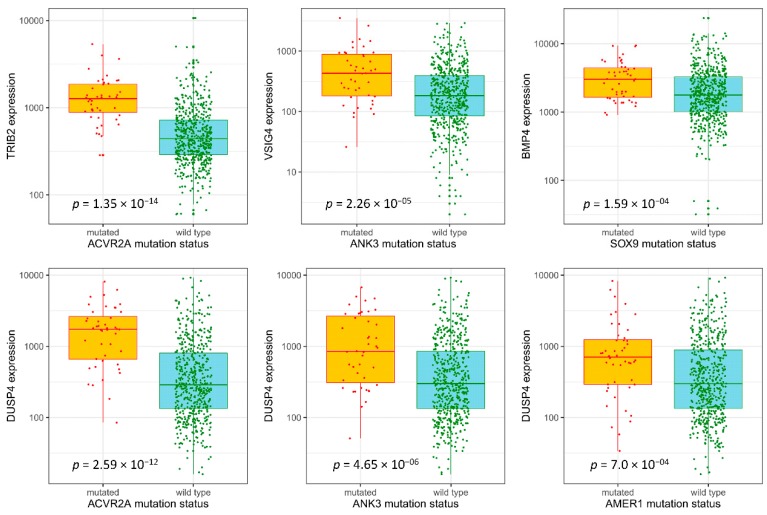
Altogether, 426 disruptive mutation-associated upregulated genes were identified. Among these, 95 were linked to worse recurrence-free survival (RFS). Based on the druggability filter, 37 potentially actionable targets were revealed. We selected seven genes and validated their expression in 171 patient specimens. The best independently validated combinations were ( = 2.6 × 10) in mutated (7.7%) patients; ( = 1.6 × 10) in mutated (8.1%) patients; ( = 1.35 × 10) in mutated patients; ( = 2.6 × 10) in mutated (7.6%) patients, and ( = 7.1 × 10) in mutated (8.2%) patients.
The results uncovered potentially druggable genes in colorectal cancer. The identified mutations could enable future patient stratification for targeted therapy.
在结直肠癌(CRC)中已鉴定出许多驱动突变,但其与靶向治疗发展的相关性仍不明确。致病性驱动突变对下游信号通路的继发效应为鉴定治疗靶点提供了一种潜在方法。我们旨在鉴定与驱动突变相关的差异表达基因作为潜在药物靶点。
利用582例CRC患者的体细胞突变和基因表达数据,纳入39916个突变状态和20500个基因的表达水平。为了发现候选靶点,通过Mann-Whitney检验比较了最常见破坏性突变的野生型和突变型病例中各种基因的表达水平。对2100例有转录组基因表达数据的患者进行了生存分析。筛选出与较差生存相关的上调基因作为潜在的可操作靶点。在一组独立的171例CRC患者中验证了最显著的命中靶点。
共鉴定出426个与破坏性突变相关的上调基因。其中,95个与无复发生存期(RFS)较差有关。基于药物可及性筛选,揭示了37个潜在的可操作靶点。我们选择了7个基因并在171例患者标本中验证了它们的表达。最佳的独立验证组合为:在KRAS突变(7.7%)患者中为(P = 2.6×10⁻⁶);在NRAS突变(8.1%)患者中为(P = 1.6×10⁻⁵);在BRAF突变患者中为(P = 1.3⁵×10⁻⁴);在PIK3CA突变(7.6%)患者中为(P = 2.6×10⁻⁶),在FBXW7突变(8.2%)患者中为(P = 7.1×10⁻⁵)。
研究结果揭示了结直肠癌中潜在的可药物化基因。所鉴定的突变可为未来靶向治疗的患者分层提供依据。