Jung Won-Sang, Hwang Hyejung, Kim Jisu, Park Hun-Young, Lim Kiwon
J Exerc Nutrition Biochem. 2019 Jun 30;23(2):45-50. doi: 10.20463/jenb.2019.0016.
The purpose of this study was to confirm that the difference in excess post-exercise oxygen consumption (EPOC) during exercise of the spending the same calories between the continuous and interval exercise.
Thirty-four healthy college students who did not regularly exercise volunteered to participate in our study. Continuous exercise was performed on an ergometer for 30 min at 60% of maximal oxygen consumption (VO2 max). Interval exercise was performed on a cycle ergometer at 80% VO2 max for 2 min initially, followed by 40% VO2 max for 1 min, and 80% VO2 max for 3 min. This was repeated six times for a total of 26 min.
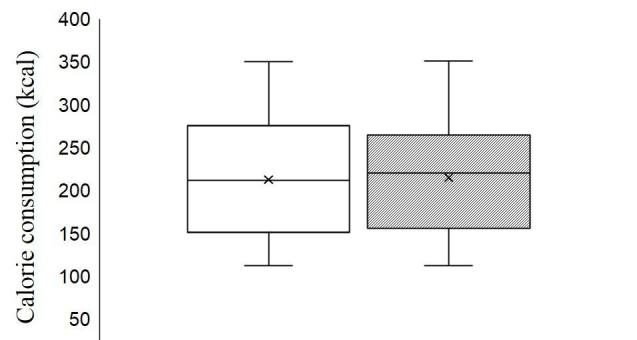
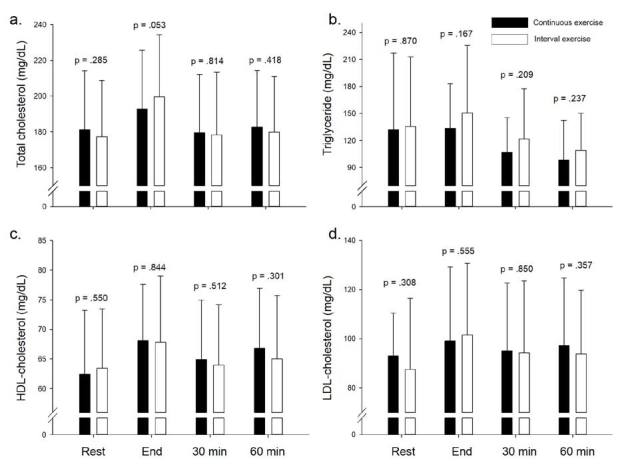
The major findings were as follows: (1) energy consumption during exercise was not significantly different between continuous exercise and interval exercise groups; (2) EPOC was higher in interval exercise than in continuous exercise for all dependent variables (i.e., total oxygen consumption, total calories, summation of heart rate); and (3) there were no significant differences in the lipid profile between continuous and interval groups.
Our study confirmed that after equalizing energy expenditure for continuous and interval exercise on a cycle ergometer in subjects in their twenties, interval exercise results in higher EPOC than continuous exercise. These data suggest that interval exercise may be more effective than continuous exercise in reducing body fat, for a given amount of energy expenditure.
本研究的目的是确认在消耗相同卡路里的运动过程中,持续运动和间歇运动后过量氧耗(EPOC)的差异。
34名不经常运动的健康大学生自愿参与我们的研究。在测力计上以最大耗氧量(VO2 max)的60%进行30分钟的持续运动。间歇运动在自行车测力计上进行,最初以VO2 max的80%运动2分钟,然后以VO2 max的40%运动1分钟,再以VO2 max的80%运动3分钟。重复此过程六次,共26分钟。
主要发现如下:(1)持续运动组和间歇运动组在运动期间的能量消耗无显著差异;(2)对于所有因变量(即总耗氧量、总卡路里、心率总和),间歇运动后的EPOC高于持续运动;(3)持续运动组和间歇运动组之间的血脂水平无显著差异。
我们的研究证实,在二十多岁的受试者中,在自行车测力计上使持续运动和间歇运动的能量消耗相等后,间歇运动产生的EPOC高于持续运动。这些数据表明,在给定的能量消耗下,间歇运动在减少体脂方面可能比持续运动更有效。