African Population and Health Research Center, APHRC Campus, 2nd Floor, Manga Close, Off Kirawa Road, P.O. Box: 10787-00100, Nairobi, Kenya.
University of Rennes, CNRS, CREM-UMR 6211, F-35000, Rennes, France.
BMC Public Health. 2019 Jul 23;19(1):988. doi: 10.1186/s12889-019-7309-9.
Immunization is one of the most cost-effective health intervention to halt the spread of childhood diseases, and improve child health. Yet, there is a substantial disparity in childhood immunization coverage. The overall objective of the study is to investigate the trends of within-country inequalities in childhood immunization coverage among children aged 12-23 months in Kenya, Ghana, and Côte d'Ivoire. The three countries included in this study are countries that are on the verge of entering the accelerated phase of the Gavi, the Vaccine Alliance's co-sharing of costs of vaccine and eventually assuming full costs of vaccines. Côte d'Ivoire is in the Gavi preparatory transition phase, entering the accelerated transition phase in 2020, with an expected transition to full self-financing in 2025. Ghana is expected to enter the accelerated transition phase in 2021 and to full self-financing in 2026 while Kenya will enter in 2022 and fully self-finance in 2027. We examine the pattern of inequality in childhood immunization coverage over time through an equity lens by mainly exploring the direction of inequality in coverage.
We use data from the Demographic Health Surveys and Multiple Indicator Cluster Surveys. The rate difference, rate ratio, and relative concentration index are used as measures of inequality.
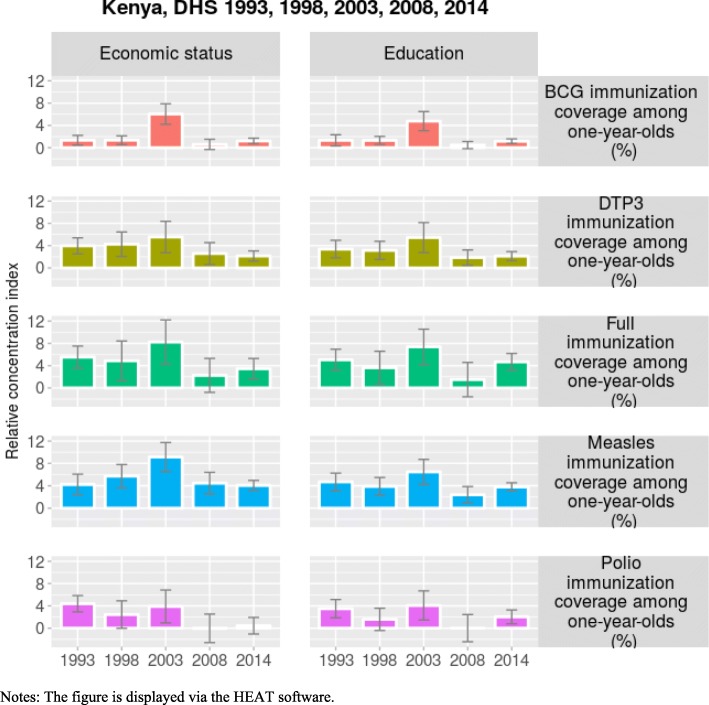
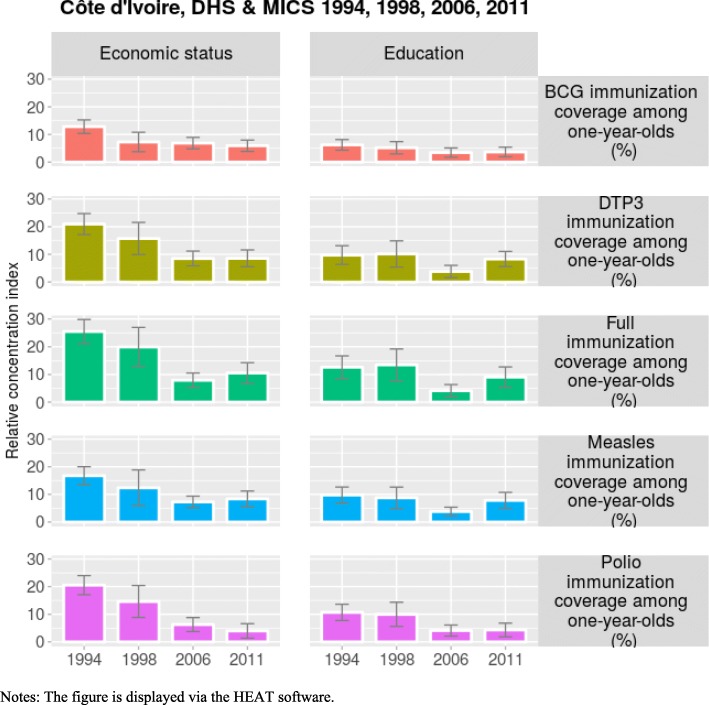
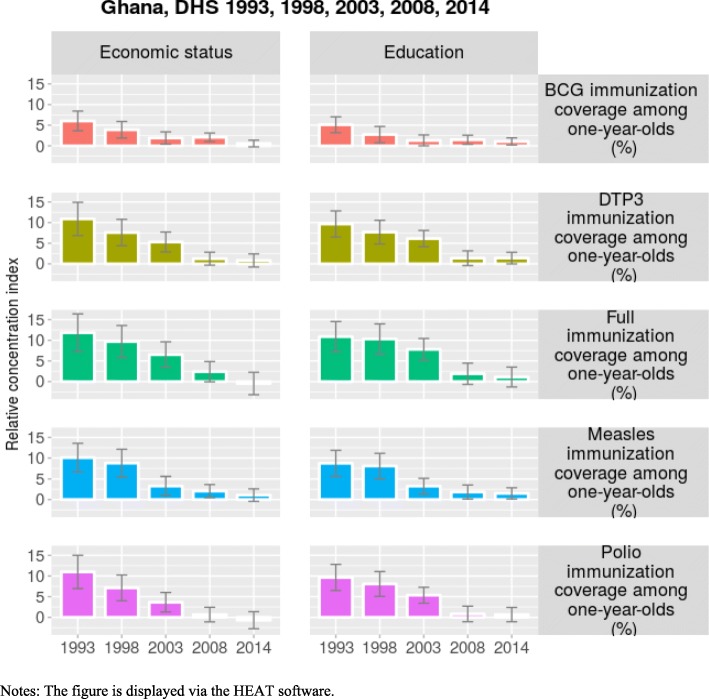
Results of the study suggest that in most years inequality in immunization coverage in the three countries persist over time, and it favors the most-advantaged households. However, there is a sharp decrease pattern in inequalities in childhood immunization coverage in Ghana over time.
Policymakers could be more strategic in addressing pro-rich inequality in immunization coverage by designing health interventions through an equity lens. Using inequality data and putting disadvantaged households at the center of health intervention designs could increase the efficiency of the primary health care system and reduce the incidence of mortality and morbidity as a result of vaccine-preventable disease.
免疫接种是阻止儿童疾病传播和改善儿童健康的最具成本效益的健康干预措施之一。然而,儿童免疫接种覆盖率存在着相当大的差距。本研究的总体目标是调查肯尼亚、加纳和科特迪瓦 12-23 个月儿童的国家内儿童免疫接种覆盖率的不平等趋势。本研究包括的三个国家都处于疫苗联盟(Gavi)成本分担的加速阶段,最终将承担疫苗的全部费用。科特迪瓦处于 Gavi 筹备过渡阶段,预计于 2020 年进入加速过渡阶段,预计于 2025 年过渡到完全自筹资金。加纳预计于 2021 年进入加速过渡阶段,于 2026 年实现完全自筹资金,肯尼亚将于 2022 年进入并于 2027 年实现完全自筹资金。我们主要通过探索覆盖率不平等的方向,从公平角度审视儿童免疫接种覆盖率不平等的模式。
我们使用来自人口与健康调查和多指标类集调查的数据。差异率、比率比和相对集中指数用作不平等的衡量指标。
研究结果表明,在大多数年份,这三个国家的免疫覆盖率不平等状况随着时间的推移而持续存在,并且有利于最有利的家庭。然而,加纳的儿童免疫覆盖率不平等状况随着时间的推移呈急剧下降趋势。
决策者可以通过公平视角设计卫生干预措施,更加注重解决免疫覆盖率方面的有利于富人的不平等问题。通过不平等数据并将弱势家庭置于卫生干预设计的中心,可以提高初级卫生保健系统的效率,并降低因疫苗可预防疾病而导致的死亡率和发病率。