Division of Nephrology, Department of Internal Medicine, University of Michigan, Ann Arbor, MI
Division of Metabolism, Endocrinology, and Diabetes, Department of Internal Medicine, University of Michigan, Ann Arbor, MI.
Diabetes. 2019 Oct;68(10):2035-2044. doi: 10.2337/db19-0145. Epub 2019 Jul 23.
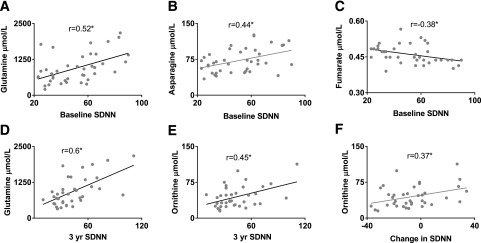
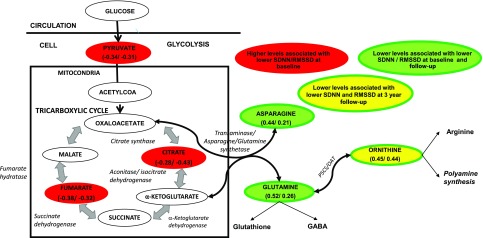
While diabetes is characterized by hyperglycemia, nutrient metabolic pathways like amino acid and tricarboxylic acid (TCA) cycle are also profoundly perturbed. As glycemic control alone does not prevent complications, we hypothesized that these metabolic disruptions are responsible for the development and progression of diabetic cardiovascular autonomic neuropathy (CAN). We performed standardized cardiovascular autonomic reflex tests and targeted fasting plasma metabolomic analysis of amino acids and TCA cycle intermediates in subjects with type 1 diabetes and healthy control subjects followed for 3 years. Forty-seven participants with type 1 diabetes (60% female and mean ± SD age 35 ± 13 years, diabetes duration 13 ± 7 years, and HbA 7.9 ± 1.2%) had lower fumarate levels and higher threonine, serine, proline, asparagine, aspartic acid, phenylalanine, tyrosine, and histidine levels compared with 10 age-matched healthy control subjects. Higher baseline fumarate levels and lower baseline amino acid levels-asparagine and glutamine-correlate with CAN (lower baseline SD of normal R-R interval [SDNN]). Baseline glutamine and ornithine levels also associated with the progression of CAN (lower SDNN at 3 years) and change in SDNN, respectively, after adjustment for baseline HbA, blood glucose, BMI, cholesterol, urine microalbumin-to- creatinine ratio, estimated glomerular filtration rate, and years of diabetes. Therefore, significant changes in the anaplerotic flux into the TCA cycle could be the critical defect underlying CAN progression.
虽然糖尿病的特征是高血糖,但氨基酸和三羧酸(TCA)循环等营养代谢途径也受到严重干扰。由于仅控制血糖并不能预防并发症,我们假设这些代谢紊乱是导致糖尿病自主神经病变(CAN)发展和进展的原因。我们对 1 型糖尿病患者和健康对照者进行了 3 年的标准化心血管自主反射测试和靶向空腹血浆代谢组学分析,以检测氨基酸和 TCA 循环中间产物。47 名 1 型糖尿病患者(60%为女性,平均年龄为 35 ± 13 岁,糖尿病病程为 13 ± 7 年,HbA1c 为 7.9 ± 1.2%)的富马酸水平较低,苏氨酸、丝氨酸、脯氨酸、天冬酰胺、天门冬氨酸、苯丙氨酸、酪氨酸和组氨酸水平较高。与 10 名年龄匹配的健康对照者相比。较高的基线富马酸水平和较低的基线氨基酸水平(天冬酰胺和谷氨酰胺)与 CAN(较低的基线正常 R-R 间期标准差[SDNN])相关。基线谷氨酰胺和鸟氨酸水平也与 CAN 的进展(3 年后 SDNN 降低)和 SDNN 的变化相关(调整基线 HbA、血糖、BMI、胆固醇、尿微量白蛋白与肌酐比值、估算肾小球滤过率和糖尿病病程后)。因此,TCA 循环中氨甲酰磷酸的通量的显著变化可能是导致 CAN 进展的关键缺陷。