Hanns Pauline, Paczulla Anna M, Medinger Michael, Konantz Martina, Lengerke Claudia
Department of Biomedicine, University Hospital and University of Basel, Basel, Switzerland.
Division of Clinical Hematology, University Hospital Basel, Basel, Switzerland.
Cell Stress. 2019 Jun 4;3(7):221-235. doi: 10.15698/cst2019.07.192.
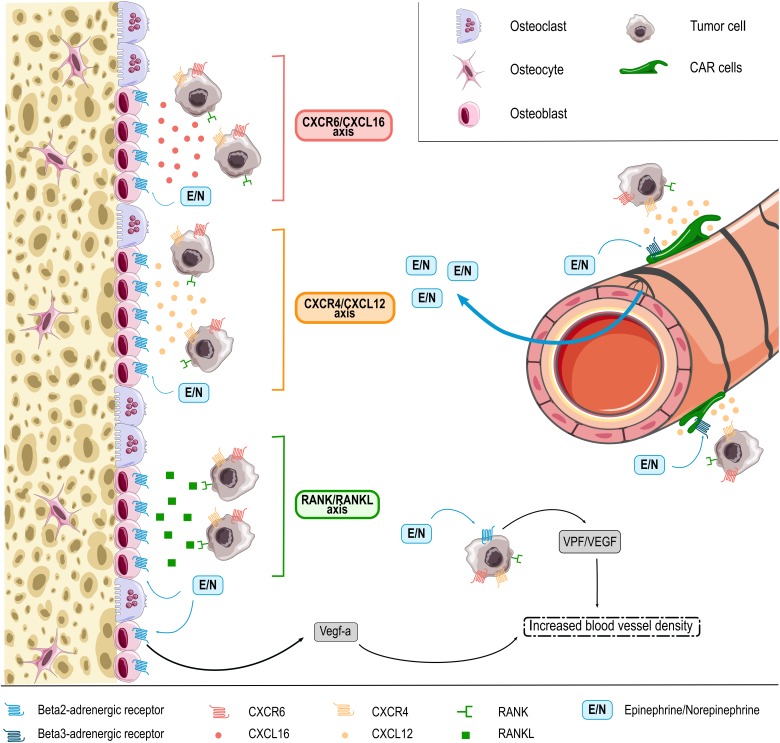
High vascularization and locally secreted factors make the bone marrow (BM) microenvironment particularly hospitable for tumor cells and bones to a preferred metastatic site for disseminated cancer cells of different origins. Cancer cell homing and proliferation in the BM are amongst other regulated by complex interactions with BM niche cells (e.g. osteoblasts, endothelial cells and mesenchymal stromal cells (MSCs)), resident hematopoietic stem and progenitor cells (HSPCs) and pro-angiogenic cytokines leading to enhanced BM microvessel densities during malignant progression. Stress and catecholamine neurotransmitters released in response to activation of the sympathetic nervous system (SNS) reportedly modulate various BM cells and may thereby influence cancer progression. Here we review the role of catecholamines during tumorigenesis with particular focus on pro-tumorigenic effects mediated by the BM niche.
高血管化和局部分泌因子使骨髓(BM)微环境对肿瘤细胞格外适宜,也使骨骼成为不同起源的播散癌细胞的首选转移部位。癌细胞在骨髓中的归巢和增殖等过程受到与骨髓生态位细胞(如成骨细胞、内皮细胞和间充质基质细胞(MSC))、常驻造血干细胞和祖细胞(HSPC)以及促血管生成细胞因子的复杂相互作用的调控,从而在恶性进展过程中导致骨髓微血管密度增加。据报道,应激和交感神经系统(SNS)激活后释放的儿茶酚胺神经递质可调节各种骨髓细胞,进而可能影响癌症进展。在此,我们综述儿茶酚胺在肿瘤发生过程中的作用,特别关注骨髓生态位介导的促肿瘤作用。