Candido Aline C, Morais Núbia de S de, Dutra Luiza V, Pinto Carina A, Franceschini Sylvia do C C, Alfenas Rita de Cássia G
Departamento de Nutrição e Saúde, Universidade Federal de Viçosa (UFV), Viçosa, MG, Brasil.
Arch Endocrinol Metab. 2019 Jul 18;63(3):306-311. doi: 10.20945/2359-3997000000151.
To determine the prevalence of insufficient iodine intake in pregnant women.
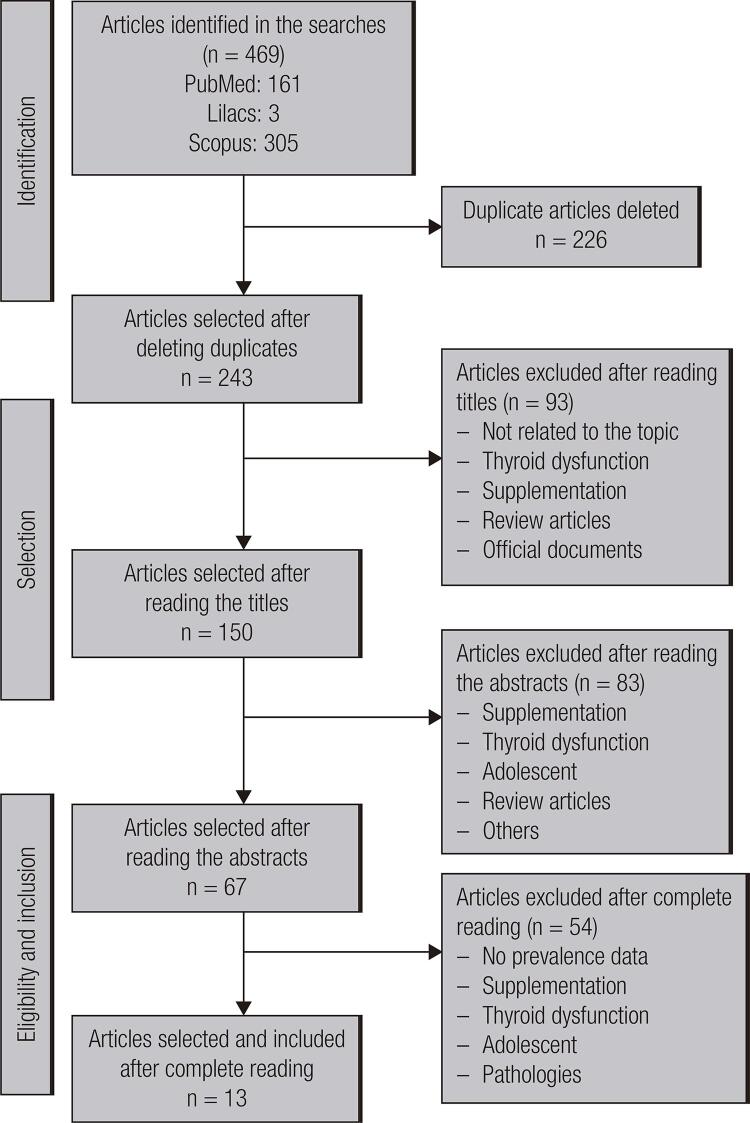
The search was performed in the electronic databases Medline (PubMed), Latin American and Caribbean Literature in Health Sciences (Lilacs) and Scopus. Review studies, experimental studies, those with adolescent pregnant women (< 20 years) and iodine supplementation were excluded. The selection followed the steps of identifying the articles in the databases, deleting the duplicates, and reading the titles, abstracts, and then the entire article. The search for the articles occurred in September 2017, using the descriptors "pregnant" and "iodine deficiency" NOT "supplementation" in English, Portuguese and Spanish.
Thirteen articles were included, the deficiency prevalence ranged from 16.1% to 84.0%, and the median of iodine intake was insufficient in 75% of the studies. There is no classification for mild, moderate or severe levels of iodine deficiency in pregnant women, which makes it impossible to know the real dimension of the problem.
The high prevalence of insufficient iodine intake in pregnant women, observed worldwide, shows the need for a population classification in order to direct public policies. Arch Endocrinol Metab. 2019;63(3):306-11.
确定孕妇碘摄入不足的患病率。
在电子数据库Medline(PubMed)、拉丁美洲和加勒比卫生科学文献数据库(Lilacs)以及Scopus中进行检索。排除综述研究、实验研究、针对青少年孕妇(<20岁)的研究以及碘补充研究。筛选过程遵循在数据库中识别文章、删除重复项、阅读标题、摘要,然后阅读全文的步骤。于2017年9月进行文章检索,使用英文、葡萄牙文和西班牙文的描述词“怀孕”和“碘缺乏”而非“补充”。
纳入13篇文章,碘缺乏患病率在16.1%至84.0%之间,75%的研究中碘摄入量中位数不足。目前尚无针对孕妇碘缺乏轻度、中度或重度水平的分类,这使得无法了解该问题的实际严重程度。
全球范围内观察到孕妇碘摄入不足的高患病率,表明需要进行人群分类以指导公共政策。《内分泌与代谢档案》。2019年;63(3):306 - 11。