Department of Health and Environmental Sciences, Xi'an Jiaotong-Liverpool University, Suzhou 215123, China.
Harris-Wellbeing Research Centre, Faculty of Health & Life Sciences, University of Liverpool, Liverpool L8 7SS, UK.
Nutrients. 2022 Apr 19;14(9):1691. doi: 10.3390/nu14091691.
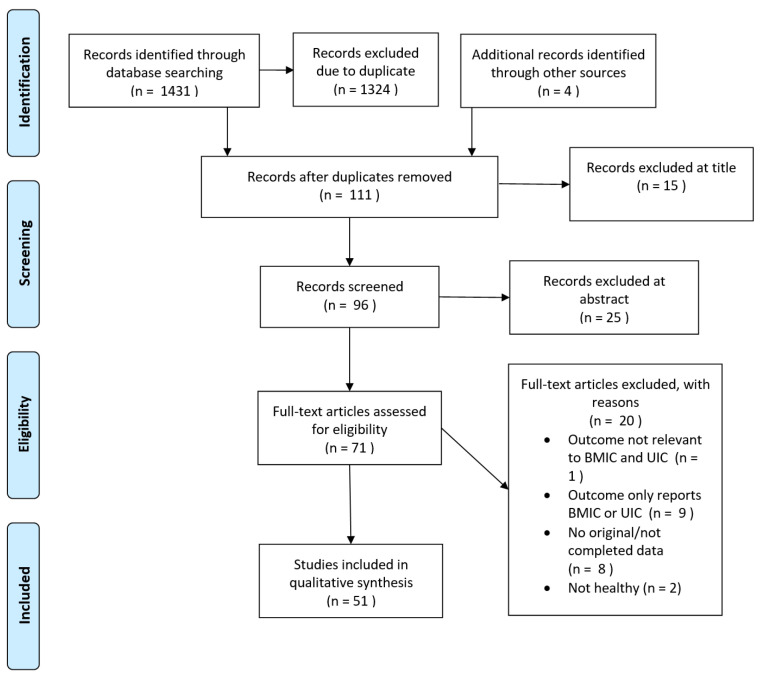
Background: Iodine is needed for the production of thyroid hormones, which are essential for infant growth and development. Given that there are wide variations in breast milk iodine concentration (BMIC) and urinary iodine concentration (UIC), it is unclear if BMIC is associated with UIC in populations residing in iodine sufficient or deficient areas. Aim: To investigate if BMIC can be used as a biomarker for iodine status in lactating women and children <2 years of age. Methods: Electronic databases; PubMed, Web of Science and Scopus were searched until year 2021, for studies investigating the relationship between BMIC and UIC. Studies were reviewed for eligibility, according to inclusion and exclusion criteria, followed by data extraction, according to the PRISMA guidelines. Results: Overall, 51 studies met the criteria for inclusion in the systematic review. BMIC ranged from 18 to 1153 µg/L. In iodine-deficient and iodine-sufficient lactating women, BMIC ranged from 26 to 185 µg/L and 15 to 1006 µg/L, respectively. In most studies, the categorisation of iodine status assessed by median UIC was consistent with the categorisation of iodine status assessed by median BMIC cut off of ≥100 µg/L, to determine iodine sufficiency in lactating women and children <2 years of age. Conclusions: The systematic review indicated that BMIC is a promising biomarker of iodine status in lactating women and children <2 years of age. However, these data need to be interpreted cautiously, given the study limitations in the included studies. Future studies should consider investigating the optimal median BMIC, as there is a lack of high-quality observational and intervention studies in lactating women and infants.
碘是甲状腺激素生成所必需的,而甲状腺激素对婴儿的生长发育至关重要。鉴于母乳碘浓度(BMIC)和尿碘浓度(UIC)存在广泛差异,尚不清楚在碘充足和碘缺乏地区,BMIC 是否与 UIC 相关。目的:研究 BMIC 是否可作为哺乳期妇女和 <2 岁儿童碘状况的生物标志物。方法:通过电子数据库(PubMed、Web of Science 和 Scopus)检索 2021 年之前的研究,以调查 BMIC 与 UIC 之间的关系。根据纳入和排除标准对研究进行评审,然后根据 PRISMA 指南进行数据提取。结果:总体而言,有 51 项研究符合系统综述的纳入标准。BMIC 范围为 18 至 1153µg/L。在碘缺乏和碘充足的哺乳期妇女中,BMIC 范围分别为 26 至 185µg/L 和 15 至 1006µg/L。在大多数研究中,通过中位数 UIC 评估的碘状况分类与通过中位数 BMIC 截断值(≥100µg/L)评估的碘状况分类一致,以确定哺乳期妇女和 <2 岁儿童的碘充足情况。结论:系统综述表明,BMIC 是哺乳期妇女和 <2 岁儿童碘状况的有前途的生物标志物。然而,鉴于纳入研究中的研究局限性,这些数据需要谨慎解释。未来的研究应考虑调查最佳中位数 BMIC,因为缺乏针对哺乳期妇女和婴儿的高质量观察性和干预性研究。