University of Algarve, Campus de Gambelas, 8005-139, Faro, Portugal.
Centre of Marine Sciences, CCMAR, University of Algarve, Campus de Gambelas, 8005-139, Faro, Portugal.
BMC Evol Biol. 2019 Jul 24;19(1):153. doi: 10.1186/s12862-019-1476-2.
Evolutionary patterns of scleractinian (stony) corals are difficult to infer given the existence of few diagnostic characters and pervasive phenotypic plasticity. A previous study of Hawaiian Montipora (Scleractinia: Acroporidae) based on five partial mitochondrial and two nuclear genes revealed the existence of a species complex, grouping one of the rarest known species (M. dilatata, which is listed as Endangered by the International Union for Conservation of Nature - IUCN) with widespread corals of very different colony growth forms (M. flabellata and M. cf. turgescens). These previous results could result from a lack of resolution due to a limited number of markers, compositional heterogeneity or reflect biological processes such as incomplete lineage sorting (ILS) or introgression.
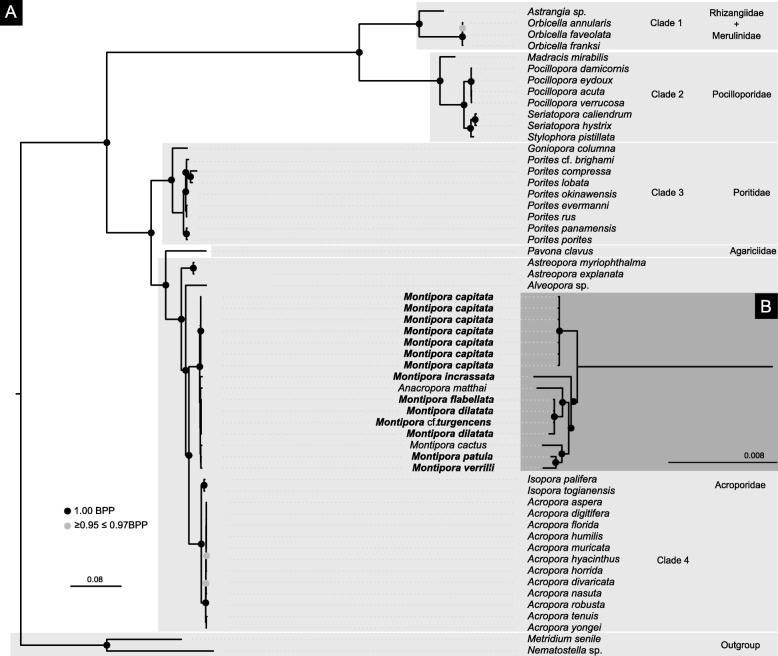
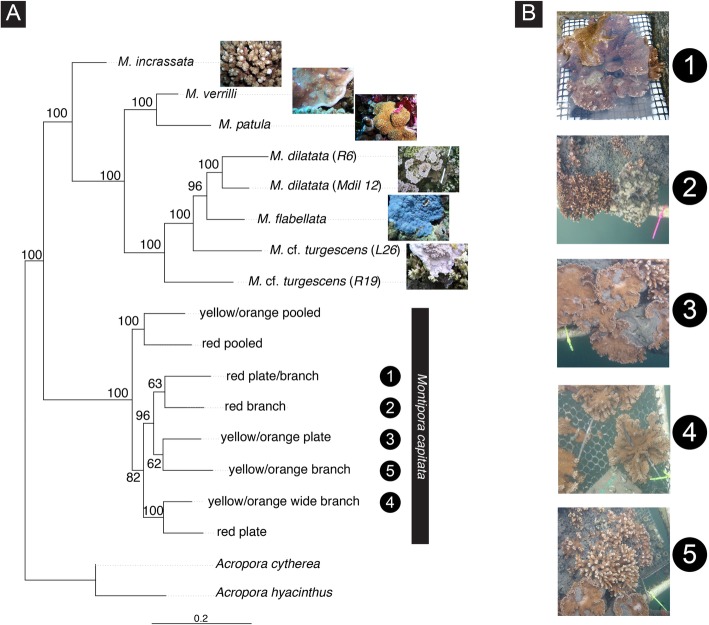
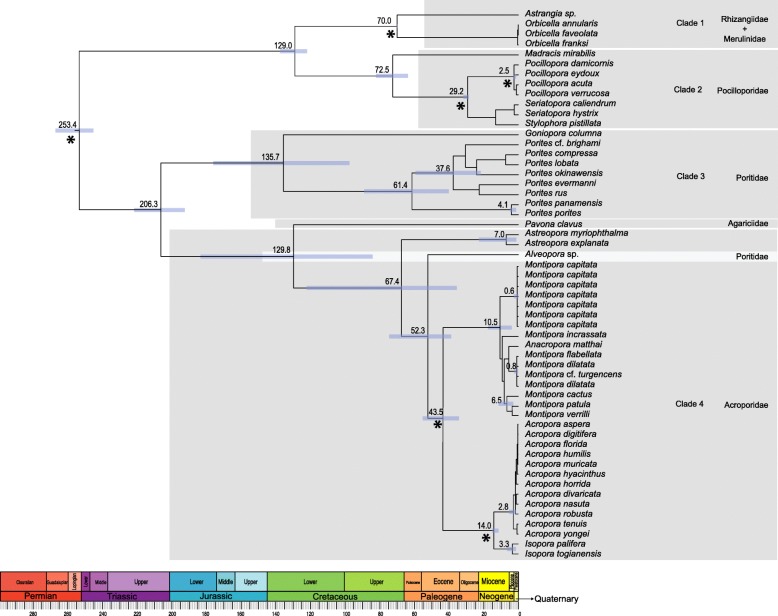
All 13 mitochondrial protein-coding genes from 55 scleractinians (14 lineages from this study) were used to evaluate if a recent origin of the M. dilatata species complex or rate heterogeneity could be compromising phylogenetic inference. Rate heterogeneity detected in the mitochondrial data set seems to have no significant impacts on the phylogenies but clearly affects age estimates. Dating analyses show different estimations for the speciation of M. dilatata species complex depending on whether taking compositional heterogeneity into account (0.8 [0.05-2.6] Myr) or assuming rate homogeneity (0.4 [0.14-0.75] Myr). Genomic data also provided evidence of introgression among all analysed samples of the complex. RADseq data indicated that M. capitata colour morphs may have a genetic basis.
Despite the volume of data (over 60,000 SNPs), phylogenetic relationships within the M. dilatata species complex remain unresolved most likely due to a recent origin and ongoing introgression. Species delimitation with genomic data is not concordant with the current taxonomy, which does not reflect the true diversity of this group. Nominal species within the complex are either undergoing a speciation process or represent ecomorphs exhibiting phenotypic polymorphisms.
由于缺乏诊断特征和普遍存在的表型可塑性,硬珊瑚(石珊瑚)的进化模式难以推断。先前基于五个部分线粒体和两个核基因对夏威夷 Montipora(石珊瑚科:Acroporidae)的研究揭示了一个物种复合体的存在,将一种已知最稀有的物种(M. dilatata,被国际自然保护联盟列为濒危物种 - IUCN)与非常不同的群体生长形式的广泛珊瑚组合在一起(M. flabellata 和 M. cf. turgescens)。这些先前的结果可能是由于标记数量有限、组成异质性或反映生物过程(如不完全谱系分选(ILS)或基因渗入)而导致分辨率不足所致。
从 55 种石珊瑚(包括本研究中的 14 个谱系)中获得了所有 13 个线粒体蛋白编码基因,以评估 M. dilatata 物种复合体的近期起源或速率异质性是否会影响系统发育推断。在线粒体数据集检测到的速率异质性似乎对系统发育没有显著影响,但清楚地影响年龄估计。约会分析表明,根据是否考虑组成异质性(0.8 [0.05-2.6] Myr)或假设速率均匀性(0.4 [0.14-0.75] Myr),M. dilatata 物种复合体的物种形成有不同的估计。基因组数据还提供了复合体中所有分析样本基因渗入的证据。RADseq 数据表明,M. capitata 颜色形态可能具有遗传基础。
尽管数据量很大(超过 60,000 个 SNPs),但 M. dilatata 物种复合体内部的系统发育关系仍未解决,这很可能是由于最近的起源和正在进行的基因渗入所致。基因组数据的物种划定与当前的分类法不一致,后者不能反映该群体的真实多样性。复合体中的命名种要么正在经历一个物种形成过程,要么代表表现出表型多态性的生态型。