
监狱牢房空间密度与传染病:一项系统综述
Prison cell spatial density and infectious and communicable diseases: a systematic review.
作者信息
Simpson Paul L, Simpson Melanie, Adily Armita, Grant Luke, Butler Tony
机构信息
Kirby Institute, University of New South Wales, Sydney, New South Wales, Australia.
Juvenile Justice New South Wales, New South Wales Department of Justice, Sydney, New South Wales, Australia.
出版信息
BMJ Open. 2019 Jul 23;9(7):e026806. doi: 10.1136/bmjopen-2018-026806.
OBJECTIVE
To summarise the extent and quality of evidence on the association between prison cell spatial density (a measure of crowding) and infectious and communicable diseases transmission among prisoners.
DESIGN
Systematic review.
DATA SOURCES
Embase, PubMed, Medline, Scopus, Web of Science, PsycINFO, PsycExtra, ProQuest Databases, ProQuest Dissertations and Theses Global, Index to Legal Periodicals, InformitOnline, Cochrane Library, Criminal Justice Abstracts and ICONDA were searched to 31 December 2018.
ELIGIBILITY CRITERIA
Studies that reported on the association between prison cell spatial density (measured in square feet or square metres of cell floor area per person) and infectious and communicable diseases in juvenile and adult populations incarcerated in a correctional facility.
DATA EXTRACTION AND SYNTHESIS
A review protocol was developed in consultation with an advisory panel. Two reviewers independently extracted data and used the Australian National Health and Medical Research Council's (NHMRC) checklist to critically appraise individual studies. An assessment of the overall body of the evidence was conducted using the NHMRC's Evidence Scale and Statement Form.
RESULTS
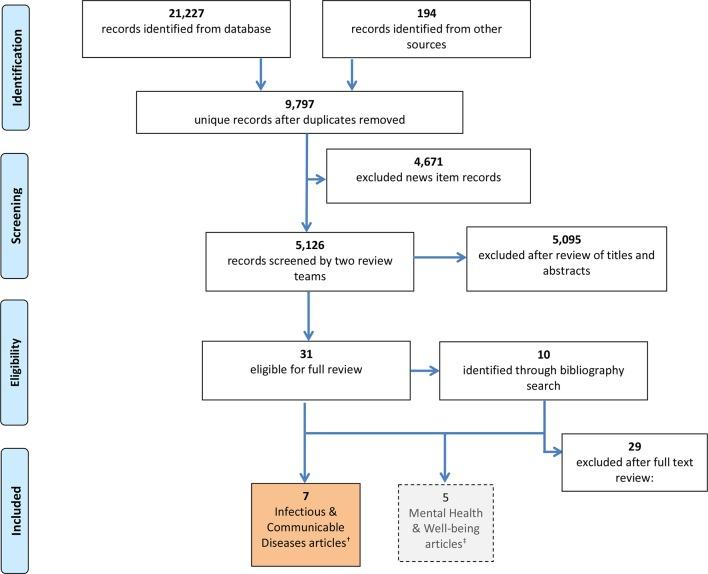
A total of 5126 articles were initially identified with seven included in the review from Pakistan (2003), Chile (2016), Nigeria (2012, 2013) and the USA (1980s). Infectious and communicable disease outcomes included pneumococcal disease/acute pneumonia, , latent tuberculosis infection, infectious skin conditions and contagious disease reporting to the prison clinic. Five articles reported statistically significant positive associations but were countered by associations possibly being explained by chance, bias or confounding factors. Heterogeneity prevented meta-analysis.
CONCLUSION
Overall, the body of evidence provides some support for an association between prison cell special density and infectious and communicable diseases, but care should be taken in the interpretation and transferability of the findings. Future research and policy responses should adequately consider prospective mediating factors implicated in associations between cell spatial density and health effects.
目的
总结关于监狱牢房空间密度(一种拥挤程度的衡量指标)与囚犯中传染病和可传播疾病传播之间关联的证据范围和质量。
设计
系统综述。
数据来源
检索了Embase、PubMed、Medline、Scopus、Web of Science、PsycINFO、PsycExtra、ProQuest数据库、ProQuest学位论文和全球博硕士论文数据库、法律期刊索引、InformitOnline、Cochrane图书馆、刑事司法摘要和ICONDA,检索截至2018年12月31日。
纳入标准
报告了监狱牢房空间密度(以每人牢房地面面积的平方英尺或平方米衡量)与惩教设施中被监禁的青少年和成年人群体中的传染病和可传播疾病之间关联的研究。
数据提取与综合
与一个咨询小组协商制定了一项综述方案。两名评审员独立提取数据,并使用澳大利亚国家卫生与医学研究委员会(NHMRC)的清单对各个研究进行严格评估。使用NHMRC的证据量表和声明表对整体证据进行评估。
结果
最初共识别出5126篇文章,其中7篇被纳入综述,分别来自巴基斯坦(2003年)、智利(2016年)、尼日利亚(2012年、2013年)和美国(20世纪80年代)。传染病和可传播疾病的结果包括肺炎球菌疾病/急性肺炎、潜伏性结核感染、传染性皮肤病以及向监狱诊所报告的传染病。5篇文章报告了具有统计学意义的正相关,但可能因偶然、偏倚或混杂因素导致的关联对其进行了反驳。异质性妨碍了荟萃分析。
结论
总体而言,证据为监狱牢房空间密度与传染病和可传播疾病之间的关联提供了一些支持,但在解释和研究结果的可转移性方面应谨慎。未来的研究和政策应对应充分考虑与牢房空间密度和健康影响之间关联相关的潜在中介因素。
 Zotero 插件