den Braver Nicolette R, Rutters Femke, van der Spek Andrea L J Kortlever, Ibi Dorina, Looman Moniek, Geelen Anouk, Elders Petra, van der Heijden Amber A, Brug Johannes, Lakerveld Jeroen, Soedamah-Muthu Sabita S, Beulens Joline W J
Department of Epidemiology and Biostatistics, Amsterdam Public Health Research Institute, Amsterdam UMC, Vrije Universiteit Amsterdam, Amsterdam, The Netherlands.
Division of Human Nutrition, Wageningen University and Research, Wageningen, The Netherlands.
Eur J Nutr. 2020 Aug;59(5):2159-2169. doi: 10.1007/s00394-019-02064-8. Epub 2019 Jul 24.
In this study, we investigated the association between adherence to the Dutch Healthy Diet index 2015 (DHD15-index) and incidence of prediabetes (preT2D) and Type 2 Diabetes (T2D) in a representative sample for the general Dutch population.
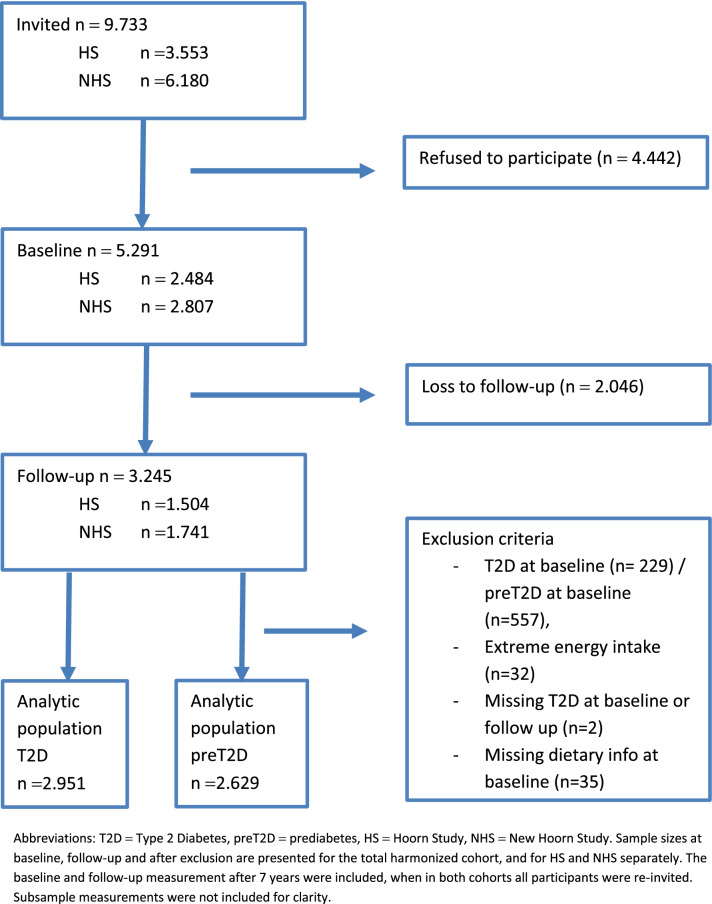
Two prospective cohort studies, The Hoorn and The New Hoorn Study, were used for data analyses. In total, data from 2951 participants without diabetes at baseline (mean age 56.5 ± 7.5 years; 49.6% male) were harmonized. Baseline dietary intake was assessed with validated Food Frequency Questionnaires and adherence to the DHD15-index was calculated (range 0-130). PreT2D and T2D were classified according to the WHO criteria 2011. Poisson regression was used to estimate prevalence ratios between participant scores on the DHD15-index and preT2D and T2D, adjusted for follow-up duration, energy intake, socio-demographic, and lifestyle factors. Change in fasting plasma glucose levels (mmol/L) over follow-up was analysed using linear regression analyses, additionally adjusted for baseline value.
During a mean follow-up of 6.3 ± 0.7 years, 837 participants developed preT2D and 321 participants developed T2D. The highest adherence to the DHD15-index was significantly associated with lower T2D incidence [model 3, PR: 0.70 (0.53; 0.92), p = 0.01]. The highest adherence to the DHD15-index pointed towards a lower incidence of preT2D [PR: 0.87 (0.74; 1.03), p = 0.11]. Higher adherence to the DHD15-index was not associated with change in fasting plasma glucose levels [β: - 0.012 (- 0.034; 0.009)mmol/L].
The present study showed that the highest compared to the lowest adherence to the DHD15-index was associated with a lower T2D incidence, and pointed towards a lower incidence of preT2D. These results support the benefits of adhering to the guidelines in T2D prevention.
在本研究中,我们在荷兰普通人群的代表性样本中,调查了遵循2015年荷兰健康饮食指数(DHD15指数)与糖尿病前期(preT2D)和2型糖尿病(T2D)发病率之间的关联。
两项前瞻性队列研究,即霍恩研究和新霍恩研究,用于数据分析。总共对2951名基线时无糖尿病的参与者(平均年龄56.5±7.5岁;49.6%为男性)的数据进行了整合。通过经过验证的食物频率问卷评估基线饮食摄入量,并计算对DHD15指数的遵循情况(范围为0 - 130)。根据2011年世界卫生组织标准对preT2D和T2D进行分类。使用泊松回归估计参与者在DHD15指数上的得分与preT2D和T2D之间的患病率比值,并对随访时间、能量摄入、社会人口统计学和生活方式因素进行了调整。使用线性回归分析对随访期间空腹血糖水平(mmol/L)的变化进行分析,并额外对基线值进行了调整。
在平均6.3±0.7年的随访期间,837名参与者发展为preT2D,321名参与者发展为T2D。对DHD15指数的最高遵循情况与较低的T2D发病率显著相关[模型3,PR:0.70(0.53;0.92),p = 0.01]。对DHD15指数的最高遵循情况表明preT2D的发病率较低[PR:0.87(0.74;1.03),p = 0.11]。对DHD15指数的更高遵循情况与空腹血糖水平的变化无关[β: - 0.012( - 0.034;0.009)mmol/L]。
本研究表明,与对DHD15指数的最低遵循情况相比,最高遵循情况与较低的T2D发病率相关,并表明preT2D的发病率较低。这些结果支持了遵循指南在T2D预防中的益处。