Center for Thrombosis and Hemostasis (CTH), University Medical Center Mainz, Mainz, Germany.
Clinic for Cardiology and Pulmonology, Heart Center, University Medical Center, Goettingen, Germany.
J Thromb Haemost. 2019 Nov;17(11):1923-1934. doi: 10.1111/jth.14589. Epub 2019 Aug 13.
While the importance of patients' quality of life (QoL) in chronic cardiac or pulmonary disease is uncontroversial, the burden of an acute pulmonary embolism (PE) on QoL has received little attention thus far.
We aimed to validate the German PEmb-QoL questionnaire, identify associations between QoL and clinical/functional parameters, and investigate the prognostic relevance of QoL for long-term survival in survivors of an acute PE episode.
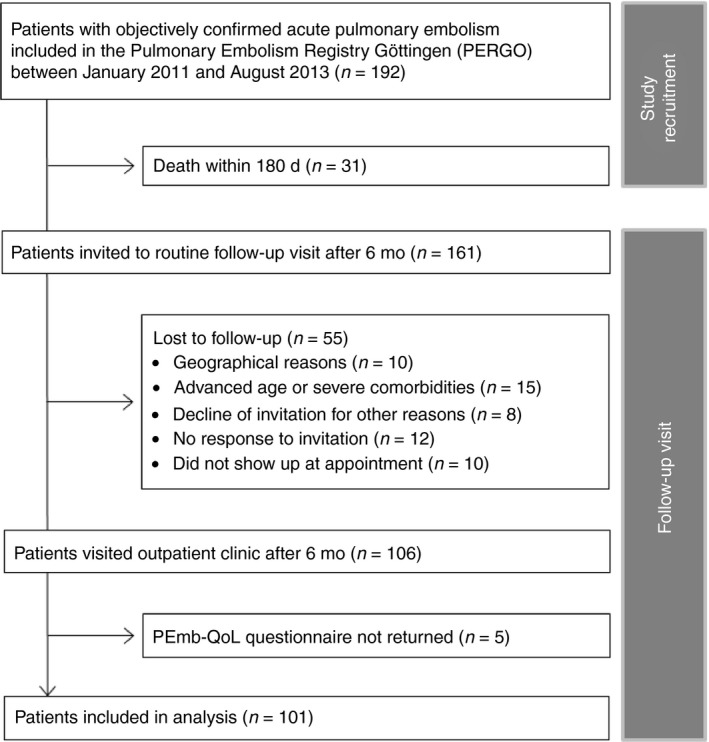
PATIENTS/METHODS: Patients were invited for a clinical follow-up visit including assessment of QoL using the German PEmb-QoL questionnaire 6 months after an objectively confirmed PE at a single center. Internal consistency reliability, construct-related validity, and regressions between PEmb-QoL and clinical patient-characteristics were assessed using standard scale construction techniques.
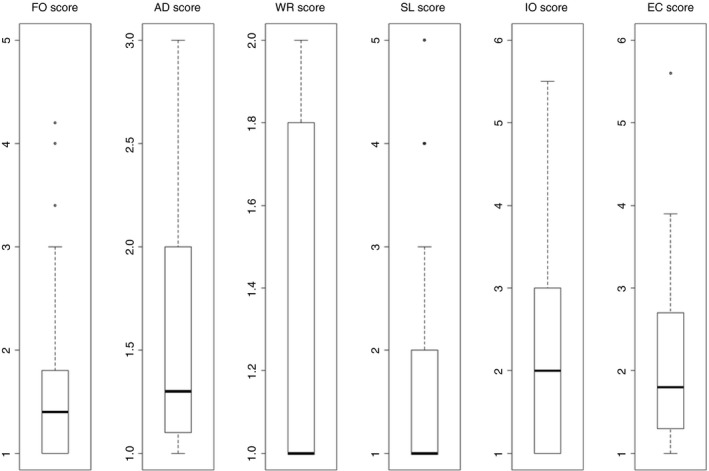
Overall, 101 patients [median age, 69 ([interquartile range] IQR 57-75) years; women, 48.5%] were examined 208 (IQR 185-242) days after PE. Internal consistency reliability and construct-related validity of the PEmb-QoL questionnaire were acceptable. As many as 47.0% of patients reported dyspnea, 27.5% had right ventricular (RV) dysfunction on transthoracic echocardiography (TTE), and 25.3% were diagnosed with post-PE impairment (PPEI) at 6-month follow-up. Furthermore, 15.9% of patients were diagnosed with depression 6 months after an acute PE. The QoL was affected by dyspnea, preexisting pulmonary disease, and PPEI, and a reduced QoL was associated with an increased risk for long-term mortality after an observation period of 3.6 years.
The German PEmb-QoL questionnaire is a reliable instrument for assessing QoL 6 months after PE. The QoL was affected by dyspnea, preexisting pulmonary disease, and PPEI and was associated with long-term mortality.
虽然慢性心脏或肺部疾病患者的生活质量(QoL)很重要,但急性肺栓塞(PE)对 QoL 的影响尚未得到充分关注。
我们旨在验证德国 PEmb-QoL 问卷,确定 QoL 与临床/功能参数之间的关系,并研究 QoL 对急性 PE 存活者长期生存的预后相关性。
患者/方法:在一家单中心,患者在客观证实的 PE 发生后 6 个月被邀请进行临床随访,包括使用德国 PEmb-QoL 问卷评估 QoL。使用标准量表构建技术评估 PEmb-QoL 的内部一致性可靠性、与结构相关的有效性以及与临床患者特征之间的回归。
共有 101 例患者[中位数年龄 69(IQR 57-75)岁;女性 48.5%]在 PE 后 208(IQR 185-242)天接受检查。PEmb-QoL 问卷的内部一致性可靠性和与结构相关的有效性是可以接受的。多达 47.0%的患者报告呼吸困难,27.5%的患者经胸超声心动图(TTE)显示右心室(RV)功能障碍,25.3%的患者在 6 个月随访时被诊断为 PE 后功能障碍(PPEI)。此外,15.9%的患者在急性 PE 后 6 个月被诊断为抑郁症。QoL 受呼吸困难、预先存在的肺部疾病和 PPEI 的影响,QoL 降低与观察期 3.6 年后长期死亡率增加相关。
德国 PEmb-QoL 问卷是一种可靠的工具,可在 PE 后 6 个月评估 QoL。QoL 受呼吸困难、预先存在的肺部疾病和 PPEI 的影响,并与长期死亡率相关。