Buitrago Dayana, Buitrago-Villanueva Ivon, Barbosa-Cornelio Ricardo, Coy-Barrera Ericsson
Bioorganic Chemistry Laboratory, Universidad Militar Nueva Granada, Cajicá 250247, Colombia.
Antioxidants (Basel). 2019 Jul 24;8(8):238. doi: 10.3390/antiox8080238.
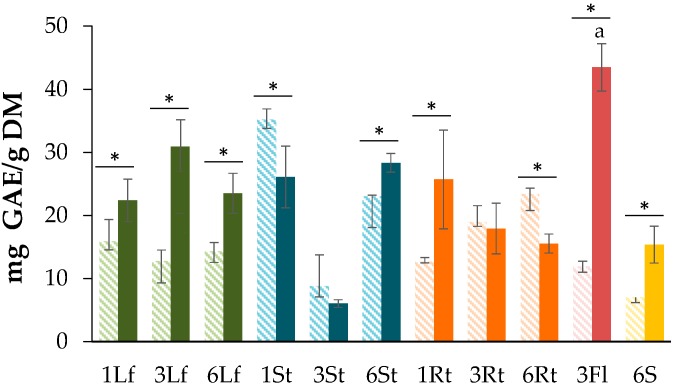
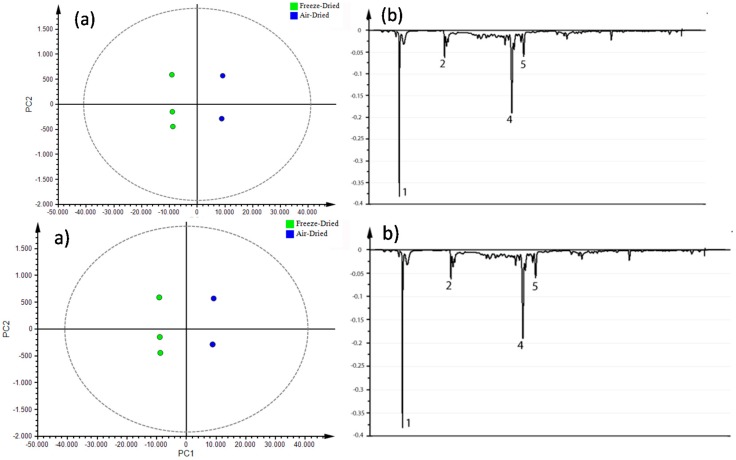
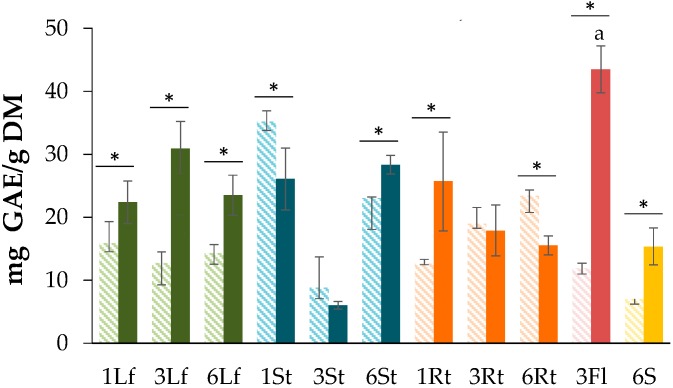
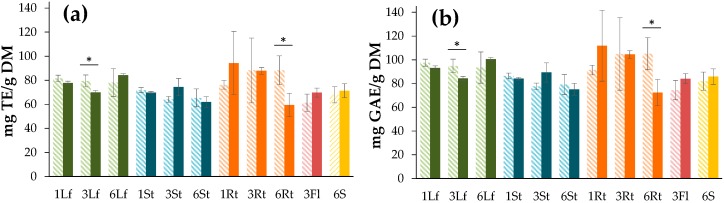
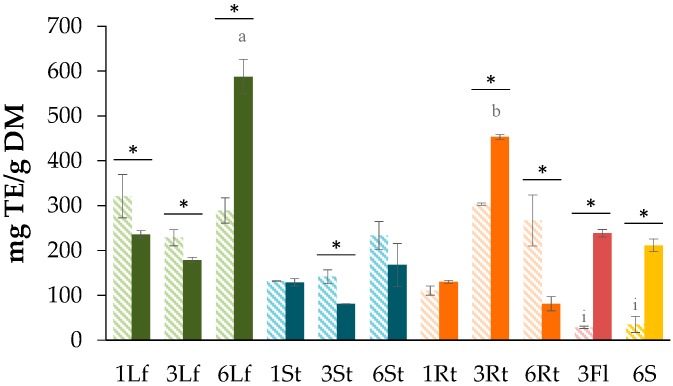
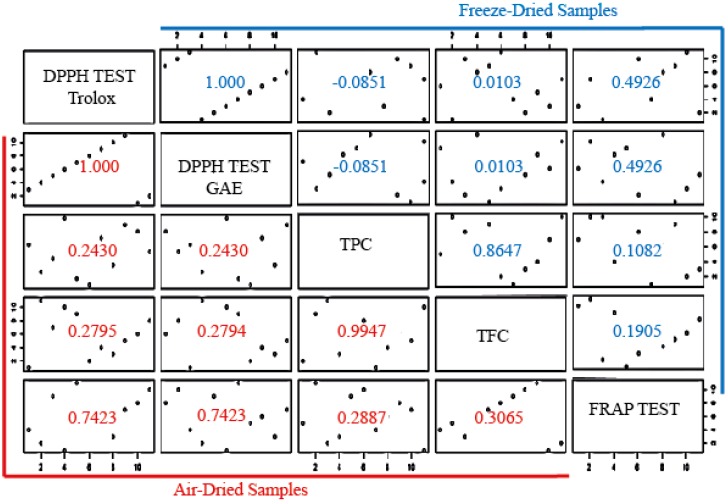
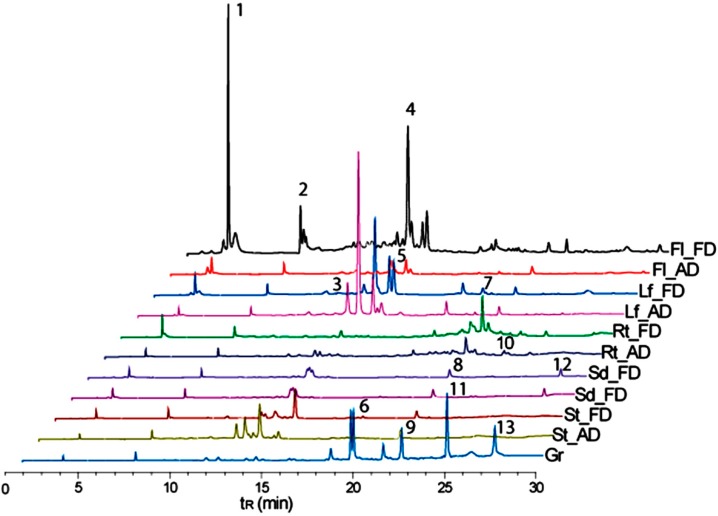
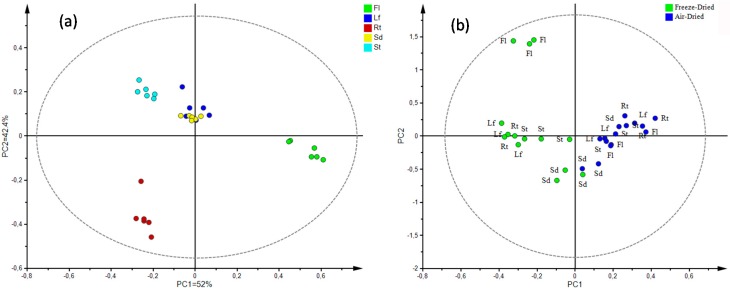
Integrated surveys of metabolic profiles and antioxidant capacity from have been limited and have particularly focused on an examination of seeds and leaves. According to this, the main aim of the present study was to address an evaluation of the antioxidant activity of crude ethanolic extracts from different plant parts (leaves, stems, roots, flowers, and seeds) harvested at different times during growth and processed by two distinct drying methods: Air-drying and freeze-drying. In order to characterize the resulting extracts, the total content of phenolics (TPC) and flavonoids (TFC) was then measured through the Folin-Ciocalteu method, while antioxidant capacity was determined using 2,2-diphenyl-1-picrylhydrazyl (DPPH) free radical scavenging and ferric-reducing antioxidant power (FRAP) methods. Parallel to this evaluation, extracts were profiled by LC-DAD-ESI-MS. Data analysis was supported by statistics. Most of the extracts obtained from freeze-dried samples showed higher TPC values ranging from 6.02 to 43.47 milligram of gallic acid equivalents per gram of plant material and a TFC between 1.30 and 12.26 milligram of quercetin equivalents per gram of plant material. After statistical analysis, a low correlation between TPC and TFC values was observed regarding antioxidant capacity from DPPH and FRAP measurements of both drying methods. A multivariate analysis showed that antioxidant components and antioxidant capacity in changed during growth and between plant parts and drying methods. These changes need to be taken into consideration when comparing the production/accumulation of beneficial bioactive compounds in this pseudocereal.
对代谢谱和抗氧化能力的综合调查一直有限,且特别侧重于对种子和叶子的研究。据此,本研究的主要目的是评估不同植物部位(叶、茎、根、花和种子)在生长过程中不同时间收获并采用两种不同干燥方法(风干和冷冻干燥)处理后得到的粗乙醇提取物的抗氧化活性。为了表征所得提取物,通过福林-西奥尔特法测定酚类物质(TPC)和黄酮类化合物(TFC)的总含量,同时使用2,2-二苯基-1-苦基肼基(DPPH)自由基清除法和铁还原抗氧化能力(FRAP)法测定抗氧化能力。与此评估并行,提取物通过液相色谱-二极管阵列-电喷雾电离质谱(LC-DAD-ESI-MS)进行分析。数据分析得到统计学支持。从冷冻干燥样品中获得的大多数提取物显示出较高的TPC值,范围为每克植物材料6.02至43.47毫克没食子酸当量,TFC为每克植物材料1.30至12.26毫克槲皮素当量。经过统计分析,对于两种干燥方法的DPPH和FRAP测量的抗氧化能力,观察到TPC和TFC值之间的低相关性。多变量分析表明,这种假谷物中的抗氧化成分和抗氧化能力在生长过程中以及植物部位和干燥方法之间会发生变化。在比较这种假谷物中有益生物活性化合物的产生/积累时,需要考虑这些变化。