CBGP, INRA, CIRAD, IRD, Montpellier SupAgro, Université Montpellier, 34000 Montpellier, France.
MIVEGEC, Université de Montpellier, CNRS, IRD, 34394 Montpellier, France.
Viruses. 2019 Jul 24;11(8):679. doi: 10.3390/v11080679.
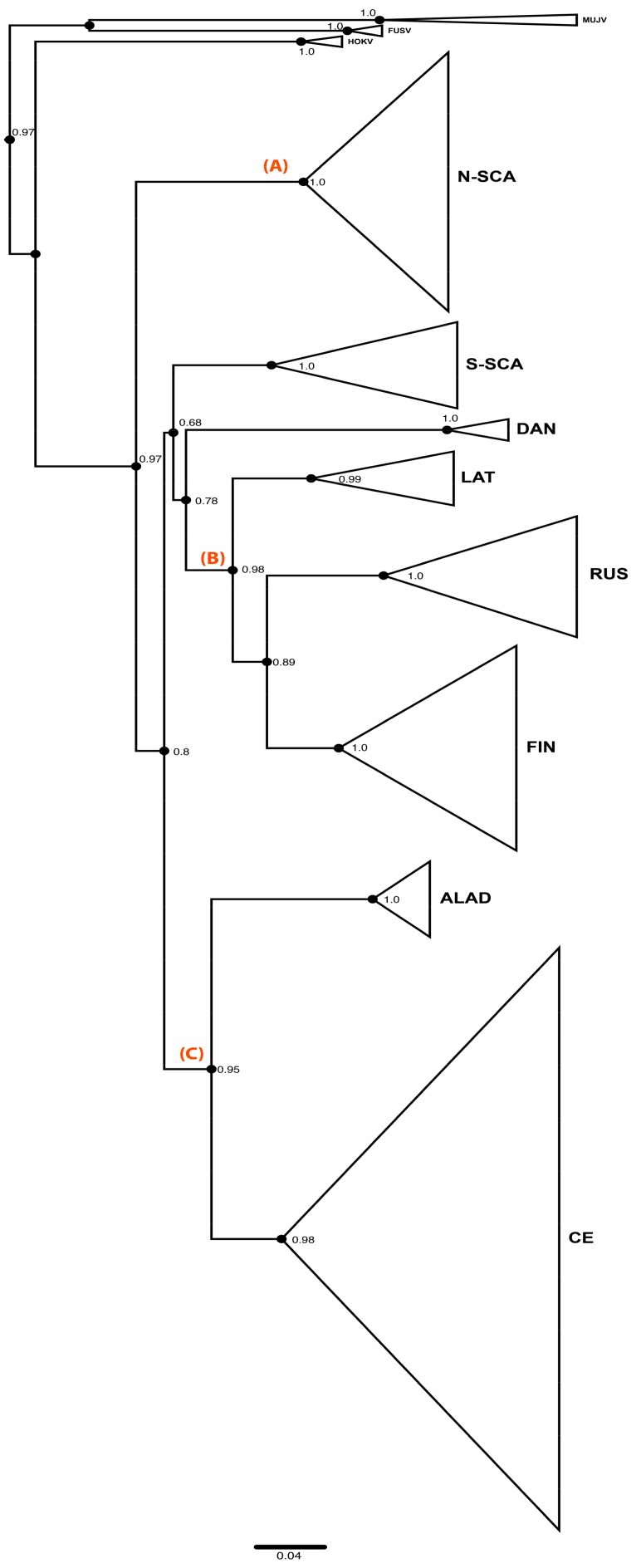
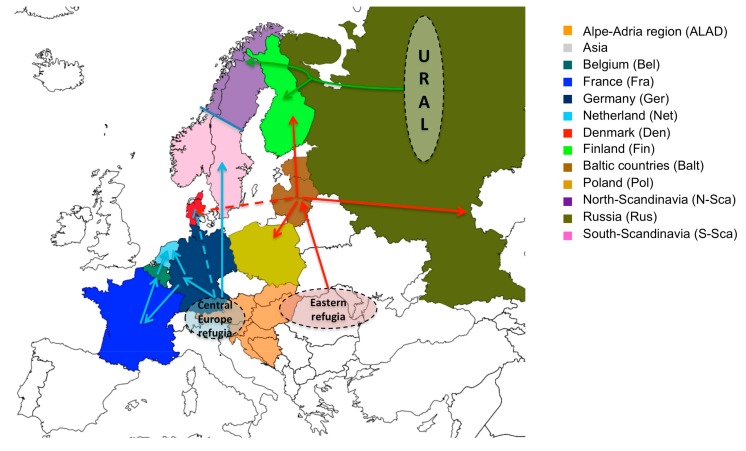
Puumala virus is an RNA virus hosted by the bank vole and is today present in most European countries. Whilst it is generally accepted that hantaviruses have been tightly co-evolving with their hosts, Puumala virus (PUUV) evolutionary history is still controversial and so far has not been studied at the whole European level. This study attempts to reconstruct the phylogeographical spread of modern PUUV throughout Europe during the last postglacial period in the light of an upgraded dataset of complete PUUV small (S) segment sequences and by using most recent computational approaches. Taking advantage of the knowledge on the past migrations of its host, we identified at least three potential independent dispersal routes of PUUV during postglacial recolonization of Europe by the bank vole. From the Alpe-Adrian region (Balkan, Austria, and Hungary) to Western European countries (Germany, France, Belgium, and Netherland), and South Scandinavia. From the vicinity of Carpathian Mountains to the Baltic countries and to Poland, Russia, and Finland. The dissemination towards Denmark and North Scandinavia is more hypothetical and probably involved several independent streams from south and north Fennoscandia.
普马拉病毒是一种由鼩鼱宿主的 RNA 病毒,目前存在于大多数欧洲国家。虽然普遍认为汉坦病毒与其宿主密切协同进化,但普马拉病毒(PUUV)的进化历史仍存在争议,迄今为止尚未在整个欧洲范围内进行研究。本研究旨在根据升级后的完整 PUUV 小(S)段序列数据集,并利用最新的计算方法,重建现代 PUUV 在过去冰期后在整个欧洲的地理扩散情况。利用宿主过去迁徙的知识,我们确定了至少三种在鼩鼱重新殖民欧洲期间 PUUV 可能独立的扩散途径。从阿尔卑斯-亚得里亚地区(巴尔干半岛、奥地利和匈牙利)到西欧国家(德国、法国、比利时和荷兰)和南斯堪的纳维亚。从喀尔巴阡山脉附近到波罗的海国家,再到波兰、俄罗斯和芬兰。向丹麦和北欧的传播更为假设,可能涉及来自南、北芬诺斯堪的纳维亚的几个独立支流。