Gawęcki Maciej, Jaszczuk-Maciejewska Agnieszka, Jurska-Jaśko Anna, Kneba Małgorzata, Grzybowski Andrzej
Dobry Wzrok Ophthalmological Clinic, Gdańsk, Poland.
Department of Ophthalmology, Univeristy of Warmia and Mazury, Olsztyn, Poland.
BMC Ophthalmol. 2019 Jul 25;19(1):160. doi: 10.1186/s12886-019-1171-5.
Central serous chorioretinopathy (CSCR) is a complex ocular entity that, in its chronic form, can lead to serious visual impairment and morphological damage to the retina. The aim of the current retrospective study was to evaluate the damage present after long-standing but resolved central serous chorioretinopathy and refer it to healthy individuals. Correlations between measurable factors-for example, duration of the disease, baseline retinal morphological parameters, or patient age and/or their degree of impairment-were also assessed.
The study group consisted of thirty-two eyes (13 female and 19 male, mean age 49.6 years SD +/- 10.5) with chronic central serous chorioretinopathy (mean duration 18.9 months SD +/- 15.4) in which complete resolution of subretinal fluid was achieved after subthreshold micropulse laser treatment. Inclusion criterion was a lack of subretinal fluid within the whole area of the central retina scanned by the spectral domain optical coherence tomography. The group was extracted out of 51 cases of chronic CSCR that were treated with that method. They were analyzed according to final best-corrected visual acuity and retinal morphological parameters as measured by spectral optical coherence tomography with angiography option (OCTA). Results were compared with the outcomes of a control group, which consisted of 40 eyes of healthy individuals with full distance visual acuity (0.0 logMAR, 1.0 Snellen) never treated with subthreshold micropulse laser. Statistical analysis included regarding correlation between final visual acuity and final central retinal thickness and retinal and functional parameters prior to treatment.
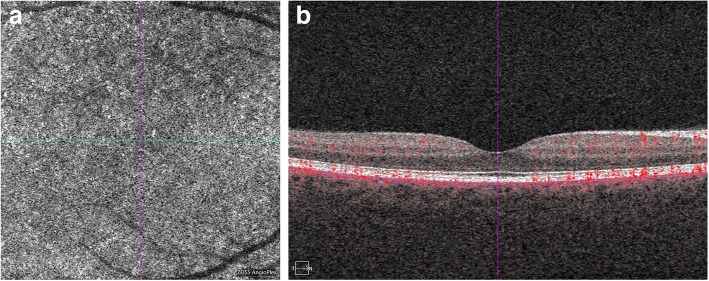
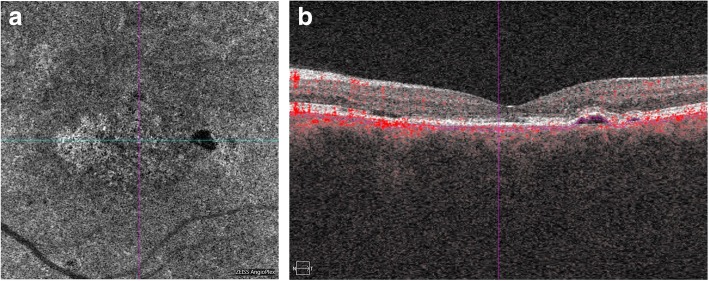
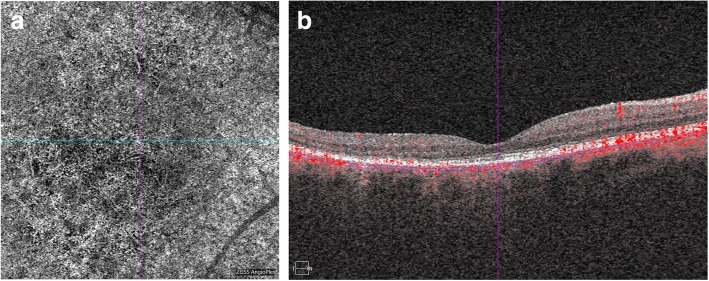
Final best-corrected visual acuity after chronic central serous chorioretinopathy was 0.23 logMAR (0.6 Snellen) and central retinal thickness was 39.32 μm smaller than in controls. No correlation was found between final visual acuity and retinal thickness and duration of the disease, patient age, and baseline morphological retinal parameters. OCTA scans revealed impaired choriocapillaries flow signal even following resolution of the disease.
Chronic central serous chorioretinopathy is a potentially damaging clinical entity that results in serious visual impairment, retinal thinning, and choroidal flow defects. Further research is needed to determine precisely the timepoint of this damage.
中心性浆液性脉络膜视网膜病变(CSCR)是一种复杂的眼部疾病,其慢性形式可导致严重的视力损害和视网膜形态损伤。本项回顾性研究的目的是评估长期但已治愈的中心性浆液性脉络膜视网膜病变后存在的损伤,并将其与健康个体进行对比。还评估了可测量因素之间的相关性,例如疾病持续时间、基线视网膜形态参数、患者年龄和/或其损伤程度。
研究组由32只眼(13名女性和19名男性,平均年龄49.6岁,标准差±10.5)组成,患有慢性中心性浆液性脉络膜视网膜病变(平均病程18.9个月,标准差±15.4),经阈下微脉冲激光治疗后视网膜下液完全消退。纳入标准是在光谱域光学相干断层扫描所扫描的整个中央视网膜区域内不存在视网膜下液。该组是从51例采用该方法治疗的慢性CSCR病例中提取出来的。根据最终最佳矫正视力和通过具有血管造影选项的光谱光学相干断层扫描(OCTA)测量的视网膜形态参数对他们进行分析。将结果与对照组的结果进行比较,对照组由40只健康个体的眼睛组成,这些个体具有全距视力(0.0 logMAR,1.0 Snellen),从未接受过阈下微脉冲激光治疗。统计分析包括治疗前最终视力与最终中央视网膜厚度以及视网膜和功能参数之间的相关性。
慢性中心性浆液性脉络膜视网膜病变后的最终最佳矫正视力为0.23 logMAR(0.6 Snellen),中央视网膜厚度比对照组小39.32μm。在最终视力与视网膜厚度、疾病持续时间、患者年龄和基线视网膜形态参数之间未发现相关性。OCTA扫描显示即使在疾病消退后脉络膜毛细血管血流信号仍受损。
慢性中心性浆液性脉络膜视网膜病变是一种潜在的破坏性临床疾病,可导致严重的视力损害、视网膜变薄和脉络膜血流缺陷。需要进一步研究以精确确定这种损伤的时间点。