Department of Surgery, Section of Transplantation.
The Center for Healthcare Outcomes and Policy, and.
Clin J Am Soc Nephrol. 2019 Aug 7;14(8):1193-1199. doi: 10.2215/CJN.01480219. Epub 2019 Jul 25.
Despite the potential for improving health status or increasing access to transplantation, national practice patterns for bariatric surgery in obese patients with ESKD are poorly understood. The purpose of this study was to describe current trends in surgical care for this population.
DESIGN, SETTING, PARTICIPANTS, & MEASUREMENTS: Using 100% Medicare data, we identified all beneficiaries undergoing bariatric surgery in the United States between 2006 and 2016. We evaluated longitudinal practice patterns using linear regression models. We also estimated risk-adjusted complications, readmissions, and length of stay using Poisson regression for patients with and without ESKD.
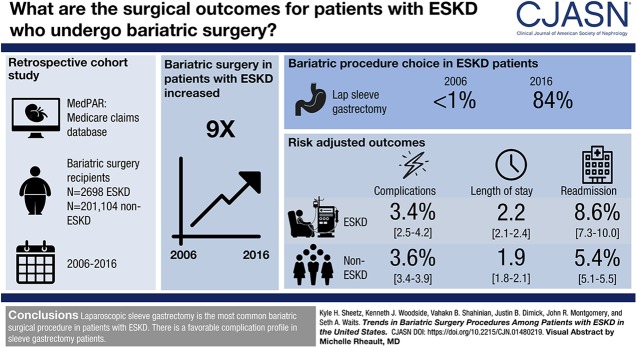
The number of patients with ESKD undergoing bariatric surgery increased ninefold between 2006 and 2016. The proportional use of sleeve gastrectomy increased from <1% in 2006 to 84% in 2016. For sleeve gastrectomy, complication rates were similar between patients with and without ESKD (3.4% versus 3.6%, respectively; difference, -0.3%; 95% confidence interval, -1.3% to 0.1%; =0.57). However, patients with ESKD had more readmissions (8.6% versus 5.4%, respectively; difference, 3.2%; 95% confidence interval, 1.9% to 4.6%; <0.001) and slightly longer hospitals stays (2.2 versus 1.9 days, respectively; difference, 0.3; 95% confidence interval, 0.1 to 0.4; <0.001).
This study suggests that laparoscopic sleeve gastrectomy has replaced Roux-en-Y gastric bypass as the most common bariatric surgical procedure in patients with ESKD. The data also demonstrate a favorable complication profile in patients with sleeve gastrectomy.
尽管肥胖合并终末期肾病(ESKD)患者进行减重手术可能改善健康状况或增加移植机会,但对全国范围内的该手术实践模式仍知之甚少。本研究旨在描述该人群的手术治疗现状。
设计、设置、参与者和测量方法:我们使用 100%的医疗保险数据,确定了 2006 年至 2016 年期间在美国接受减重手术的所有受益患者。我们使用线性回归模型评估了纵向实践模式。我们还使用泊松回归模型对有和无 ESKD 的患者分别评估了风险调整后的并发症、再入院和住院时间。
2006 年至 2016 年,接受减重手术的 ESKD 患者数量增加了 9 倍。袖状胃切除术的应用比例从 2006 年的<1%增加到 2016 年的 84%。对于袖状胃切除术,有和无 ESKD 的患者并发症发生率相似(分别为 3.4%和 3.6%;差值,-0.3%;95%置信区间,-1.3%至 0.1%;=0.57)。然而,ESKD 患者的再入院率更高(分别为 8.6%和 5.4%;差值,3.2%;95%置信区间,1.9%至 4.6%;<0.001),住院时间稍长(分别为 2.2 天和 1.9 天;差值,0.3;95%置信区间,0.1 至 0.4;<0.001)。
本研究表明,腹腔镜袖状胃切除术已取代 Roux-en-Y 胃旁路术成为 ESKD 患者最常见的减重手术。数据还表明,袖状胃切除术患者的并发症发生率较低。