Department of Marine Ecology, Institut Mediterrani d'Estudis Avançats, Universitat de les Illes Balears-Consejo Superior de Investigaciones Científicas, 07190 Esporles, Illes Balears, Spain;
Department of Marine Ecology, Institut Mediterrani d'Estudis Avançats, Universitat de les Illes Balears-Consejo Superior de Investigaciones Científicas, 07190 Esporles, Illes Balears, Spain.
Proc Natl Acad Sci U S A. 2019 Aug 6;116(32):15997-16002. doi: 10.1073/pnas.1904837116. Epub 2019 Jul 25.
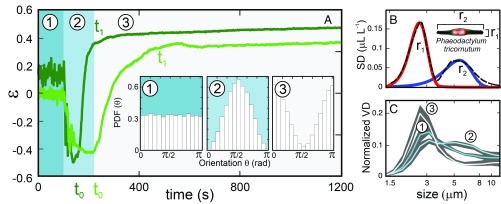
Finding a partner in an inherently unsteady 3-dimensional system, such as the planktonic marine environment, is a difficult task for nonswimming organisms with poor control over their orientation. We experimentally investigate the process of cell pairing in pennate marine diatoms and present field evidence of its occurrence in the ocean. We describe the mechanism as a 3-step process in which pennate diatoms () vertically reorient while sinking from surface turbulent waters to a more stable environment (i.e., under the seasonal pycnocline), () segregate from incompatible partners (e.g., dead or different sized cells), and () pair with other partners as a result of the hydrodynamic instabilities generated by collective cell sinking. This is, eminently, a cell abundance-dependent process, therefore being more effective when population sinking is synchronized. We suggest that this selective process, enabling matching of size-compatible healthy partners, could be fundamental in understanding sexual reproduction in pennate diatoms.
在不稳定的三维系统(如浮游海洋环境)中寻找伴侣对于游动能力差、难以控制自身方向的非游泳生物来说是一项艰巨的任务。我们通过实验研究了羽纹硅藻的细胞配对过程,并提供了海洋中发生这种现象的实地证据。我们将该机制描述为一个 3 步过程,其中羽纹硅藻()在从表面激流到更稳定环境(即季节性密度跃层下)下沉时垂直重新定向,()与不兼容的伴侣(如死亡或不同大小的细胞)分离,以及()由于集体细胞下沉产生的水动力不稳定性而与其他伴侣配对。这显然是一个依赖于细胞丰度的过程,因此当种群下沉同步时效果更好。我们认为,这种选择性过程能够使大小兼容的健康伴侣相匹配,对于理解羽纹硅藻的有性繁殖可能是至关重要的。