Department of Medicine 3, Rheumatology and Immunology, Friedrich Alexander-University Erlangen-Nürnberg, Universitätsklinikum Erlangen, Erlangen, Germany.
Redoxis/Pronoxis AB, Medicon Village Lund, Sweden.
Redox Biol. 2019 Sep;26:101279. doi: 10.1016/j.redox.2019.101279. Epub 2019 Jul 20.
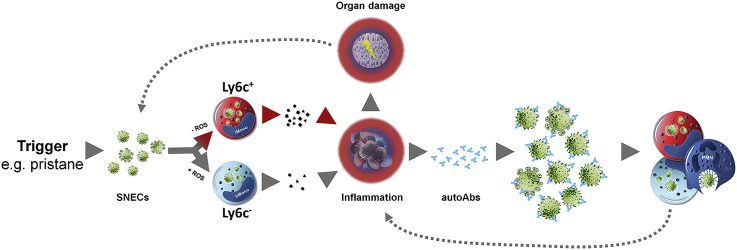
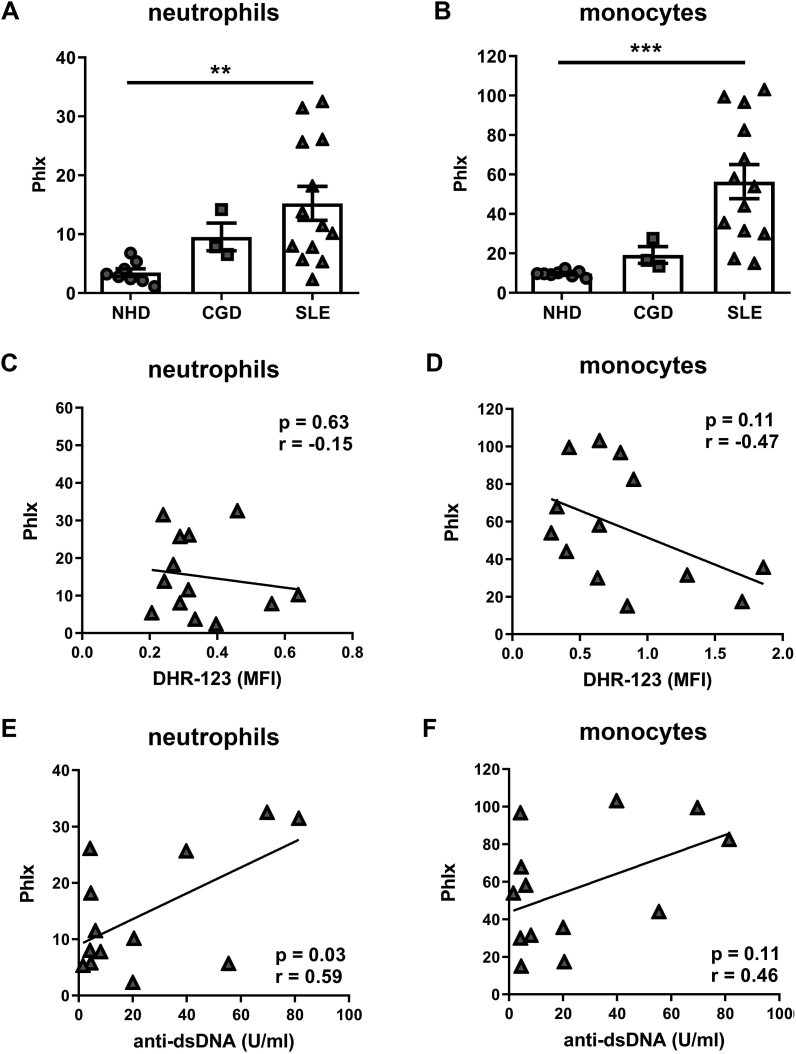
The phagocyte NADPH oxidase (the NOX2 complex) generates superoxide, the precursor to reactive oxygen species (ROS). ROS possess both antimicrobial and immunoregulatory function. Inactivating mutations in alleles of the NOX2 complex cause chronic granulomatous disease (CGD), characterized by an enhanced susceptibility to infections and autoimmune diseases such as Systemic lupus erythematosus (SLE). The latter is characterized by insufficient removal of dead cells, resulting in an autoimmune response against components of the cell's nucleus when non-cleared apoptotic cells lose their membrane integrity and present autoantigenic molecules in an inflammatory context. Here we aimed to shed light on the role of the NOX2 complex in handling of secondary necrotic cells (SNECs) and associated consequences for inflammation and autoimmunity during lupus. We show that individuals with SLE and CGD display accumulation of SNECs in blood monocytes and neutrophils. In a CGD phenotypic mouse strain (Ncf1** mice) build-up of SNECs in Ly6C blood monocytes was connected with a delayed degradation of the phagosomal cargo and accompanied by production of inflammatory mediators. Treatment with HO or activators of ROS-formation reconstituted phagosomal abundance of SNECs to normal levels. Induction of experimental lupus further induced increased antibody-dependent uptake of SNECs into neutrophils. Lupus-primed Ncf1** neutrophils took up more SNECs than wild type neutrophils, whereas SNEC-accumulation in regulatory Ly6C monocytes was lower in Ncf1**mice. We deduce that the inflammatory rerouting of immune-stimulatory necrotic material into inflammatory phagocyte subsets contributes to the connection between low ROS production by the NOX2 complex and SLE.
吞噬细胞 NADPH 氧化酶(NOX2 复合物)产生超氧化物,是活性氧(ROS)的前体。ROS 具有抗菌和免疫调节功能。NOX2 复合物等位基因的失活突变导致慢性肉芽肿病(CGD),其特征是对感染和自身免疫性疾病(如系统性红斑狼疮(SLE))的易感性增加。后者的特征是无法有效清除死亡细胞,导致当未被清除的凋亡细胞失去细胞膜完整性并在炎症环境中呈现自身抗原分子时,针对细胞核成分的自身免疫反应。在这里,我们旨在阐明 NOX2 复合物在处理次级坏死细胞(SNECs)中的作用以及在狼疮期间对炎症和自身免疫的相关影响。我们表明,SLE 和 CGD 患者的血液单核细胞和中性粒细胞中 SNECs 的积累。在 CGD 表型小鼠品系(Ncf1** 小鼠)中,Ly6C 血液单核细胞中 SNECs 的积累与吞噬体货物的降解延迟有关,并伴有炎症介质的产生。用 HO 或 ROS 形成的激活剂治疗可将吞噬体中 SNECs 的丰度恢复正常水平。实验性狼疮的诱导进一步诱导了 SNECs 进入中性粒细胞的抗体依赖性摄取增加。狼疮激活的 Ncf1中性粒细胞摄取的 SNECs 多于野生型中性粒细胞,而 Ncf1 小鼠中调节性 Ly6C 单核细胞中的 SNEC 积累较低。我们推断,NOX2 复合物产生的 ROS 水平低与 SLE 之间的关联是由于将免疫刺激性坏死物质炎症性重路由到炎症性吞噬细胞亚群所致。