Wang Jiaxing, Geisert Eldon E, Struebing Felix L
Emory Eye Center, Department of Ophthalmology, Emory University, 1365B Clifton Road NE, Atlanta GA.
Center for Neuropathology and Prion Research, Ludwig Maximilian University of Munich, Germany.
Mol Vis. 2019 Jul 5;25:345-358. eCollection 2019.
The goal of the present study is to provide an independent assessment of the retinal transcriptome signatures of C57BL/6J (B6) and DBA/2J (D2) mice, and to enhance existing microarray data sets for accurately defining the allelic differences in the BXD recombinant inbred strains.
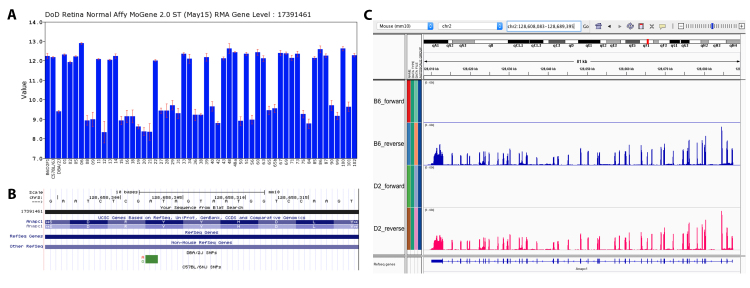
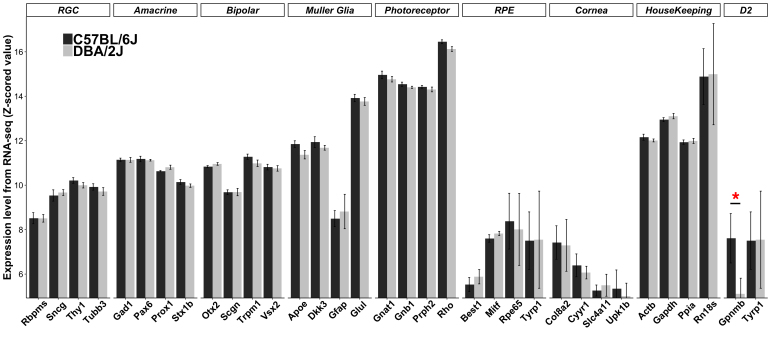
Retinas from B6 and D2 mice (three of each) were used for the RNA sequencing (RNA-seq) analysis. Transcriptome features were examined for both strains. Differentially expressed genes between the two strains were identified, and bioinformatic analysis was performed to analyze the transcriptome differences between the B6 and D2 strains, including Gene Ontology (GO) analysis, Phenotype and Reactome enrichment, and Kyoto Encyclopedia of Genes and Genomes (KEGG) analysis. The RNA-seq data were then directly compared with one of the microarray data sets (Department of Defense [DoD] Retina Normal Affy MoGene 2.0 ST RMA Gene Level Microarray Database) hosted on GeneNetwork.
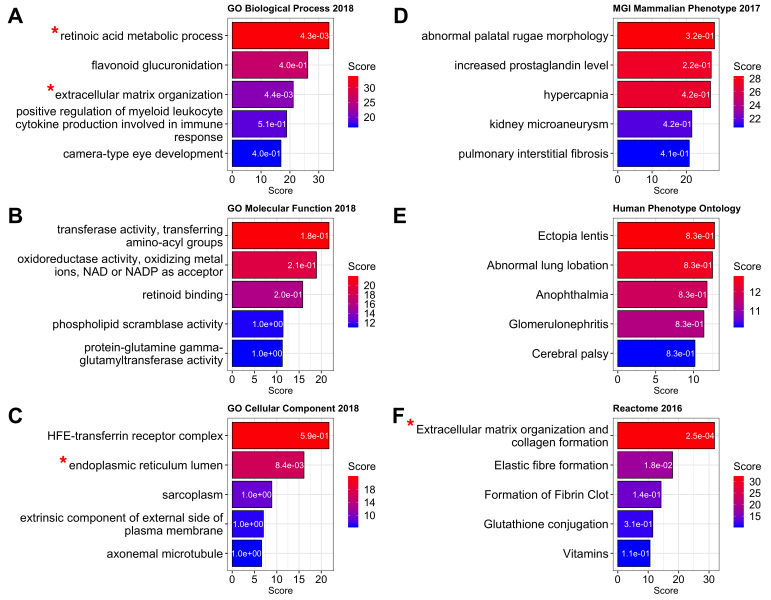
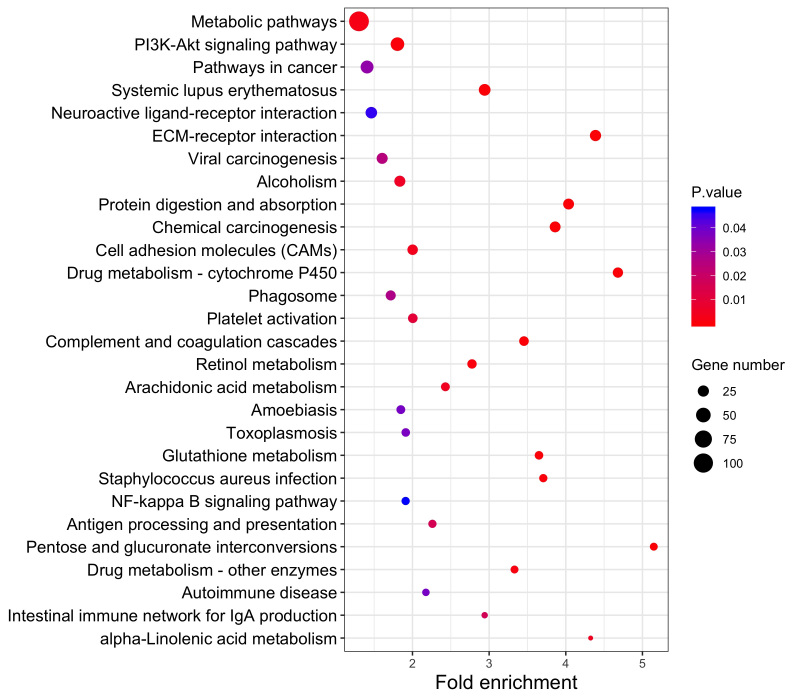
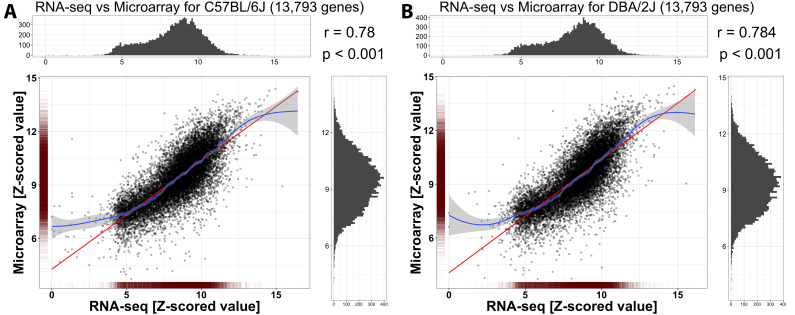
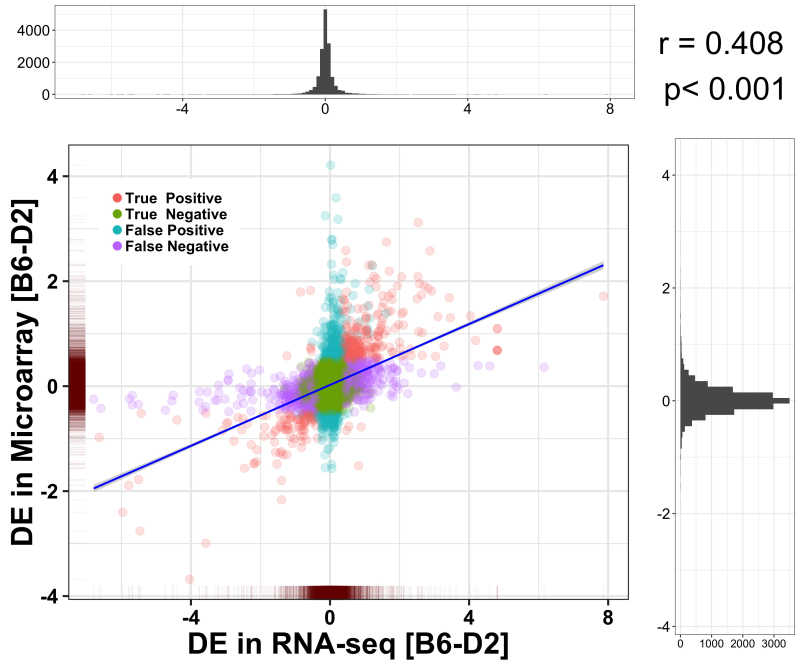
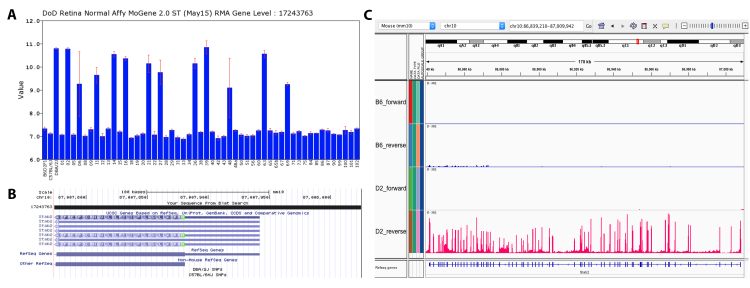
RNA-seq provided an in-depth analysis of the transcriptome of the B6 and D2 retinas with a total of more than 30,000,000 reads per sample. More than 70% of the reads were uniquely mapped, resulting in a total of 18,100 gene counts for all six samples. A total of 1,665 genes were differentially expressed, with 858 of these more highly expressed in the B6 retinas and 807 more highly expressed in the D2 retinas. Several molecular pathways were differentially active between the two strains, including the retinoic acid metabolic process, endoplasmic reticulum lumen, extracellular matrix (ECM) organization, and the PI3K-Akt signaling pathway. The most enriched KEGG pathways were the pentose and glucuronate interconversions pathway, the cytochrome P450 pathway, the protein digestion and absorption pathway, and the ECM-receptor interaction pathway. Each of these pathways had a more than fourfold enrichment. The DoD Normal Retina Microarray Database provided expression profiling for 26,191 annotated transcripts for B6 mouse, D2 mouse, and 53 BXD strains. A total of 13,793 genes in this microarray data set were comparable to the RNA-seq data set. For the B6 and D2 retinas, the RNA-seq data and the microarray data were highly correlated with each other (Pearson's r=0.780 for the B6 mice and 0.784 for D2 mice). These results suggest that the microarray data set can reliably detect differentially expressed genes between the B6 and D2 retinas, with an overall accuracy of 91.1%. Examples of true positive and false positive genes are provided.
Retinal transcriptome features of B6 and D2 mouse strains provide a useful reference for a better understanding of the mouse retina. Generally, the microarray database presented on GeneNetwork shows good agreement with the RNA-seq data, but we note that any allelic difference between B6 and D2 mice should be verified with the latter.
本研究的目的是对C57BL/6J(B6)和DBA/2J(D2)小鼠的视网膜转录组特征进行独立评估,并增强现有的微阵列数据集,以准确界定BXD重组近交系中的等位基因差异。
使用B6和D2小鼠(各3只)的视网膜进行RNA测序(RNA-seq)分析。检查了两个品系的转录组特征。鉴定了两个品系之间差异表达的基因,并进行了生物信息学分析,以分析B6和D2品系之间的转录组差异,包括基因本体(GO)分析、表型和反应组富集分析以及京都基因与基因组百科全书(KEGG)分析。然后将RNA-seq数据与GeneNetwork上托管的一个微阵列数据集(国防部[DoD]视网膜正常Affy MoGene 2.0 ST RMA基因水平微阵列数据库)直接进行比较。
RNA-seq对B6和D2视网膜的转录组进行了深入分析,每个样本的读数总数超过3000万。超过70%的读数被唯一映射,所有六个样本的基因计数总数为18100个。共有1665个基因差异表达,其中858个在B6视网膜中表达更高,807个在D2视网膜中表达更高。两个品系之间有几个分子途径差异活跃,包括视黄酸代谢过程、内质网腔、细胞外基质(ECM)组织和PI3K-Akt信号通路。最富集的KEGG途径是戊糖和葡萄糖醛酸相互转化途径、细胞色素P450途径、蛋白质消化和吸收途径以及ECM-受体相互作用途径。这些途径中的每一个都有超过四倍的富集。DoD正常视网膜微阵列数据库提供了B6小鼠、D2小鼠和53个BXD品系的26191个注释转录本的表达谱。该微阵列数据集中共有13793个基因与RNA-seq数据集可比。对于B6和D2视网膜,RNA-seq数据和微阵列数据彼此高度相关(B6小鼠的皮尔逊r=0.780,D2小鼠的皮尔逊r=0.784)。这些结果表明,微阵列数据集可以可靠地检测B6和D2视网膜之间差异表达的基因,总体准确率为91.1%。提供了真阳性和假阳性基因的示例。
B6和D2小鼠品系的视网膜转录组特征为更好地理解小鼠视网膜提供了有用的参考。一般来说,GeneNetwork上呈现的微阵列数据库与RNA-seq数据显示出良好的一致性,但我们注意到B6和D2小鼠之间的任何等位基因差异都应用后者进行验证。