Jiang Wenhao, King Tricia Z, Turner Jessica A
Department of Psychology and the Neuroscience Institute, Georgia State University, Atlanta, GA, United States.
Mind Research Network, Albuquerque, NM, United States.
Front Psychiatry. 2019 Jul 12;10:494. doi: 10.3389/fpsyt.2019.00494. eCollection 2019.
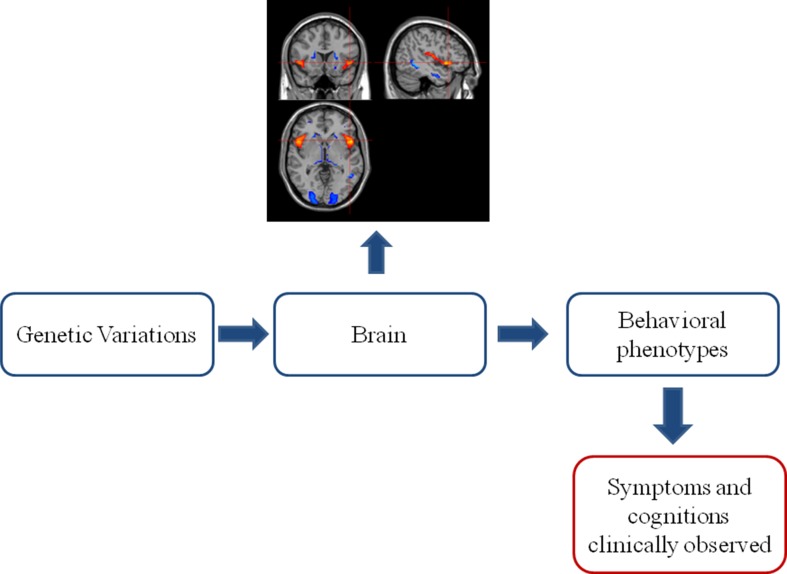
Current diagnoses of schizophrenia and related psychiatric disorders are classified by phenomenological principles and clinical descriptions while ruling out other symptoms and conditions. Specific biomarkers are needed to assist the current diagnostic system. However, complicated gene and environment interactions induce great disease heterogeneity. This unclear etiology and heterogeneity raise difficulties in distinguishing schizophrenia-related effects. Simultaneously, the overlap in symptoms, genetic variations, and brain alterations in schizophrenia and related psychiatric disorders raises similar difficulties in determining disease-specific effects. Imaging genetics is a unique methodology to assess the impact of genetic factors on both brain structure and function. More importantly, imaging genetics builds a bridge to understand the behavioral and clinical implications of genetics and neuroimaging. By characterizing and quantifying the brain measures affected in psychiatric disorders, imaging genetics is contributing to identifying potential biomarkers for schizophrenia and related disorders. To date, candidate gene analysis, genome-wide association studies, polygenetic risk score analysis, and large-scale collaborative studies have made contributions to the understanding of schizophrenia with the potential to serve as biomarkers. Despite limitations, imaging genetics remains promising as more aggregative, clustering methods and imaging genetics-compatible clinical assessments are employed in future studies. We review imaging genetics' contribution to our understanding of the heterogeneity within schizophrenia and the commonalities across schizophrenia and other diagnostic borders, and we will discuss whether imaging genetics is ready to form its own diagnostic system.
目前,精神分裂症及相关精神障碍的诊断是依据现象学原理和临床描述进行分类,同时排除其他症状和病症。需要特定的生物标志物来辅助当前的诊断系统。然而,复杂的基因与环境相互作用导致了极大的疾病异质性。这种病因不明和异质性给区分精神分裂症相关效应带来了困难。同时,精神分裂症及相关精神障碍在症状、基因变异和脑改变方面的重叠,在确定疾病特异性效应时也带来了类似的困难。影像遗传学是一种独特的方法,用于评估遗传因素对脑结构和功能的影响。更重要的是,影像遗传学搭建了一座桥梁,以理解遗传学和神经影像学的行为及临床意义。通过对受精神障碍影响的脑测量指标进行表征和量化,影像遗传学有助于识别精神分裂症及相关疾病的潜在生物标志物。迄今为止,候选基因分析、全基因组关联研究、多基因风险评分分析以及大规模合作研究都为理解精神分裂症做出了贡献,这些研究结果有可能作为生物标志物。尽管存在局限性,但随着未来研究采用更多的聚合、聚类方法以及与影像遗传学兼容的临床评估,影像遗传学仍然具有前景。我们回顾了影像遗传学对我们理解精神分裂症内部异质性以及精神分裂症与其他诊断边界之间共性的贡献,并将讨论影像遗传学是否已准备好形成其自身的诊断系统。