School of Biological Sciences, University of Aberdeen, Aberdeen, United Kingdom.
Centre for Genome-Enabled Biology and Medicine, University of Aberdeen, Aberdeen, United Kingdom.
Front Immunol. 2019 Jul 12;10:1558. doi: 10.3389/fimmu.2019.01558. eCollection 2019.
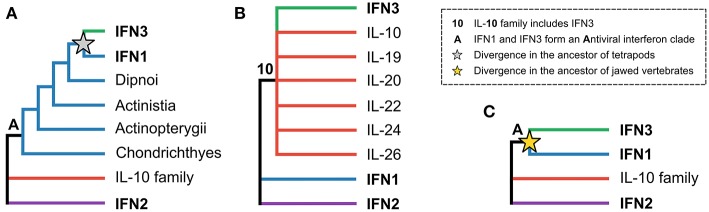
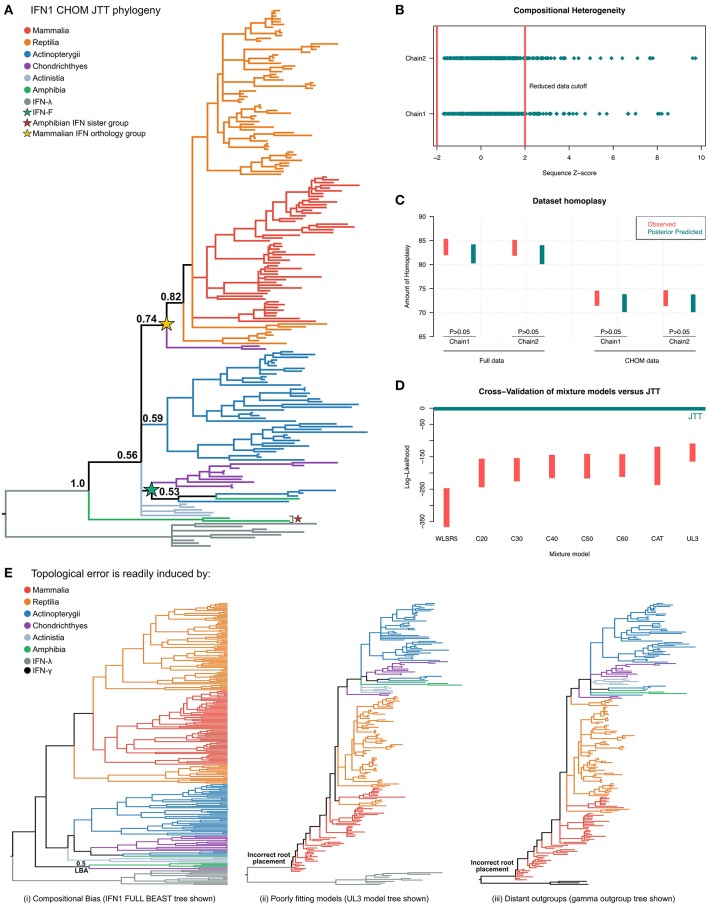
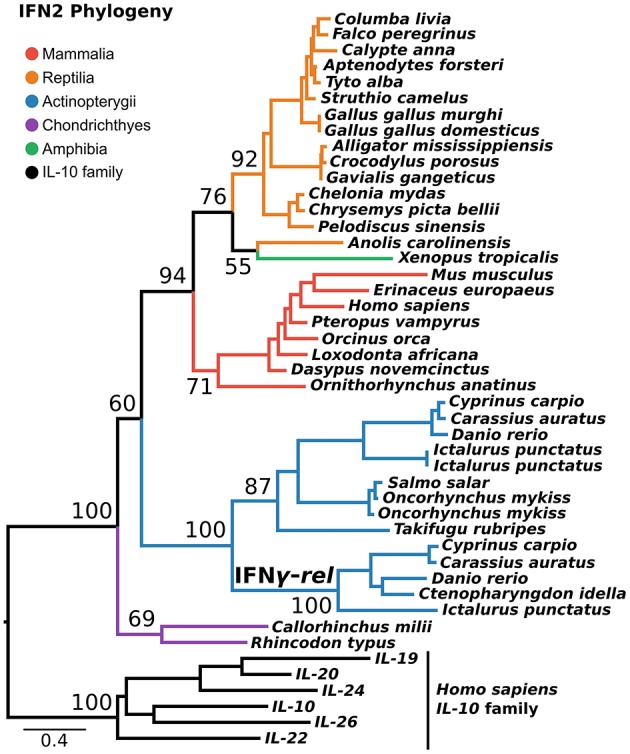
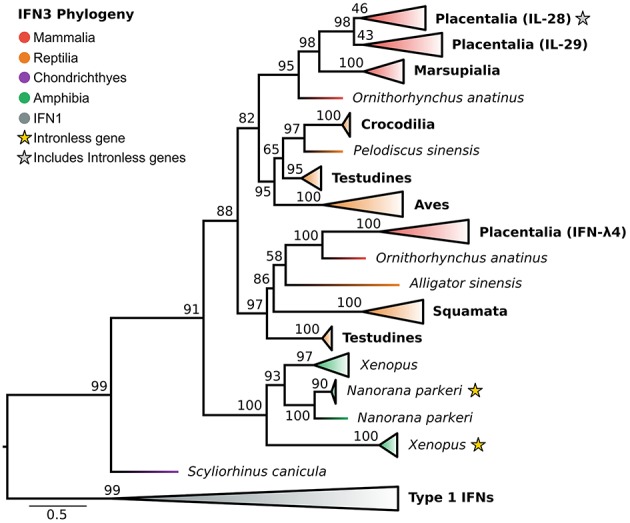
Interferons orchestrate host antiviral responses in jawed vertebrates. They are categorized into three classes; IFN1 and IFN3 are the primary antiviral cytokine lineages, while IFN2 responds to a broader variety of pathogens. The evolutionary relationships within and between these three classes have proven difficult to resolve. Here, we reassess interferon evolution, considering key phylogenetic pitfalls including taxon sampling, alignment quality, model adequacy, and outgroup choice. We reveal that cartilaginous fishes, and hence the jawed vertebrate ancestor, possess(ed) orthologs of all three interferon classes. We show that IFN3 groups sister to IFN1, resolve the origins of the human IFN3 lineages, and find that intronless IFN3s emerged at least three times. IFN2 genes are highly conserved, except for IFN-γ-rel, which we confirm resulted from a teleost-specific duplication. Our analyses show that IFN1 phylogeny is highly sensitive to phylogenetic error. By accounting for this, we describe a new backbone IFN1 phylogeny that implies several IFN1 genes existed in the jawed vertebrate ancestor. One of these is represented by the intronless IFN1s of tetrapods, including mammalian-like repertoires of reptile IFN1s and a subset of amphibian IFN1s, in addition to newly-identified intron-containing shark IFN1 genes. IFN-f, previously only found in teleosts, likely represents another ancestral jawed vertebrate IFN1 family member, suggesting the current classification of fish IFN1s into two groups based on the number of cysteines may need revision. The providence of the remaining fish IFN1s and the coelacanth IFN1s proved difficult to resolve, but they may also be ancestral jawed vertebrate IFN1 lineages. Finally, a large group of amphibian-specific IFN1s falls sister to all other IFN1s and was likely also present in the jawed vertebrate ancestor. Our results verify that intronless IFN1s have evolved multiple times in amphibians and indicate that no one-to-one orthology exists between mammal and reptile IFN1s. Our data also imply that diversification of the multiple IFN1s present in the jawed vertebrate ancestor has occurred through a rapid birth-death process, consistent with functional maintenance over a 450-million-year host-pathogen arms race. In summary, this study reveals a new model of interferon evolution important to our understanding of jawed vertebrate antiviral immunity.
干扰素在有颌脊椎动物中协调宿主抗病毒反应。它们分为三类;IFN1 和 IFN3 是主要的抗病毒细胞因子谱系,而 IFN2 对更广泛的病原体有反应。这三类之间以及内部的进化关系一直难以解决。在这里,我们重新评估干扰素的进化,考虑到关键的系统发育陷阱,包括分类群采样、对齐质量、模型充分性和外群选择。我们揭示了软骨鱼类,因此有颌脊椎动物的祖先,拥有所有三种干扰素类别的同源物。我们表明,IFN3 与 IFN1 姐妹群,解决了人类 IFN3 谱系的起源,并发现无内含子的 IFN3 至少出现了三次。IFN2 基因高度保守,除了 IFN-γ-rel,我们证实它是由硬骨鱼特异性复制产生的。我们的分析表明,IFN1 系统发育对系统发育错误非常敏感。通过考虑到这一点,我们描述了一个新的 IFN1 系统发育骨干,表明在有颌脊椎动物的祖先中存在几个 IFN1 基因。其中一个由四足动物的无内含子 IFN1 代表,包括爬行类 IFN1 的类似哺乳动物的库和一部分两栖类 IFN1,以及新发现的鲨鱼含内含子 IFN1 基因。IFN-f,以前只在硬骨鱼中发现,可能代表另一个祖先有颌脊椎动物 IFN1 家族成员,这表明目前基于半胱氨酸数量将鱼类 IFN1 分为两类的分类可能需要修订。其余鱼类 IFN1 和腔棘鱼 IFN1 的起源难以确定,但它们也可能是祖先有颌脊椎动物 IFN1 谱系。最后,一大组两栖动物特异性 IFN1 与所有其他 IFN1 姐妹群,并且可能也存在于有颌脊椎动物的祖先中。我们的结果验证了无内含子 IFN1 在两栖动物中已经多次进化,并表明哺乳动物和爬行类 IFN1 之间不存在一对一的直系同源关系。我们的数据还表明,有颌脊椎动物祖先中存在的多种 IFN1 的多样化是通过快速的生死过程发生的,这与在 4.5 亿年的宿主-病原体军备竞赛中保持功能一致。总之,这项研究揭示了干扰素进化的一个新模型,这对我们理解有颌脊椎动物抗病毒免疫很重要。