Goswami Chitrita, Poonia Sarita, Kumar Lalit, Sengupta Debarka
Department of Computer Science and Engineering, Indraprastha Institute of Information Technology, New Delhi, India.
Department of Computational Biology, Indraprastha Institute of Information Technology, New Delhi, India.
Front Oncol. 2019 Jul 12;9:633. doi: 10.3389/fonc.2019.00633. eCollection 2019.
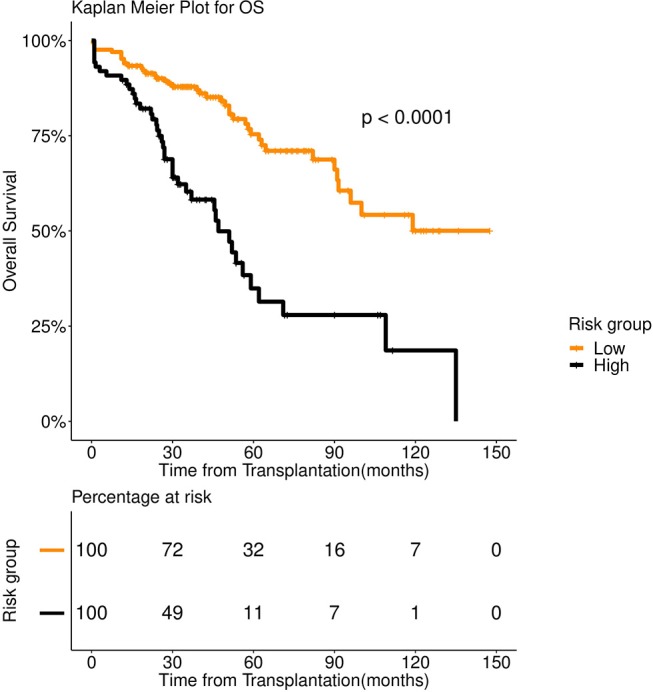
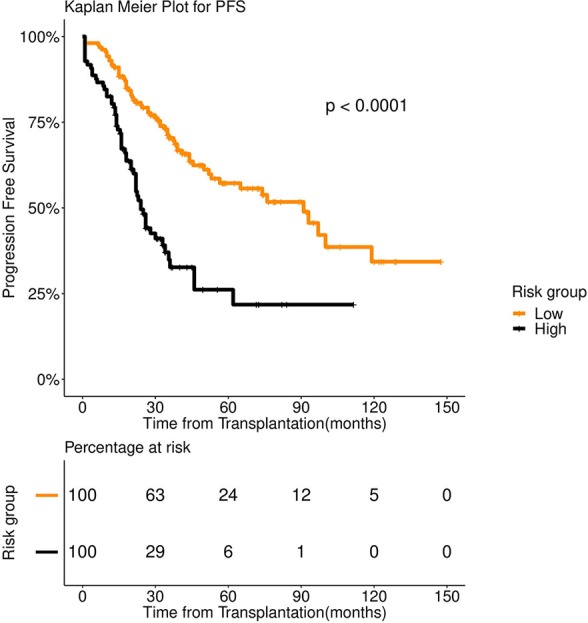
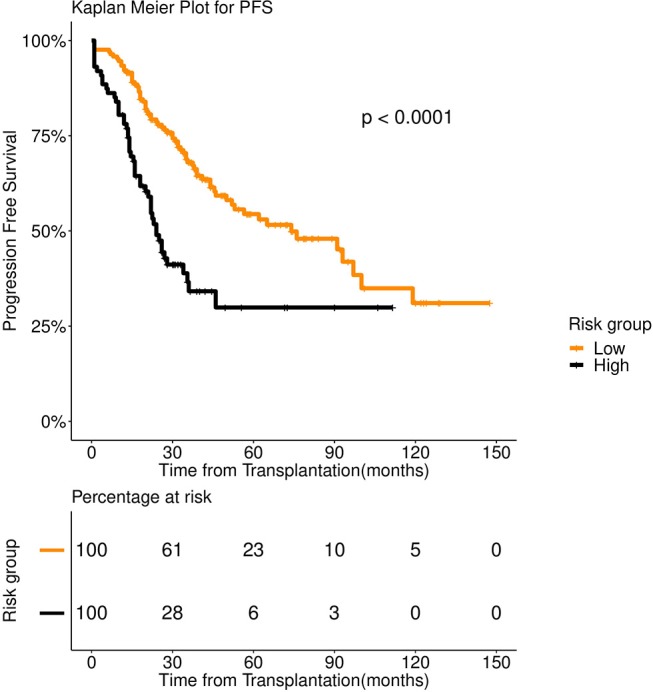
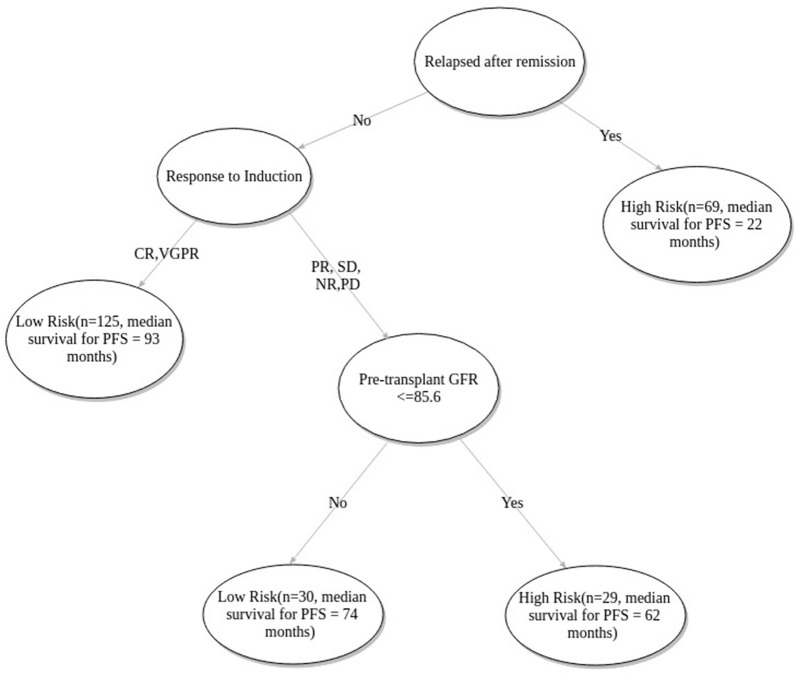
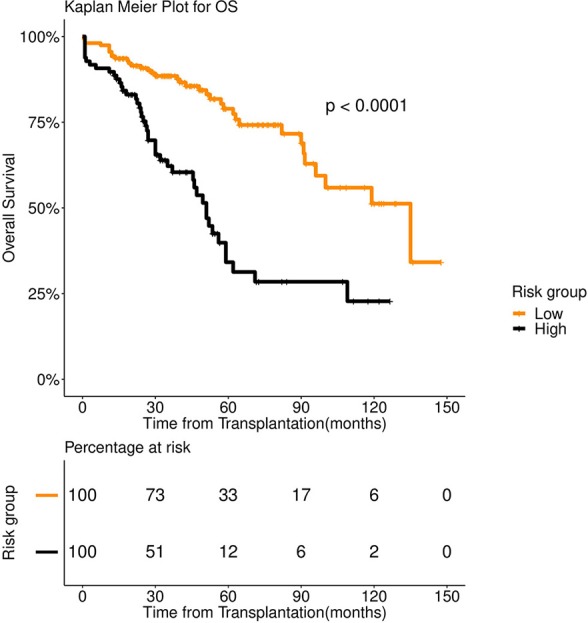
Over the last decade autologous stem cell transplantation (ASCT) has emerged as the standard of care in the management of Multiple Myeloma (MM). However, the cases of early relapse (within 36 months) after the stem cell rescue remains a significant challenge. For a lot of practical purposes, it is crucial to identify whether a patient undergoing ASCT falls into the high-risk group (likely to relapse within 36 months) or a low risk one. Our analysis showed that existing MM staging systems (International Staging System or ISS and Durie Salmon Staging or DSS) are not sufficient to discriminate between the risk groups significantly. To address this, we gathered a total of 39 clinical and laboratory parameters of 347 patients from the Department of Medical Oncology of All India Institute of Medical Sciences (AIIMS). We employed a stacked machine learning model consisting spectral clustering and Fast and Frugal Tree (FFT) technique to come up with a 3-factor multivariate 2-stage staging scheme, which turns out to be extremely decisive about the outcome of the stem cell rescue. Our model comes up with a three-factor (1. if patients has relapsed following remission, 2. response to induction, 3. pre-transplant Glomerular Filtration Rate or GFR) staging scheme. The resulting model stratifies patients into high-risk and low-risk groups with markedly distinct progression-free (median survival-24 months vs. 91 months) and overall survival (median survival-51 months vs. 135 months) patterns.
在过去十年中,自体干细胞移植(ASCT)已成为多发性骨髓瘤(MM)治疗的标准方法。然而,干细胞救援后早期复发(36个月内)的病例仍然是一个重大挑战。出于许多实际目的,确定接受ASCT的患者是属于高风险组(可能在36个月内复发)还是低风险组至关重要。我们的分析表明,现有的MM分期系统(国际分期系统或ISS以及Durie Salmon分期或DSS)不足以显著区分风险组。为了解决这个问题,我们收集了全印度医学科学研究所(AIIMS)医学肿瘤学系347名患者的总共39项临床和实验室参数。我们采用了一种由谱聚类和快速节俭树(FFT)技术组成的堆叠机器学习模型,得出了一种三因素多变量两阶段分期方案,该方案对干细胞救援的结果极具决定性。我们的模型得出了一种三因素(1.患者缓解后是否复发,2.诱导反应,3.移植前肾小球滤过率或GFR)分期方案。所得模型将患者分为高风险组和低风险组,其无进展(中位生存期分别为24个月和91个月)和总生存期(中位生存期分别为51个月和135个月)模式明显不同。