Feinberg School of Medicine, Northwestern University, Chicago, Illinois, USA.
Washington University School of Medicine, St. Louis, Missouri, USA.
Am J Gastroenterol. 2019 Sep;114(9):1502-1511. doi: 10.14309/ajg.0000000000000327.
Irritable bowel syndrome with diarrhea (IBS-D) is a functional gastrointestinal disorder with limited effective treatment options. We evaluated the efficacy and safety of eluxadoline in patients with IBS-D who reported inadequate symptom control with prior loperamide.
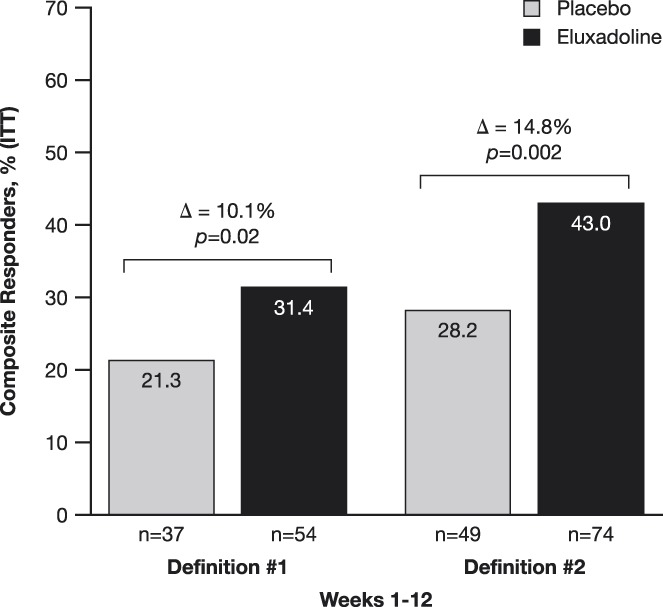
Three hundred forty-six adults with IBS-D (Rome III criteria) were randomly assigned to placebo or eluxadoline 100 mg twice daily for 12 weeks. Patients recorded daily IBS-D symptoms, including worst abdominal pain (WAP) and stool consistency (through Bristol Stool Scale). The primary endpoint was proportion of composite responders, defined as patients who met daily composite response criteria (≥40% WAP improvement and <5 Bristol Stool Scale score) for at least 50% of treatment days, and recorded ≥60 days of diary entries over the 12-week period.
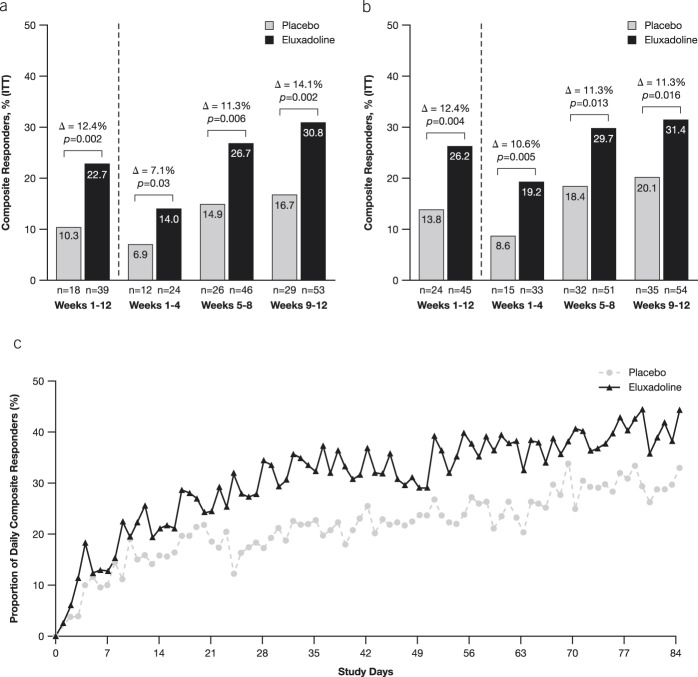
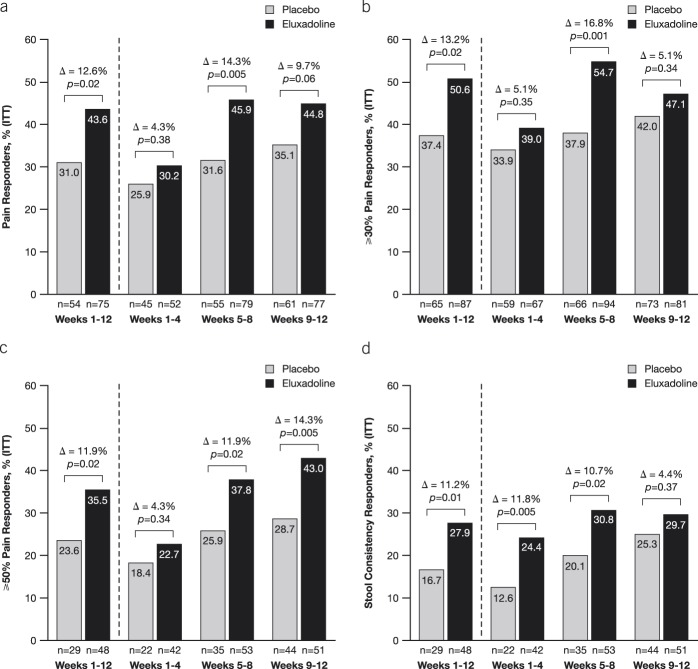
Over 12 weeks, a significantly greater proportion of eluxadoline patients achieved the primary composite responder endpoint compared to placebo (22.7% vs 10.3%, P = 0.002), and component endpoints of improvements in stool consistency (27.9% vs 16.7%, P = 0.01) and WAP (43.6% vs 31.0%, P = 0.02). Additionally, a greater proportion of eluxadoline patients met the composite responder endpoint assessed at monthly intervals compared to placebo (weeks 1-4: 14.0% vs 6.9%, P = 0.03; weeks 5-8: 26.7% vs 14.9%, P = 0.006; weeks 9-12: 30.8% vs 16.7%, P = 0.002). Rates of adverse events were comparable in both groups (37.4% vs 35.3%); no treatment-related serious adverse event, cases of sphincter of Oddi spasm, or pancreatitis were reported.
Eluxadoline appears safe and effective for treating IBS-D symptoms in patients with an intact gallbladder reporting inadequate relief with prior loperamide use.
腹泻型肠易激综合征(IBS-D)是一种功能性胃肠疾病,其治疗选择有限。我们评估了在先前使用洛哌丁胺治疗后症状控制不足的 IBS-D 患者中,埃鲁索多林的疗效和安全性。
346 例 IBS-D 成人(罗马 III 标准)被随机分配至安慰剂或埃鲁索多林 100mg,每日两次,治疗 12 周。患者记录每日 IBS-D 症状,包括最严重腹痛(WAP)和粪便稠度(通过布里斯托粪便量表)。主要终点是复合应答者的比例,定义为至少 50%的治疗天数符合每日复合应答标准(WAP 改善≥40%和布里斯托粪便量表评分<5),并且在 12 周期间记录了≥60 天的日记条目。
在 12 周内,与安慰剂相比,埃鲁索多林患者达到主要复合应答终点的比例显著更高(22.7% vs 10.3%,P = 0.002),并且粪便稠度改善(27.9% vs 16.7%,P = 0.01)和 WAP(43.6% vs 31.0%,P = 0.02)的各个组成部分的终点也有所改善。此外,与安慰剂相比,埃鲁索多林患者在每月间隔时间达到复合应答终点的比例更高(第 1-4 周:14.0% vs 6.9%,P = 0.03;第 5-8 周:26.7% vs 14.9%,P = 0.006;第 9-12 周:30.8% vs 16.7%,P = 0.002)。两组不良反应发生率相当(37.4% vs 35.3%);没有报告与治疗相关的严重不良事件、Oddi 括约肌痉挛或胰腺炎。
埃鲁索多林似乎安全有效,可用于治疗既往使用洛哌丁胺治疗后症状控制不足的胆囊完整的 IBS-D 患者的症状。