Department of Medicine, Massachusetts General Hospital and Harvard Medical School, Boston, MA, USA.
Division of Gastroenterology, Department of Medicine, Massachusetts General Hospital and Harvard Medical School, Boston, MA, USA.
Drug Des Devel Ther. 2020 Apr 9;14:1391-1400. doi: 10.2147/DDDT.S216056. eCollection 2020.
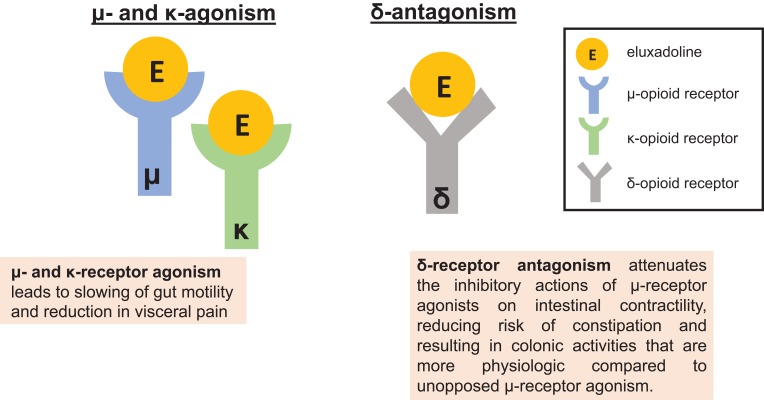
Irritable bowel syndrome (IBS) is a functional gastrointestinal (GI) disorder characterized by chronic abdominal pain associated with changes in bowel habits. It is the most common GI problem seen by gastroenterologists. IBS is a heterogenous disorder encompassing a spectrum of underlying mechanisms and clinical presentations. The pathophysiology of diarrhea-predominant form of IBS (IBS-D) remains poorly understood, and current available therapeutic options for IBS-D are limited. Eluxadoline is a novel, locally acting mixed μ- and κ-opioid receptor agonist and δ-receptor antagonist approved by the Food and Drug Administration (FDA) for treatment of adults with IBS-D. Data from two phase III clinical trials showed that approximately 25-30% of the eluxadoline-treated patients achieved composite clinical response, defined by a reduction of abdominal pain and improvement in stool consistency. Patients who achieve composite response during the first month of therapy were significantly more likely to demonstrate sustained clinical response. The most common adverse events reported with eluxadoline use were constipation, nausea and abdominal pain. The risk of abuse, dependence, or withdrawal is low. Serious adverse events associated with eluxadoline include sphincter of Oddi spasm (SOS) and pancreatitis particularly in patients without a gallbladder. Development of pancreatitis is likely secondary to SOS, but it remains unclear why pancreatitis occurs so quickly after initial doses. This adverse event profile helps guide proper selection of IBS-D patients for eluxadoline use, with important contraindications including absence of a gallbladder, biliary duct obstruction or sphincter of Oddi dysfunction, alcoholism, history of pancreatitis, or structural diseases of the pancreas. With the recent clinical trials demonstrating its efficacy, eluxadoline provides an additional option to the few existing pharmacologic interventions available for IBS-D. In this review, we discuss the drug development, efficacy and safety of eluxadoline, as well as selection criteria for identifying appropriate candidates for this medication.
肠易激综合征(IBS)是一种功能性胃肠道(GI)疾病,其特征为慢性腹痛伴排便习惯改变。它是胃肠病学家最常遇到的胃肠道问题。IBS 是一种异质性疾病,包含一系列潜在机制和临床表现。腹泻型肠易激综合征(IBS-D)的病理生理学仍知之甚少,目前用于治疗 IBS-D 的治疗选择有限。Eluxadoline 是一种新型的局部作用的混合μ-和κ-阿片受体激动剂和δ-受体拮抗剂,已被美国食品和药物管理局(FDA)批准用于治疗 IBS-D 的成人患者。两项 III 期临床试验的数据表明,大约 25-30%的 Eluxadoline 治疗患者达到复合临床缓解,定义为腹痛减轻和粪便稠度改善。在治疗的第一个月内达到复合缓解的患者更有可能持续临床缓解。报告的 Eluxadoline 最常见的不良反应是便秘、恶心和腹痛。滥用、依赖或戒断的风险低。与 Eluxadoline 相关的严重不良事件包括Oddi 括约肌痉挛(SOS)和胰腺炎,特别是在没有胆囊的患者中。胰腺炎的发生可能与 SOS 有关,但尚不清楚为什么在初始剂量后很快就会发生胰腺炎。这种不良事件谱有助于指导 IBS-D 患者正确选择 Eluxadoline 治疗,重要的禁忌症包括无胆囊、胆管梗阻或 Oddi 括约肌功能障碍、酒精中毒、胰腺炎史或胰腺结构疾病。最近的临床试验证明了其疗效,Eluxadoline 为 IBS-D 提供了少数现有药物干预措施之外的另一种选择。在这篇综述中,我们讨论了 Eluxadoline 的药物开发、疗效和安全性,以及确定适合这种药物的合适候选者的选择标准。