Khan Aminul Islam, Dutta Prashanta
School of Mechanical and Materials Engineering, Washington State University, Pullman, WA 99164-2920, USA.
Micromachines (Basel). 2019 Jul 26;10(8):498. doi: 10.3390/mi10080498.
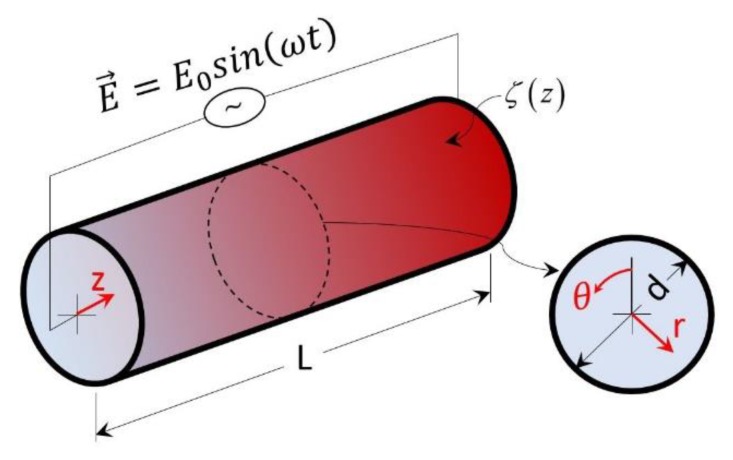
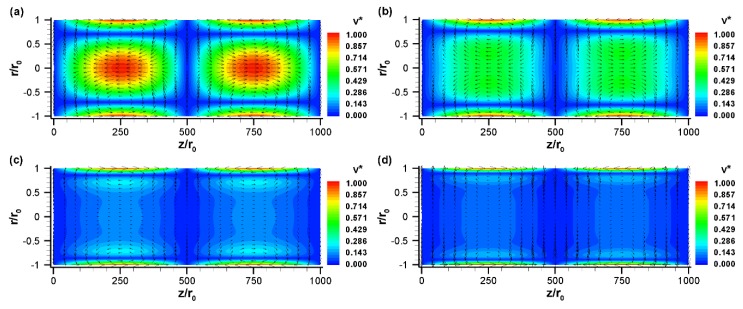
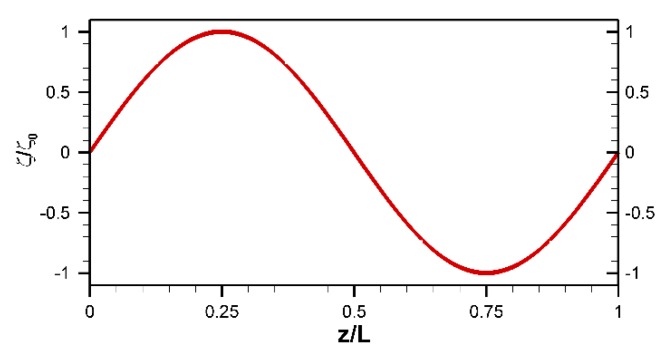
Time-periodic electroosmotic flow (EOF) with heterogeneous surface charges on channel walls can potentially be used to mix species or reagent molecules in microfluidic devices. Although significant research efforts have been placed to understand different aspects of EOF, its role in the mixing process is still poorly understood, especially for non-homogeneous surface charge cases. In this work, dynamic aspects of EOF in a cylindrical capillary are analyzed for heterogeneous surface charges. Closed form analytical solutions for time-periodic EOF are obtained by solving the Navier-Stokes equation. An analytical expression of induced pressure is also obtained from the velocity field solution. The results show that several vortices can be formed inside the microchannel with sinusoidal surface charge distribution. These vortices change their pattern and direction as the electric field change its strength and direction with time. In addition, the structure and strength of the vorticity depend on the frequency of the external electric field and the size of the channel. As the electric field frequency or channel diameter increases, vortices are shifted towards the channel surface and the perturbed flow region becomes smaller, which is not desired for effective mixing. Moreover, the number of vorticities depends on the periodicity of the surface charge.
通道壁上具有异质表面电荷的时间周期电渗流(EOF)有可能用于在微流控装置中混合物种或试剂分子。尽管已经投入了大量研究工作来理解电渗流的不同方面,但其在混合过程中的作用仍未得到充分理解,特别是对于非均匀表面电荷情况。在这项工作中,针对异质表面电荷分析了圆柱形毛细管中电渗流的动态方面。通过求解纳维 - 斯托克斯方程获得了时间周期电渗流的闭式解析解。还从速度场解中得到了感应压力的解析表达式。结果表明,在具有正弦表面电荷分布的微通道内可以形成几个涡旋。随着电场随时间改变其强度和方向,这些涡旋会改变它们的模式和方向。此外,涡度的结构和强度取决于外部电场的频率和通道的尺寸。随着电场频率或通道直径增加,涡旋向通道表面移动,并且扰动流动区域变小,这对于有效混合是不利的。此外,涡旋的数量取决于表面电荷的周期性。