Porto Yuri Duarte, Trombete Felipe Machado, Freitas-Silva Otniel, de Castro Izabela Miranda, Direito Gloria Maria, Ascheri José Luis Ramirez
Graduate Program in Food Science and Technology, Institute of Technology, Federal Rural University of Rio de Janeiro (UFRRJ), Seropédica 23897-000, Brazil.
Food Engineering Department, Federal University of São João del-Rei, Campus Sete Lagoas, Sete Lagoas 35701-970, Brazil.
Microorganisms. 2019 Jul 28;7(8):220. doi: 10.3390/microorganisms7080220.
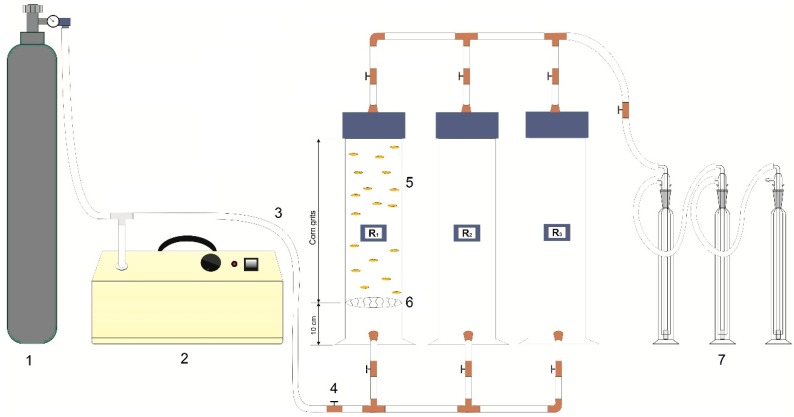
Corn is one of the most cultivated cereals in Brazil. However, its grains are constantly exposed to contamination by mycotoxins. Corn grits are used by the food industry to produce a large variety of corn products such as canjiquinha, a cultural food easily purchased by the Brazilian consumer at low prices. Some studies have demonstrated high contamination of this product by aflatoxins (AFs), representing a potential risk of exposure due to such a contamination. In this study, the efficacy of gaseous ozonation was evaluated on the levels of aflatoxins and on the microbial contamination of corn grits. The application of gaseous ozone was tested in different combinations of exposure time, ozone concentration, and canjiquinha mass. After the ozonation treatment, samples were collected for aflatoxin and microbiological analyses. Aflatoxins were evaluated using a high-performance liquid chromatography with fluorescence detection (HPLC-FD) system using pre-column derivatization, and the microbiological analyses were carried out for toxin-producer fungi and mesophilic bacteria. After ozone detoxification, results showed reductions up to 57% in aflatoxin levels. Total fungal count was reduced around 3.0 cycles log CFU g and total mesophilic counts were reduced to non-detectable levels. These results demonstrated that ozonation is an effective alternative for reducing aflatoxin and microbial contamination in products like canjiquinha, thereby improving food safety.
玉米是巴西种植最广泛的谷物之一。然而,其籽粒经常受到霉菌毒素污染。食品工业使用玉米粗粉生产多种玉米产品,如康吉昆哈,这是一种巴西消费者很容易低价买到的传统食品。一些研究表明,这种产品受到黄曲霉毒素(AFs)的高度污染,这种污染存在潜在的暴露风险。在本研究中,评估了气态臭氧处理对玉米粗粉中黄曲霉毒素水平和微生物污染的效果。测试了气态臭氧在不同暴露时间、臭氧浓度和康吉昆哈质量组合下的应用。臭氧处理后,采集样品进行黄曲霉毒素和微生物分析。使用柱前衍生化的高效液相色谱-荧光检测(HPLC-FD)系统评估黄曲霉毒素,并对产毒素真菌和嗜温细菌进行微生物分析。臭氧解毒后,结果显示黄曲霉毒素水平降低了57%。真菌总数减少了约3.0个对数循环CFU/g,嗜温菌总数降至检测不到的水平。这些结果表明,臭氧处理是减少康吉昆哈等产品中黄曲霉毒素和微生物污染的有效替代方法,从而提高了食品安全。