Xue Wenya, Macleod Joshua, Blaxland James
ZERO2FIVE Food Industry Centre, Cardiff Metropolitan University, Cardiff CF5 2YB, UK.
Cardiff School of Sports and Health Science, Cardiff Metropolitan University, Cardiff CF5 2YB, UK.
Foods. 2023 Feb 14;12(4):814. doi: 10.3390/foods12040814.
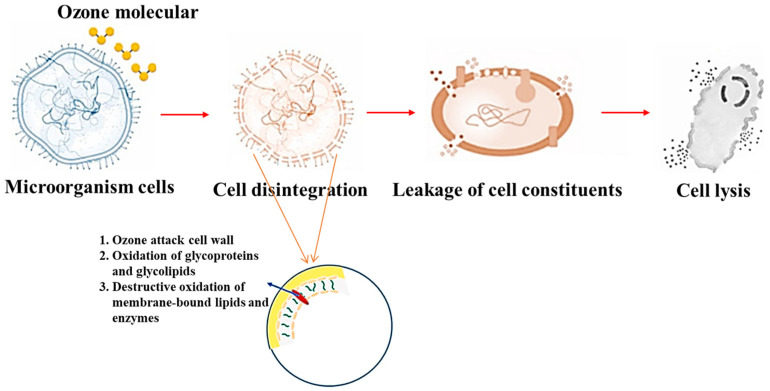
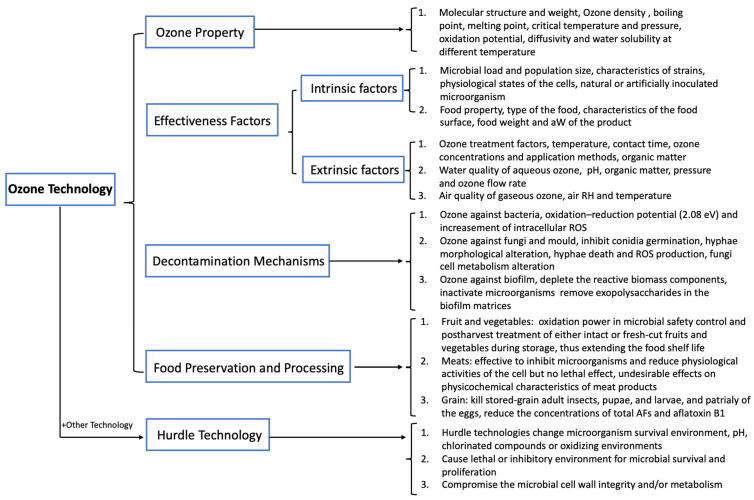
The need for microorganism control in the food industry has promoted research in food processing technologies. Ozone is considered to be a promising food preserving technique and has gained great interest due to its strong oxidative properties and significant antimicrobial efficiency, and because its decomposition leaves no residues in foods. In this ozone technology review, the properties and the oxidation potential of ozone, and the intrinsic and extrinsic factors that affect the microorganism inactivation efficiency of both gaseous and aqueous ozone, are explained, as well as the mechanisms of ozone inactivation of foodborne pathogenic bacteria, fungi, mould, and biofilms. This review focuses on the latest scientific studies on the effects of ozone in controlling microorganism growth, maintaining food appearance and sensorial organoleptic qualities, assuring nutrient contents, enhancing the quality of food, and extending food shelf life, e.g., vegetables, fruits, meat, and grain products. The multifunctionality effects of ozone in food processing, in both gaseous and aqueous form, have promoted its use in the food industries to meet the increased consumer preference for a healthy diet and ready-to-eat products, although ozone may present undesirable effects on physicochemical characteristics on certain food products at high concentrations. The combined uses of ozone and other techniques (hurdle technology) have shown a promotive future in food processing. It can be concluded from this review that the application of ozone technology upon food requires increased research; specifically, the use of treatment conditions such as concentration and humidity for food and surface decontamination.
食品工业中对微生物控制的需求推动了食品加工技术的研究。臭氧被认为是一种很有前景的食品保鲜技术,因其具有很强的氧化特性和显著的抗菌效率,且其分解后不会在食品中留下残留物,因而备受关注。在这篇臭氧技术综述中,阐述了臭氧的性质和氧化电位,以及影响气态和液态臭氧微生物灭活效率的内在和外在因素,还有臭氧灭活食源性病原体细菌、真菌、霉菌和生物膜的机制。这篇综述聚焦于关于臭氧在控制微生物生长、保持食品外观和感官品质、确保营养成分、提高食品质量以及延长食品保质期(如蔬菜、水果、肉类和谷物产品)方面作用的最新科学研究。臭氧在食品加工中气态和液态形式的多功能作用,促使其在食品工业中得到应用,以满足消费者对健康饮食和即食产品日益增长的偏好,尽管高浓度臭氧可能会对某些食品的物理化学特性产生不良影响。臭氧与其他技术的联合使用(栅栏技术)在食品加工中显示出了良好的前景。从这篇综述可以得出结论,臭氧技术在食品上的应用需要更多研究;具体而言,需要研究针对食品和表面去污的浓度和湿度等处理条件的使用。