Department of Health Policy & Management, School of Public Health, Sun Yat-sen University, 74 Zhongshan 2nd Road, Guangzhou, Guangdong, 510080, People's Republic of China.
Department of Pathology, the 3rd Affiliated Hospital, Sun Yat University, 600 Tianhe Road, Guangzhou, Guangdong, China.
BMC Public Health. 2019 Jul 29;19(1):1017. doi: 10.1186/s12889-019-7350-8.
Depression is regarded as a major public health concern in our society. While living arrangements as a structural factor of social support may contribute to older adults' depression. Our study aims to investigate the association between living arrangements and depressive symptoms among older adults in the whole China, and to explore whether such influences differ by genders.
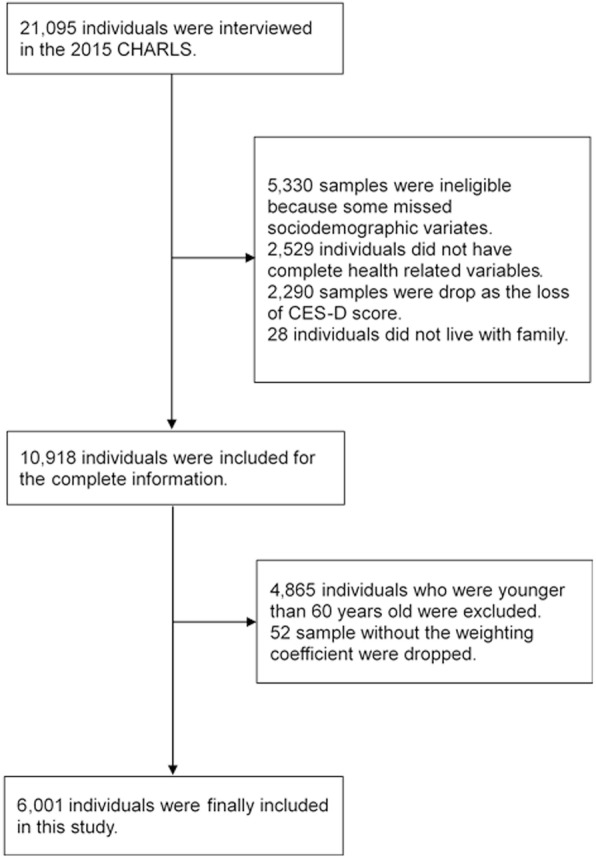
Data were obtained from the 2015 China Health and Retirement Longitudinal Study. The sample was comprised of 6001 individuals aged ≥60 years. Depressive symptoms were measured by the 10-item Short-Form Center for Epidemiological Studies Depression. Independent variables were divided into 4 groups, considering living with/without a spouse and living with/without a child. The multivariate logistic regression was used to estimate the relationship between living arrangements and depressive symptoms in four models.
Compared with living only with a spouse, people living with a spouse and child, or living alone were more likely to have depressive symptoms (odds ratio = 1.23 95% CI 1.06-1.42 and 1.40 95% CI 1.03-1.92, respectively). Women were more associated with depressive symptoms (odds ratio = 2.13), but there were no significant associations between living arrangements and depressive symptoms among women. Men living with a spouse and a child had stronger positively depressive symptoms (odds ratio = 1.37).
Older adults living alone, or living with both a child and spouse were more likely to have depressive symptoms. It is important to provide more social services for those older adult, particularly for men living with a spouse and child.
抑郁症被认为是我们社会的一个主要公共卫生问题。虽然居住安排作为社会支持的结构因素可能会导致老年人抑郁。我们的研究旨在调查居住安排与中国老年人抑郁症状之间的关系,并探讨这种影响是否因性别而异。
数据来自 2015 年中国健康与退休纵向研究。样本包括 6001 名年龄≥60 岁的个体。抑郁症状通过 10 项短式中心流行病学研究抑郁量表进行测量。自变量分为 4 组,考虑与配偶同住/不同住和与子女同住/不同住。使用多变量逻辑回归模型在四个模型中估计居住安排与抑郁症状之间的关系。
与仅与配偶同住相比,与配偶和子女同住或独居的人更有可能出现抑郁症状(优势比=1.23,95%置信区间为 1.06-1.42 和 1.40,95%置信区间为 1.03-1.92)。女性与抑郁症状的相关性更强(优势比=2.13),但女性的居住安排与抑郁症状之间没有显著关联。与配偶和子女同住的男性出现更强的抑郁症状(优势比=1.37)。
独居或与子女和配偶同住的老年人更有可能出现抑郁症状。为那些老年人,特别是与配偶和子女同住的男性提供更多的社会服务非常重要。