Department of Microbiology, University of Bayreuth, Bayreuth, Germany.
Department of Molecular Structural Biology, Max Planck Institute of Biochemistry, Planegg-Martinsried, Germany.
Nat Microbiol. 2019 Nov;4(11):1978-1989. doi: 10.1038/s41564-019-0512-8. Epub 2019 Jul 29.
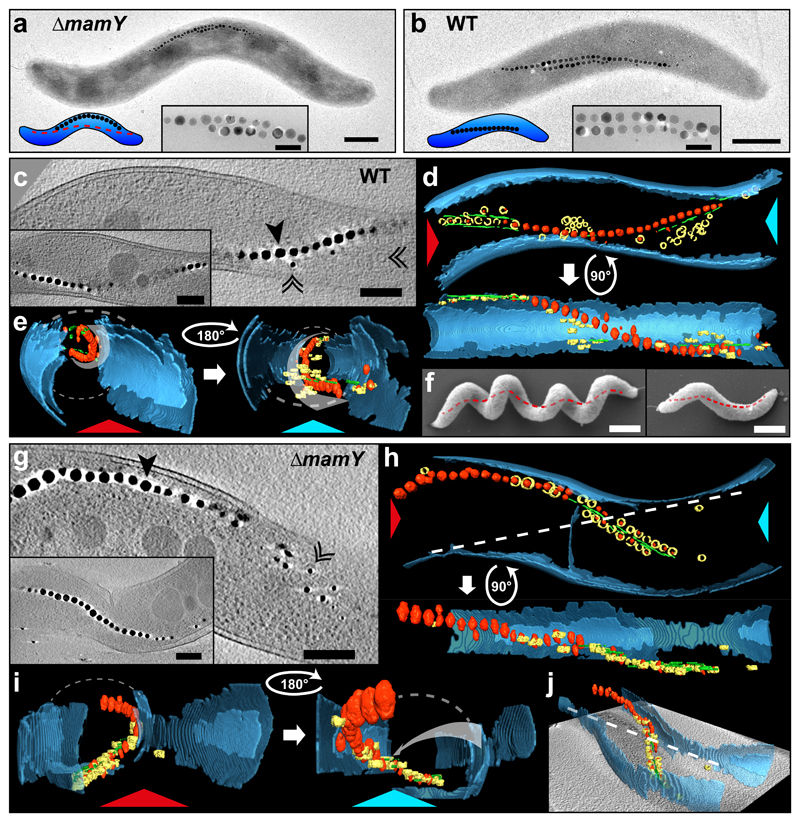
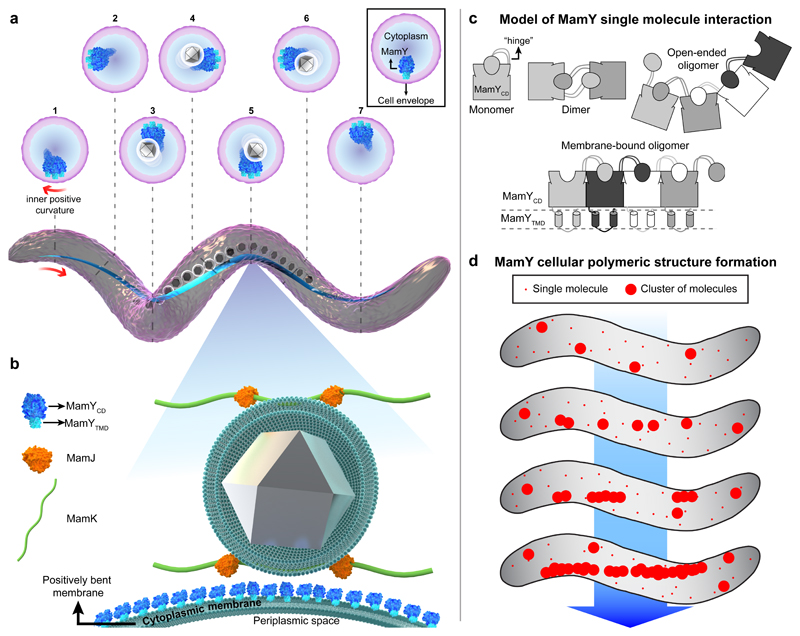
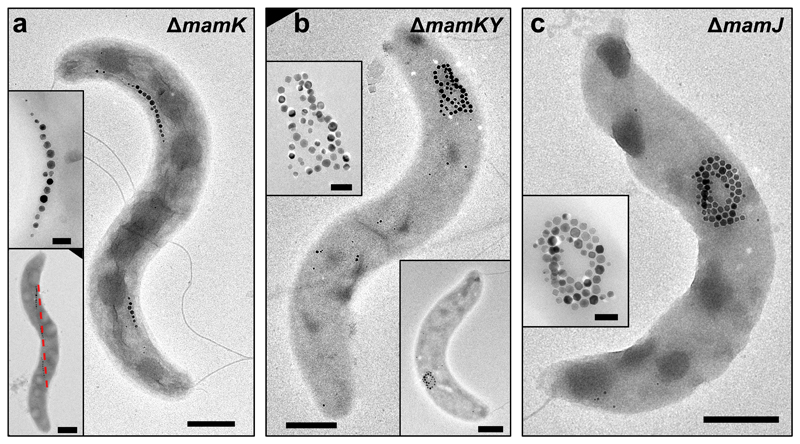
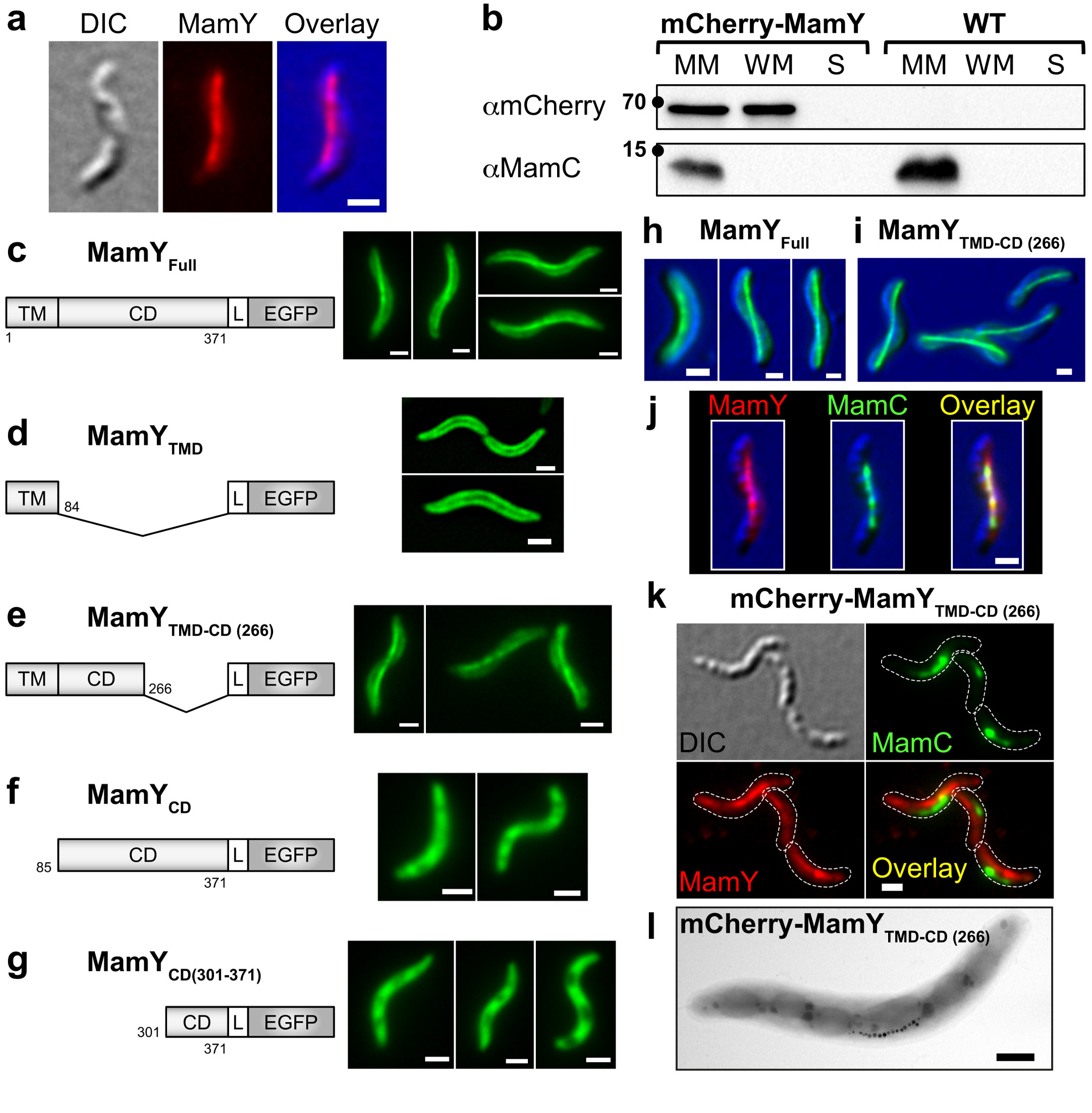
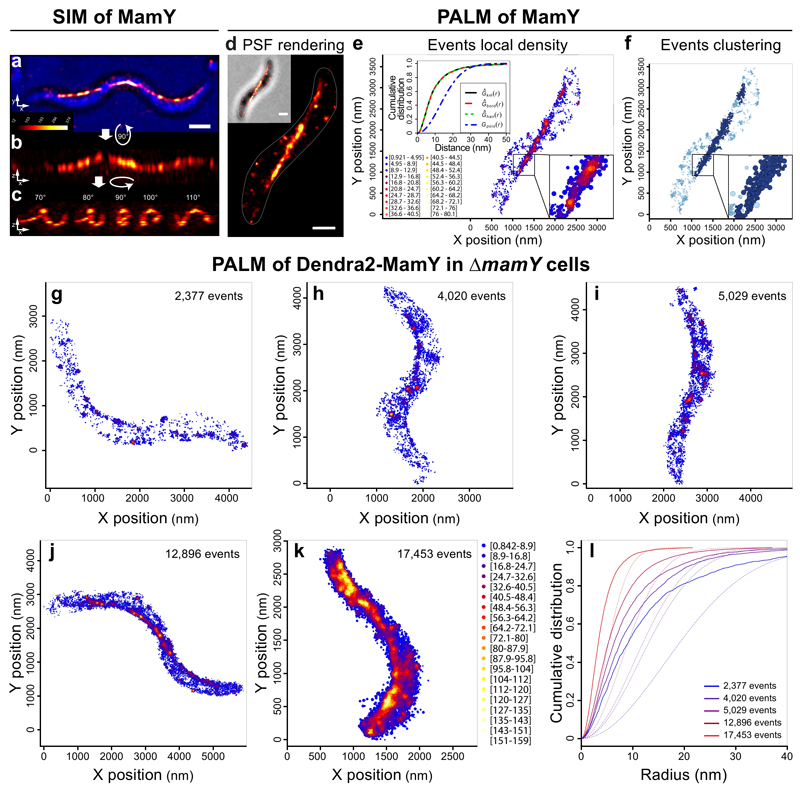
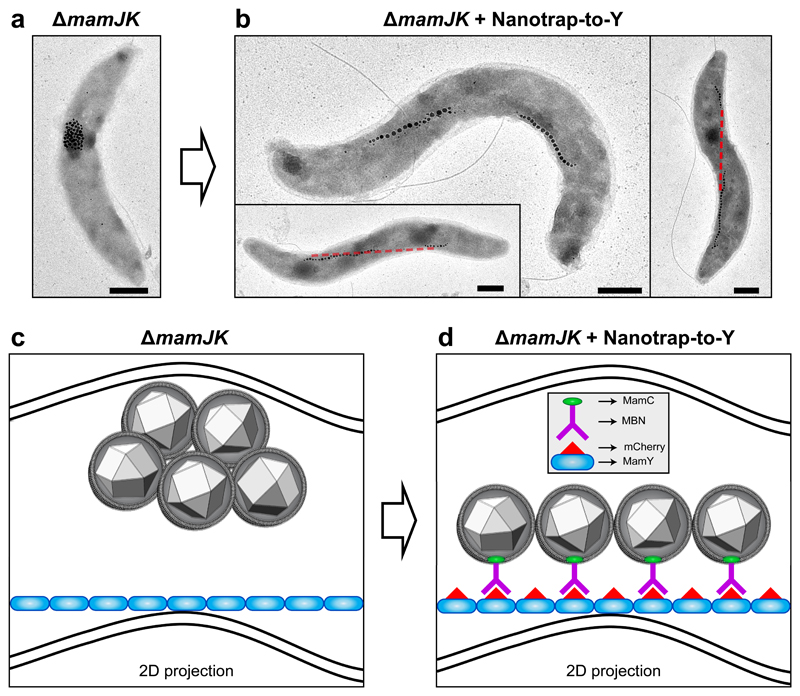
To navigate within the geomagnetic field, magnetotactic bacteria synthesize magnetosomes, which are unique organelles consisting of membrane-enveloped magnetite nanocrystals. In magnetotactic spirilla, magnetosomes become actively organized into chains by the filament-forming actin-like MamK and the adaptor protein MamJ, thereby assembling a magnetic dipole much like a compass needle. However, in Magnetospirillum gryphiswaldense, discontinuous chains are still formed in the absence of MamK. Moreover, these fragmented chains persist in a straight conformation indicating undiscovered structural determinants able to accommodate a bar magnet-like magnetoreceptor in a helical bacterium. Here, we identify MamY, a membrane-bound protein that generates a sophisticated mechanical scaffold for magnetosomes. MamY localizes linearly along the positive inner cell curvature (the geodetic cell axis), probably by self-interaction and curvature sensing. In a mamY deletion mutant, magnetosome chains detach from the geodetic axis and fail to accommodate a straight conformation coinciding with reduced cellular magnetic orientation. Codeletion of mamKY completely abolishes chain formation, whereas on synthetic tethering of magnetosomes to MamY, the chain configuration is regained, emphasizing the structural properties of the protein. Our results suggest MamY is membrane-anchored mechanical scaffold that is essential to align the motility axis of magnetotactic spirilla with their magnetic moment vector and to perfectly reconcile magnetoreception with swimming direction.
为了在地球磁场中导航,趋磁细菌会合成磁小体,这是一种独特的细胞器,由膜包裹的磁铁矿纳米晶体组成。在趋磁螺旋菌中,磁小体通过丝状肌动蛋白样蛋白 MamK 和衔接蛋白 MamJ 被主动组织成链,从而组装成一个类似于指南针指针的磁偶极子。然而,在 Magnetospirillum gryphiswaldense 中,即使没有 MamK,也会形成不连续的链。此外,这些断裂的链仍保持直线构象,表明存在未被发现的结构决定因素,能够在螺旋形细菌中容纳类似于条形磁铁的磁受体。在这里,我们鉴定出了 MamY,一种膜结合蛋白,它为磁小体生成了一个复杂的机械支架。MamY 在线性地沿着正的细胞内曲率(测地线细胞轴)定位,可能是通过自我相互作用和曲率感应。在 mamY 缺失突变体中,磁小体链从测地线轴上脱离,无法适应直线构象,同时细胞的磁性取向也会降低。mamKY 的完全缺失会完全消除链的形成,而在磁小体与 MamY 的人工连接上,链的构型得以恢复,这强调了该蛋白的结构特性。我们的结果表明,MamY 是一种膜锚定的机械支架,对于将趋磁螺旋菌的运动轴与其磁矩矢量对齐,以及完美协调磁感受与游动方向至关重要。