Center for Child Health, Behavior, and Development, Seattle Children's Research Institute, Seattle, WA, USA.
Department of Psychiatry and Behavioral Sciences, University of Washington, Seattle, WA, USA.
J Child Psychol Psychiatry. 2019 Oct;60(10):1123-1132. doi: 10.1111/jcpp.13099. Epub 2019 Jul 30.
In primary analyses, dialectical behavior therapy (DBT) was associated with greater reduction in self-harm during treatment than individual/group supportive therapy (IGST). The objective of this paper was to examine predictors and moderators of treatment outcomes for suicidal adolescents who participated in a randomized controlled trial evaluating DBT and IGST.
Adolescents (N = 173) were included in the intent-to-treat sample and randomized to receive 6 months of DBT or IGST. Potential baseline predictors and moderators were identified within four categories: demographics, severity markers, parental psychopathology, and psychosocial variables. Primary outcomes were suicide attempts (SA) and nonsuicidal self-injury evaluated at baseline, midtreatment (3 months), and end of treatment (6 months) via the Suicide Attempt and Self-Injury Interview (Psychological Assessment, 18, 2006, 303). For each moderator or predictor, a generalized linear mixed model was conducted to examine main and interactive effects of treatment and the candidate variable on outcomes.
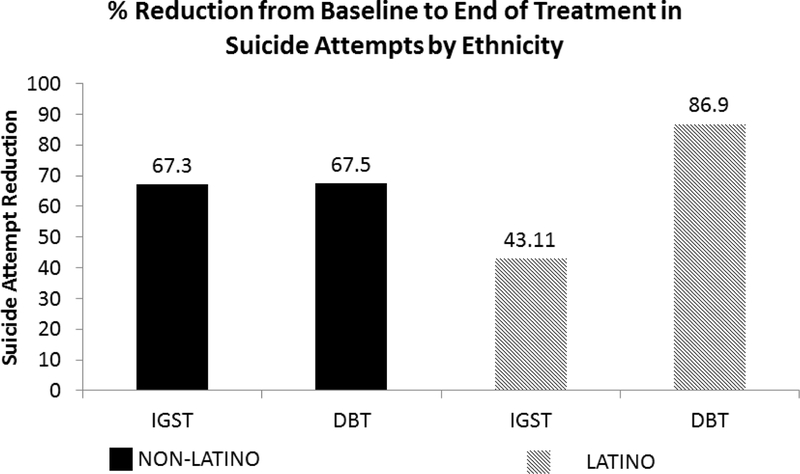
Adolescents with higher family conflict, more extensive self-harm histories, and more externalizing problems produced on average more reduction on SH frequency from baseline to post-treatment. Adolescents meeting BPD diagnosis were more likely to have high SH frequency at post-treatment. Analyses indicated significant moderation effects for emotion dysregulation on NSSI and SH. DBT was associated with better rates of improvement compared to IGST for adolescents with higher baseline emotion dysregulation and those whose parents reported greater psychopathology and emotion dysregulation. A significant moderation effect for ethnicity on SA over the treatment period was observed, where DBT produced better rate of improvement compared to IGST for Hispanic/Latino individuals.
These findings may help to inform salient treatment targets and guide treatment planning. Adolescents that have high levels of family conflict, externalizing problems, and increased level of severity markers demonstrated the most change in self-harm behaviors over the course of treatment and benefitted from both treatment interventions. Those with higher levels of emotion dysregulation and parent psychopathology may benefit more from the DBT.
在初步分析中,辩证行为疗法(DBT)在治疗过程中减少自伤的效果优于个体/团体支持治疗(IGST)。本文的目的是检验参加随机对照试验评估 DBT 和 IGST 的自杀青少年的治疗结果的预测因素和调节因素。
将 173 名青少年纳入意向治疗样本,并随机分配接受 6 个月的 DBT 或 IGST。在四个类别中确定了潜在的基线预测因素和调节因素:人口统计学、严重程度标志物、父母精神病理学和心理社会变量。主要结局是通过自杀尝试和自我伤害访谈(心理评估,18,2006,303)在基线、治疗中期(3 个月)和治疗结束时(6 个月)评估自杀企图(SA)和非自杀性自我伤害。对于每个调节因素或预测因素,都进行了广义线性混合模型分析,以检验治疗和候选变量对结局的主要和交互作用。
家庭冲突较多、自我伤害史较广泛、外化问题较多的青少年在从基线到治疗后,SH 频率的平均减少量更大。符合 BPD 诊断的青少年在治疗后更有可能出现高 SH 频率。情绪调节障碍对 NSSI 和 SH 的分析表明存在显著的调节作用。与 IGST 相比,DBT 与情绪调节障碍较高的青少年和父母报告的心理病理学和情绪调节障碍较多的青少年的改善率更高。在治疗期间,对 SA 的种族显著调节作用表明,与 IGST 相比,DBT 对西班牙裔/拉丁裔个体的改善率更高。
这些发现可能有助于确定重要的治疗目标,并指导治疗计划。在治疗过程中,家庭冲突程度较高、外化问题较多、严重程度标志物水平较高的青少年在自我伤害行为方面的变化最大,并且两种治疗干预都有效。情绪调节障碍和父母精神病理学水平较高的青少年可能从 DBT 中获益更多。