Hu Changchun, Huang Jialing, Shang Yushan, Huang Tingting, Jiang Wenhao, Yuan Yonggui
School of Medicine, Southeast University, Nanjing, China.
Department of Clinical Psychology, Affiliated Hangzhou First People's Hospital, Zhejiang University School of Medicine, Hangzhou, China.
Child Adolesc Psychiatry Ment Health. 2023 Jan 28;17(1):16. doi: 10.1186/s13034-023-00557-3.
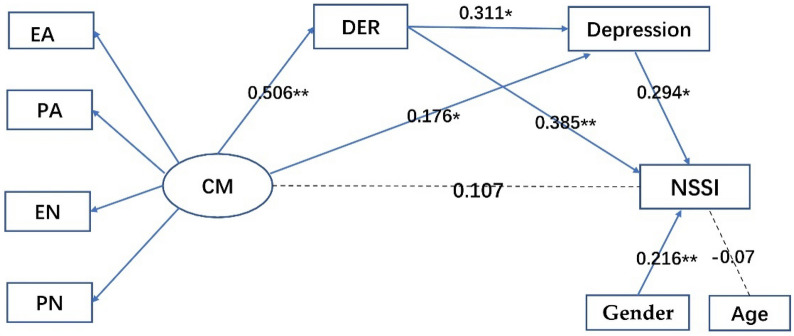
Although child maltreatment (CM) experiences are recognized risk factors for nonsuicidal self-injury (NSSI), the mechanisms underlying this relationship remain unclear. The purpose of this study was to examine whether difficulty in emotion regulation (DER) and depressive symptoms mediate the relationship between child maltreatment experiences and NSSI severity, adjusting for demographic variables.
The participants were 224 adolescent inpatients recruited from a hospital in China (mean age 15.30 years, SD = 1.83; 78.6% females). Study measures included the Clinician-Rated Severity of Nonsuicidal Self-Injury (CRSNSSI), Childhood Trauma Questionnaire (CTQ-SF), Difficulties in Emotion Regulation Scale (DERS), and Patient Health Questionnaire-9 (PHQ-9). The hypothesized chain mediation model was tested using the structural equation model.
A total of 146 (65.18%) adolescents reported engaging in NSSI during the past 12 months, and 103 (45.98%) participants met the DSM-5 diagnostic criteria for NSSI. Emotional neglect (48.1%) and emotional abuse (46.1%) had the highest prevalence, followed by physical neglect (43.1%) and physical abuse (24.1%), whereas sexual abuse (12.5%) was the least prevalent form of CM. Separately, both DER and depressive symptoms significantly mediated the association between CM and NSSI, with DER being the strongest mediator, with an indirect effect of 49.40% (p = 0.014). At the same time, we also proved a potential chain-mediated pathway of DER and depression in the relationship between CM and NSSI.
Child maltreatment seems to play a role in the aetiology of NSSI. DER and depressive symptoms both have a mediating role in the relationship between CM and NSSI. Importantly, DER seems to be a mediator with a stronger indirect effect compared to depressive symptoms.
尽管儿童虐待经历被认为是非自杀性自伤(NSSI)的风险因素,但这种关系背后的机制仍不清楚。本研究的目的是检验情绪调节困难(DER)和抑郁症状是否在儿童虐待经历与NSSI严重程度之间的关系中起中介作用,并对人口统计学变量进行调整。
参与者为从中国一家医院招募的224名青少年住院患者(平均年龄15.30岁,标准差=1.83;78.6%为女性)。研究测量包括临床医生评定的非自杀性自伤严重程度(CRSNSSI)、儿童创伤问卷(CTQ-SF)、情绪调节困难量表(DERS)和患者健康问卷-9(PHQ-9)。使用结构方程模型检验假设的链式中介模型。
共有146名(65.18%)青少年报告在过去12个月内有过NSSI行为,103名(45.98%)参与者符合NSSI的DSM-5诊断标准。情感忽视(48.1%)和情感虐待(46.1%)的发生率最高,其次是身体忽视(43.1%)和身体虐待(24.1%),而性虐待(12.5%)是儿童虐待最不常见的形式。单独来看,DER和抑郁症状均显著介导了儿童虐待与NSSI之间的关联,DER是最强的中介因素,间接效应为49.40%(p=0.014)。同时,我们还证明了DER和抑郁在儿童虐待与NSSI关系中的潜在链式中介途径。
儿童虐待似乎在NSSI的病因学中起作用。DER和抑郁症状在儿童虐待与NSSI的关系中均起中介作用。重要的是,与抑郁症状相比,DER似乎是一个具有更强间接效应的中介因素。