Department of Otolaryngology, Sun Yat-sen Memorial Hospital, Sun Yat-sen University, Guangzhou, China.
Institute of Hearing and Speech-Language Science, Sun Yat-sen University, Guangzhou, China.
Dis Markers. 2019 Jul 8;2019:7165257. doi: 10.1155/2019/7165257. eCollection 2019.
To explore whether peripheral inflammatory, metabolic, and hemostatic parameters could predict the pathogenesis of successive bilateral sudden sensorineural hearing loss (SSNHL).
This study reviewed 33 patients with successive bilateral SSNHL and 215 patients with unilateral SSNHL. Clinical characteristics and hematological parameters were compared, including the inflammatory markers (like neutrophil lymphocyte ratio (NLR), monocyte lymphocyte ratio (MLR), and platelet lymphocyte ratio (PLR)) and metabolic features (including hypertension, triglyceridemia, dyslipidemia, and hyperglycemia), as well as hemostatic indices (including prothrombin time (PT), activated partial thromboplastin time (APTT), and fibrinogen).
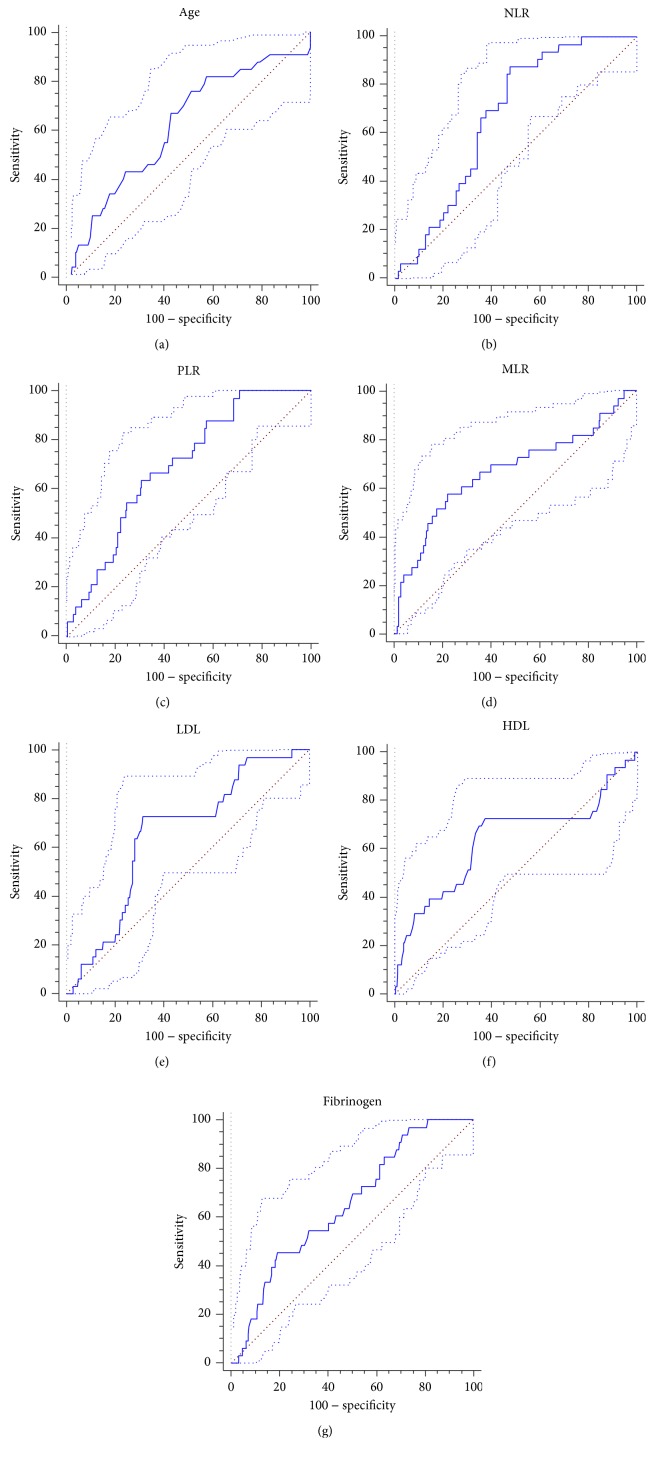
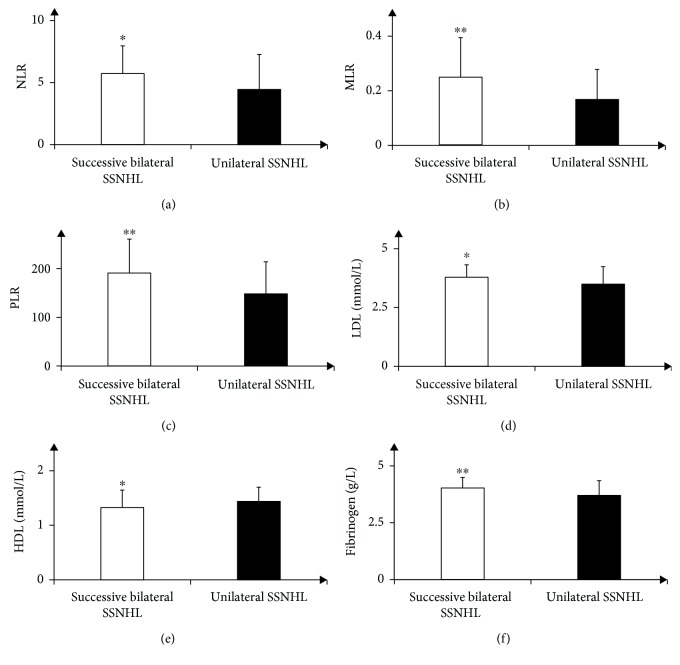
In the successive bilateral SSNHL group, older average onset age (48.67 ± 15.36 vs. 42.71 ± 13.58, < 0.05), higher male to female ratio (18 : 15 vs. 112 : 103, > 0.05), and poorer therapeutic efficacy (12% vs. 59%, < 0.01) were observed than those in the unilateral SSNHL group. Compared to the unilateral SSNHL group, NLR, MLR, and PLR in the successive bilateral SSNHL group were significantly higher (NLR: 5.72 ± 2.23 vs. 4.45 ± 2.82, = 0.01; MLR: 0.25 ± 0.15 vs. 0.17 ± 0.11, < 0.01; PLR: 190.70 ± 69.79 vs. 148.18 ± 65.67; < 0.01); the LDL level was significantly higher; yet, the HDL level was significantly lower (LDL: 3.79 ± 0.53 vs. 3.49 ± 0.74; HDL: 1.33 ± 0.32 vs. 1.44 ± 0.26; < 0.05 for both); fibrinogen was significantly higher (4.03 ± 0.47 vs. 3.70 ± 0.65; < 0.01). Logistic regression analysis demonstrated that the risk factors for successive bilateral SSNHL included age, NLR, MLR, PLR, LDL, HDL, diabetes, and fibrinogen. However, only NLR, MLR, PLR, diabetes, LDL, and HDL independently predicted successive bilateral SSNHL.
Selected blood inflammatory markers combined with metabolic parameters were positively correlated with successive bilateral SSNHL.
探讨外周炎性、代谢和止血参数是否可以预测连续双侧突发性聋的发病机制。
本研究回顾性分析了 33 例连续双侧突发性聋患者和 215 例单侧突发性聋患者的临床特征和血液学参数,包括炎症标志物(如中性粒细胞/淋巴细胞比值(NLR)、单核细胞/淋巴细胞比值(MLR)和血小板/淋巴细胞比值(PLR))和代谢特征(包括高血压、高甘油三酯血症、血脂异常和高血糖)以及止血指数(包括凝血酶原时间(PT)、活化部分凝血活酶时间(APTT)和纤维蛋白原)。
在连续双侧突发性聋组中,平均发病年龄较大(48.67 ± 15.36 岁比 42.71 ± 13.58 岁, < 0.05),男女比例较高(18:15 比 112:103, > 0.05),且治疗效果较差(12%比 59%, < 0.01)。与单侧突发性聋组相比,连续双侧突发性聋组 NLR、MLR 和 PLR 明显升高(NLR:5.72 ± 2.23 比 4.45 ± 2.82, = 0.01;MLR:0.25 ± 0.15 比 0.17 ± 0.11, < 0.01;PLR:190.70 ± 69.79 比 148.18 ± 65.67, < 0.01);LDL 水平明显升高,而 HDL 水平明显降低(LDL:3.79 ± 0.53 比 3.49 ± 0.74;HDL:1.33 ± 0.32 比 1.44 ± 0.26, < 0.05);纤维蛋白原明显升高(4.03 ± 0.47 比 3.70 ± 0.65, < 0.01)。Logistic 回归分析表明,连续双侧突发性聋的危险因素包括年龄、NLR、MLR、PLR、LDL、HDL、糖尿病和纤维蛋白原。然而,只有 NLR、MLR、PLR、糖尿病、LDL 和 HDL 独立预测连续双侧突发性聋。
选定的血液炎症标志物与代谢参数相结合与连续双侧突发性聋呈正相关。