Jarquín-Díaz Víctor Hugo, Balard Alice, Jost Jenny, Kraft Julia, Dikmen Mert Naci, Kvičerová Jana, Heitlinger Emanuel
Department of Molecular Parasitology, Institute for Biology, Humboldt University Berlin (HU), Philippstr. 13, Haus 14, 10115, Berlin, Germany.
Research Group Ecology and Evolution of Molecular Parasite-Host Interactions, Leibniz-Institute for Zoo and Wildlife Research (IZW), Im Forschungsverbund Berlin e.V. Alfred-Kowalke-Straße 17, 10315, Berlin, Germany.
Int J Parasitol Parasites Wildl. 2019 Jul 10;10:29-40. doi: 10.1016/j.ijppaw.2019.07.004. eCollection 2019 Dec.
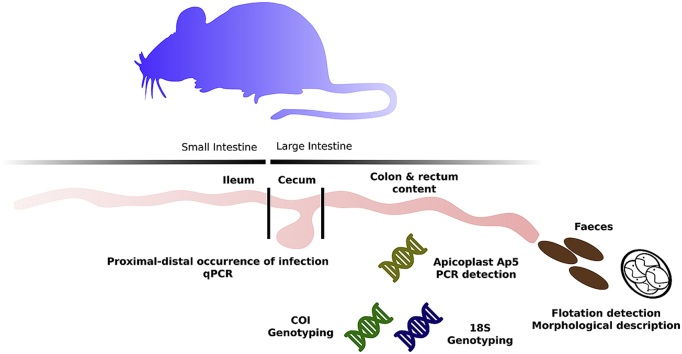
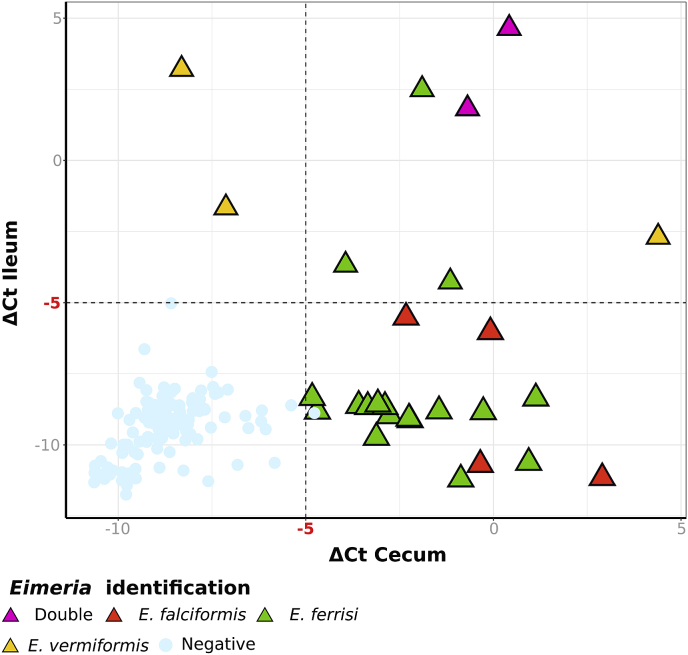
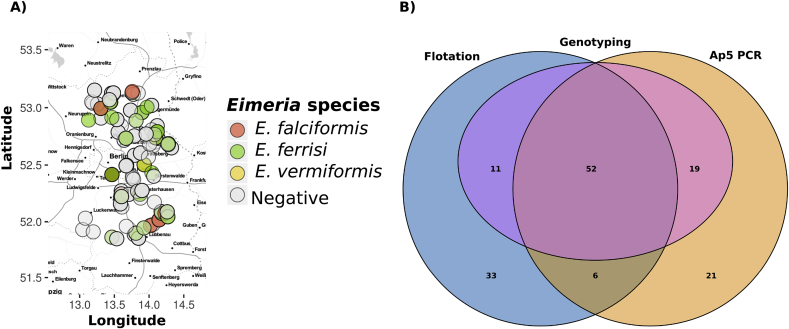
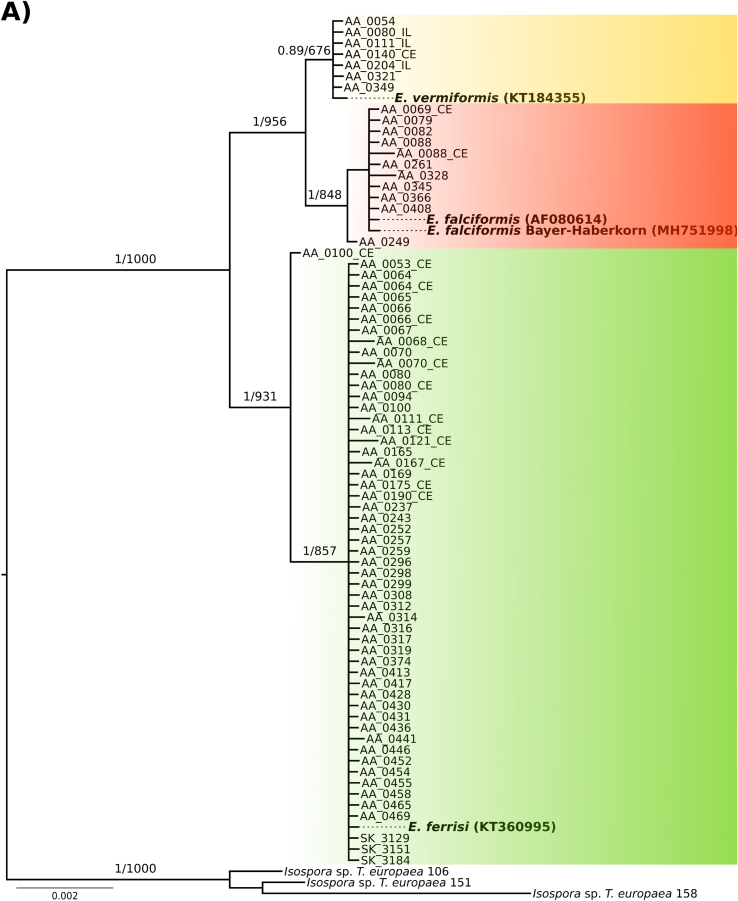
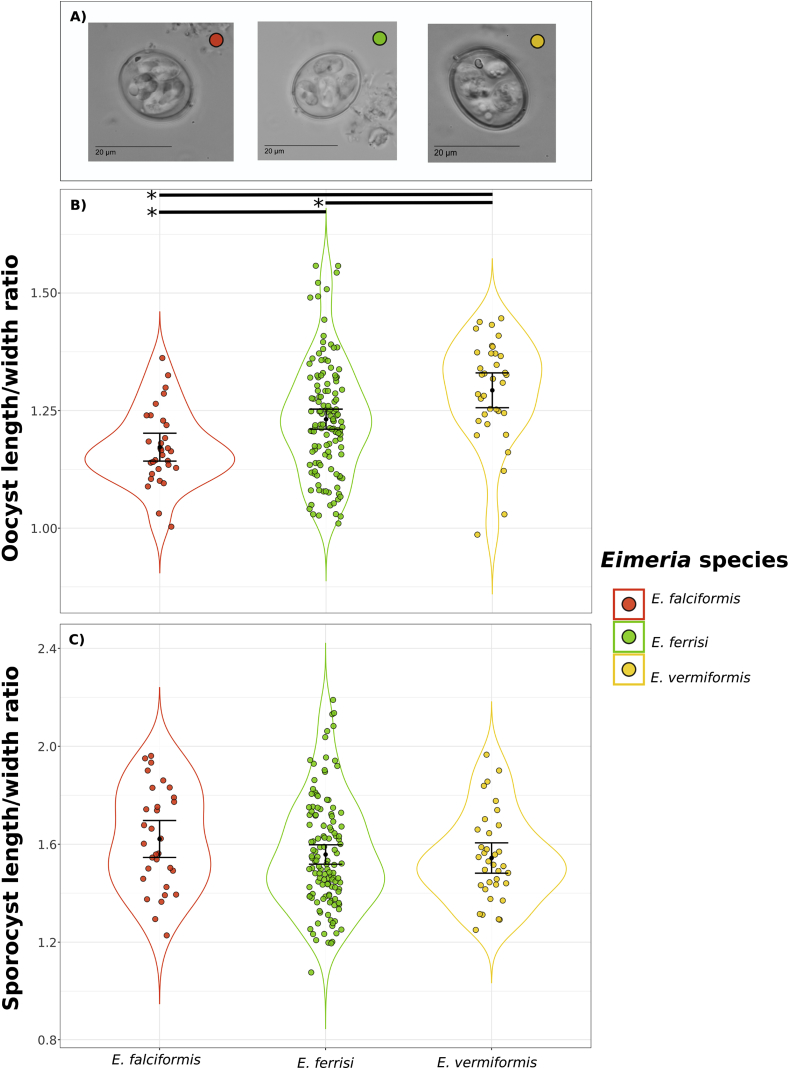
Detection and quantification of coccidia in studies of wildlife can be challenging. Therefore, prevalence of coccidia is often not assessed at the parasite species level in non-livestock animals. Parasite species - specific prevalences are especially important when studying evolutionary questions in wild populations. We tested whether increased host population density increases prevalence of individual species at the farm level, as predicted by epidemiological theory. We studied free-living commensal populations of the house mouse () in Germany, and established a strategy to detect and quantify infections. We show that a novel diagnostic primer targeting the apicoplast genome (Ap5) and coprological assessment after flotation provide complementary detection results increasing sensitivity. Genotyping PCRs confirm detection in a subset of samples and cross-validation of different PCR markers does not indicate bias towards a particular parasite species in genotyping. We were able to detect double infections and to determine the preferred niche of each parasite species along the distal-proximal axis of the intestine. Parasite genotyping from tissue samples provides additional indication for the absence of species bias in genotyping amplifications. Three species were found infecting house mice at different prevalences: (16.7%; 95% CI 13.2-20.7), (4.2%; 95% CI 2.6-6.8) and (1.9%; 95% CI 0.9-3.8). We also find that mice in dense populations are more likely to be infected with and . We provide methods for the assessment of prevalences of coccidia at the species level in rodent systems. We show and discuss how such data can help to test hypotheses in ecology, evolution and epidemiology on a species level.
在野生动物研究中,球虫的检测和定量可能具有挑战性。因此,在非家畜动物中,球虫的流行率通常不在寄生虫物种水平上进行评估。当研究野生种群的进化问题时,寄生虫物种特异性流行率尤为重要。我们测试了宿主种群密度的增加是否会如流行病学理论所预测的那样,在农场层面增加单个物种的流行率。我们研究了德国野生的家鼠()共生种群,并建立了一种检测和定量感染的策略。我们表明,一种针对顶质体基因组的新型诊断引物(Ap5)以及浮选后的粪便学评估提供了互补的检测结果,提高了灵敏度。基因分型PCR证实了在一部分样本中的检测,并且不同PCR标记的交叉验证并未表明在基因分型中对特定寄生虫物种存在偏差。我们能够检测到双重感染,并确定每种寄生虫物种在肠道远端 - 近端轴上的偏好生态位。从组织样本进行的寄生虫基因分型为基因分型扩增中不存在物种偏差提供了额外的证据。发现三种球虫以不同的流行率感染家鼠:(16.7%;95%置信区间13.2 - 20.7)、(4.2%;95%置信区间2.6 - 6.8)和(1.9%;95%置信区间0.9 - 3.8)。我们还发现,密集种群中的小鼠更有可能感染和。我们提供了在啮齿动物系统中评估球虫物种水平流行率的方法。我们展示并讨论了这些数据如何有助于在物种层面检验生态学、进化和流行病学中的假设。