Ahangari Cohan Reza, Nouri Inanlou Davoud, Samiee Aref Mohammad Hasan, Zeinali Sirous, Farhoudi Ramin
Department of Nanobiotechnology, New Technologies Research Group, Pasteur Institute of Iran, Tehran, Iran.
Department of Quality Control, Pasteur Institute of Iran, Tehran, Iran.
Adv Biomed Res. 2019 Jun 28;8:40. doi: 10.4103/abr.abr_53_19. eCollection 2019.
The key point in the production procedure of inbred animals is checking the genetic purity. Skin grafting and coat color test are used traditionally to prove genetic purity, but they have some disadvantages. Recent advances in DNA profiling have enabled scientists to check easily the genetic purity of laboratory animals. In the current study, a set of microsatellite markers was designed to check the purity of inbred laboratory mice.
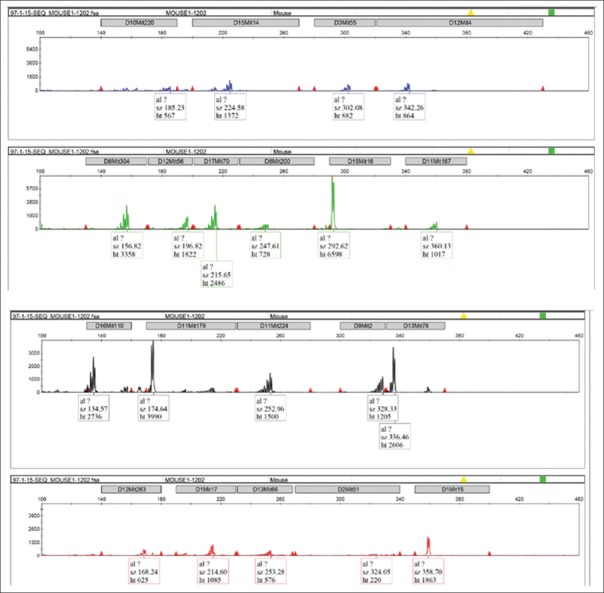
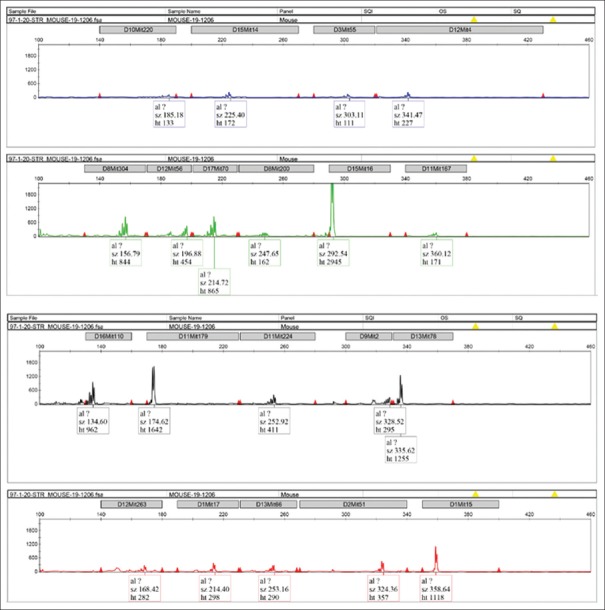
Twenty microsatellites located on 20 chromosomes were employed to create a distinctive genetic profile for parentage analysis. Each individual primer was designed based on distinguishable colors and separable sizes.
Twenty specific microsatellite markers were used in the polymerase chain reaction mixture to identify inbred BALB/cJ strains. Our results confirmed that the designed microsatellites are excellent genetic markers for testing inbred BALB/cJ strain in laboratories.
Our study showed that genetic profiling using microsatellite markers allows us to detect the genetic differences of laboratory mouse species in quality control tests and validation steps.
近交系动物生产过程中的关键在于检查遗传纯度。传统上使用皮肤移植和毛色测试来证明遗传纯度,但它们存在一些缺点。DNA 图谱分析的最新进展使科学家能够轻松检查实验动物的遗传纯度。在本研究中,设计了一组微卫星标记来检查近交系实验小鼠的纯度。
使用位于20条染色体上的20个微卫星来创建用于亲代分析的独特遗传图谱。每个单独的引物基于可区分的颜色和可分离的大小进行设计。
在聚合酶链反应混合物中使用20个特定的微卫星标记来鉴定近交BALB/cJ品系。我们的结果证实,所设计的微卫星是在实验室中测试近交BALB/cJ品系的优秀遗传标记。
我们的研究表明,使用微卫星标记进行遗传图谱分析使我们能够在质量控制测试和验证步骤中检测实验小鼠物种的遗传差异。