Kalkman Hans O
Retired pharmacologist, Gänsbühlgartenweg 7, CH4132 Muttenz, Switzerland.
Pharmaceuticals (Basel). 2019 Jul 29;12(3):113. doi: 10.3390/ph12030113.
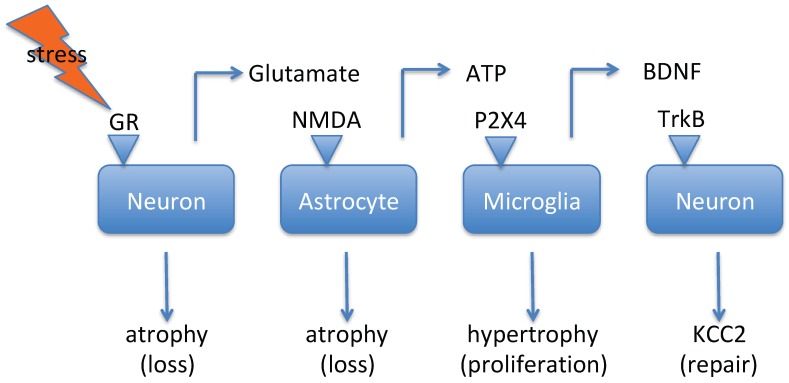
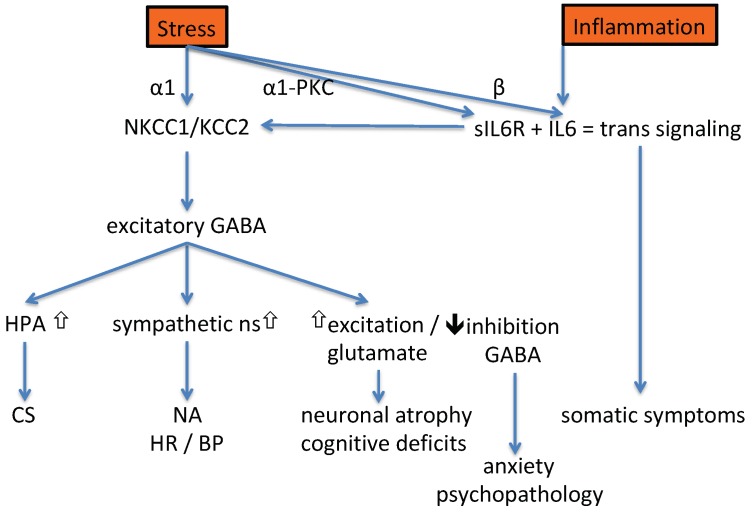
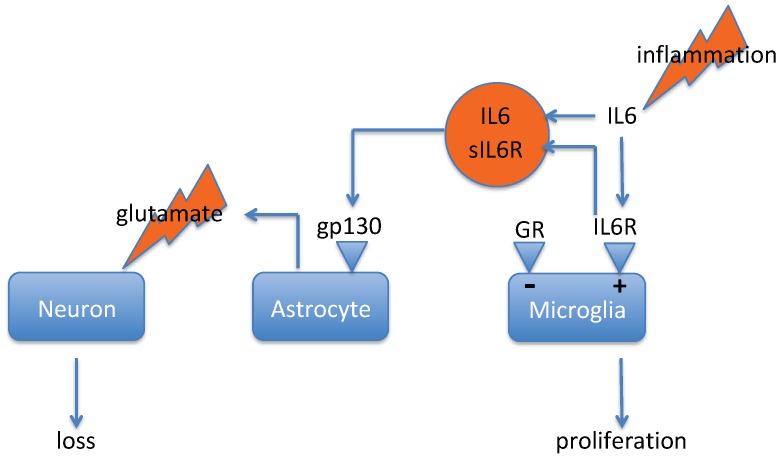
Inflammation and psychological stress are risk factors for major depression and suicide. Both increase central glutamate levels and activate the hypothalamic-pituitary-adrenal axis and the sympathetic nervous system. Both factors also affect the function of the chloride transporters, Na-K-Cl-cotransporter-1 (NKCC1) and K-Cl-cotransporter-2 (KCC2), and provoke interleukin-6 (IL-6) trans-signaling. This leads to measurable increases in circulating corticosteroids, catecholamines, anxiety, somatic and psychological symptoms, and a decline in cognitive functions. Recognition of the sequence of pathological events allows the prediction of novel targets for therapeutic intervention. Amongst others, these include blockade of the big-K potassium channel, blockade of the P2X4 channel, TYK2-kinase inhibition, noradrenaline α2B-receptor antagonism, nicotinic α7-receptor stimulation, and the Sgp130Fc antibody. A better understanding of downstream processes evoked by inflammation and stress also allows suggestions for tentatively better biomarkers (e.g., SERPINA3N, MARCKS, or C-tryptophan metabolism).
炎症和心理压力是重度抑郁症和自杀的危险因素。两者都会增加中枢谷氨酸水平,并激活下丘脑-垂体-肾上腺轴和交感神经系统。这两个因素还会影响氯离子转运体、钠-钾-氯协同转运蛋白-1(NKCC1)和钾-氯协同转运蛋白-2(KCC2)的功能,并引发白细胞介素-6(IL-6)转信号传导。这会导致循环皮质类固醇、儿茶酚胺、焦虑、躯体和心理症状出现可测量的增加,以及认知功能下降。认识到病理事件的序列有助于预测治疗干预的新靶点。其中包括阻断大电导钾通道、阻断P2X4通道、抑制酪氨酸激酶2(TYK2)、拮抗去甲肾上腺素α2B受体、刺激烟碱α7受体以及使用Sgp130Fc抗体。更好地理解炎症和压力引发的下游过程也有助于提出可能更好的生物标志物(如丝氨酸蛋白酶抑制剂A3N、富含丙氨酸的蛋白激酶C底物或C-色氨酸代谢)。