Chevrette Marc G, Bratburd Jennifer R, Currie Cameron R, Stubbendieck Reed M
Department of Bacteriology, University of Wisconsin-Madison, Madison, Wisconsin, USA.
Laboratory of Genetics, University of Wisconsin-Madison, Madison, Wisconsin, USA.
mSystems. 2019 Jul 30;4(4):e00175-19. doi: 10.1128/mSystems.00175-19.
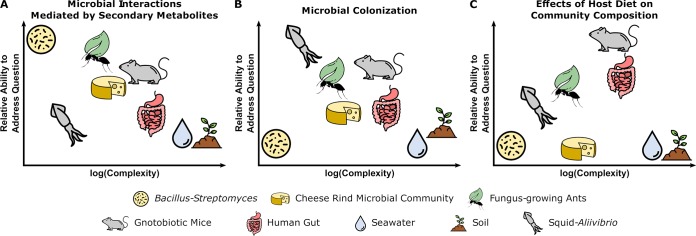
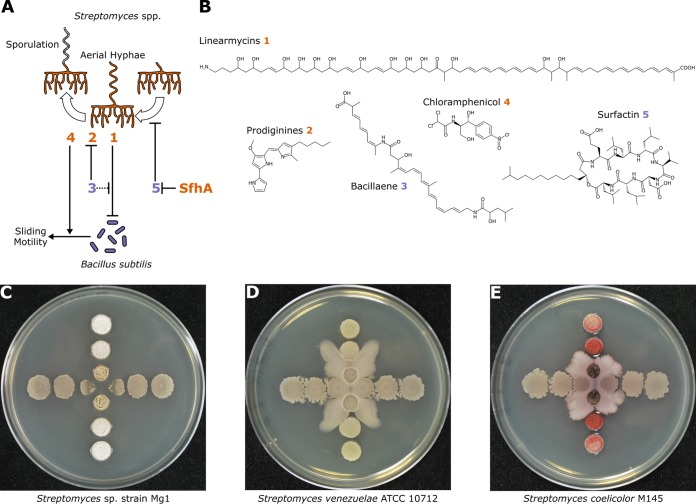
Low-cost, high-throughput nucleic acid sequencing ushered the field of microbial ecology into a new era in which the microbial composition of nearly every conceivable environment on the planet is under examination. However, static "screenshots" derived from sequence-only approaches belie the underlying complexity of the microbe-microbe and microbe-host interactions occurring within these systems. Reductionist experimental models are essential to identify the microbes involved in interactions and to characterize the molecular mechanisms that manifest as complex host and environmental phenomena. Herein, we focus on three models (-, -Hawaiian bobtail squid, and gnotobiotic mice) at various levels of taxonomic complexity and experimental control used to gain molecular insight into microbe-mediated interactions. We argue that when studying microbial communities, it is crucial to consider the scope of questions that experimental systems are suited to address, especially for researchers beginning new projects. Therefore, we highlight practical applications, limitations, and tradeoffs inherent to each model.
低成本、高通量的核酸测序技术将微生物生态学领域带入了一个新时代,在这个时代,地球上几乎每一个可想象环境中的微生物组成都在被研究。然而,仅基于序列的方法所得到的静态“截图”掩盖了这些系统中微生物与微生物以及微生物与宿主相互作用的潜在复杂性。简化论的实验模型对于识别参与相互作用的微生物以及表征表现为复杂宿主和环境现象的分子机制至关重要。在此,我们聚焦于三种处于不同分类复杂性和实验控制水平的模型(——夏威夷短尾乌贼和悉生小鼠),用于深入了解微生物介导的相互作用的分子机制。我们认为,在研究微生物群落时,考虑实验系统适合解决的问题范围至关重要,尤其是对于刚开始新项目的研究人员。因此,我们强调了每个模型固有的实际应用、局限性和权衡。