Department of Marine Sciences, University of North Carolina, Chapel Hill, NC 27599.
Department of Biochemistry and Molecular Biology, Pennsylvania State University, University Park, PA 16802.
Proc Natl Acad Sci U S A. 2018 Sep 4;115(36):E8528-E8537. doi: 10.1073/pnas.1808302115. Epub 2018 Aug 20.
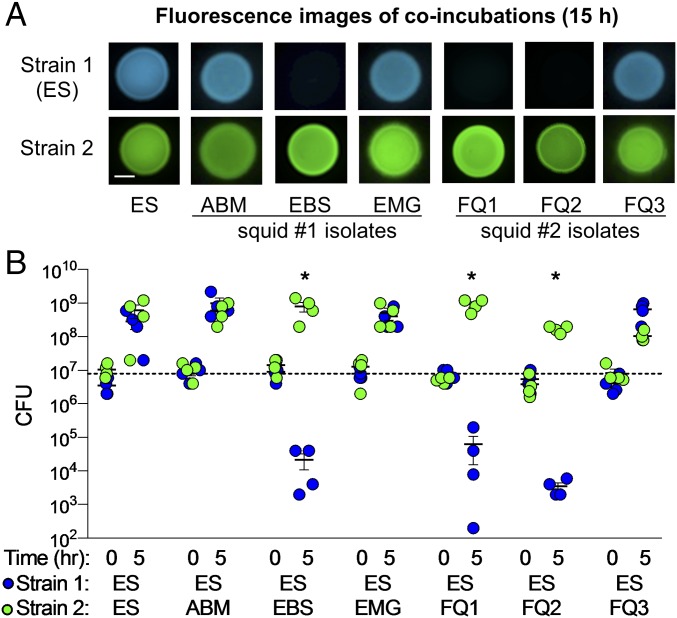
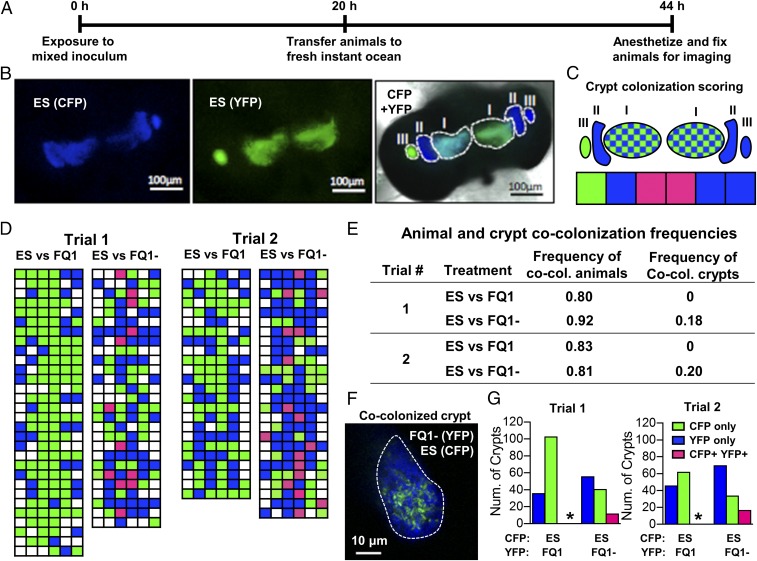
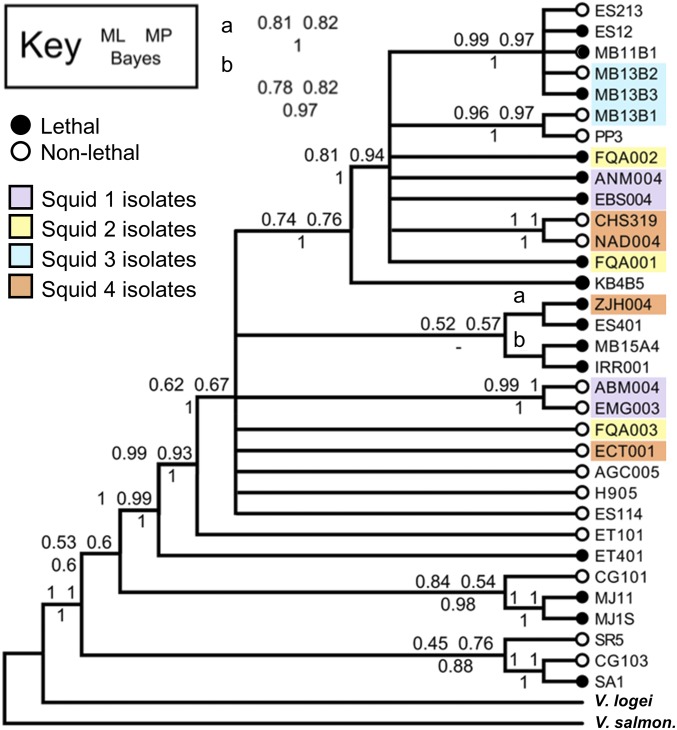
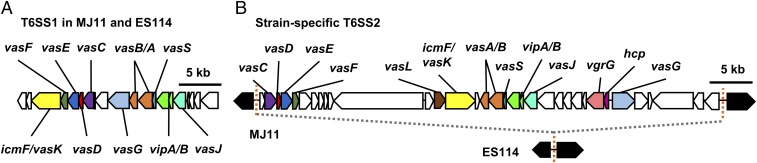
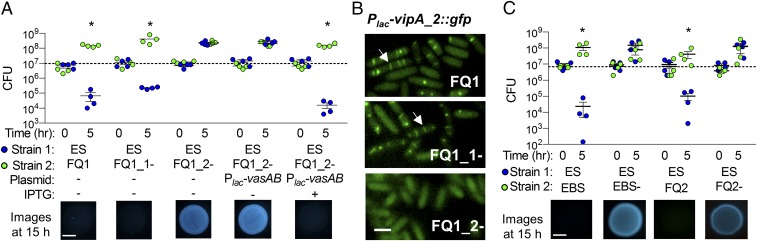
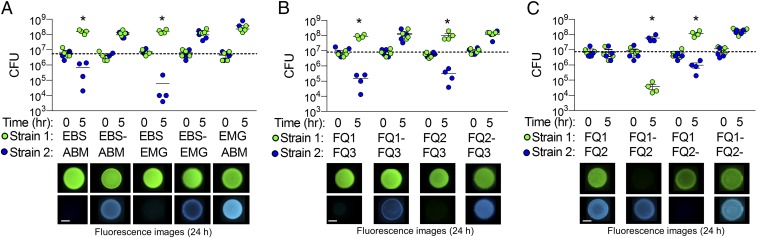
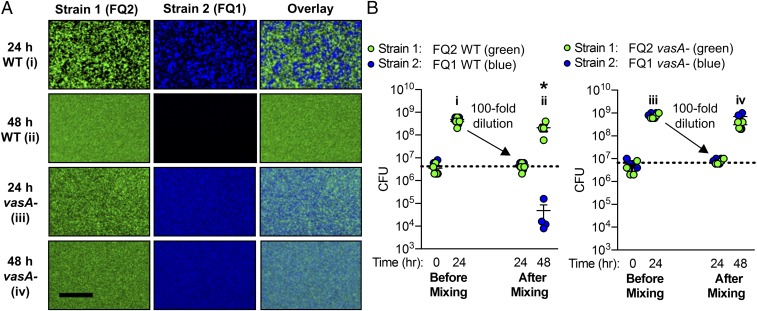
Intraspecific competition describes the negative interaction that occurs when different populations of the same species attempt to fill the same niche. Such competition is predicted to occur among host-associated bacteria but has been challenging to study in natural biological systems. Although many bioluminescent strains exist in seawater, only a few strains are found in the light-organ crypts of an individual wild-caught squid, suggesting a possible role for intraspecific competition during early colonization. Using a culture-based assay to investigate the interactions of different strains, we found "lethal" and "nonlethal" isolates that could kill or not kill the well-studied light-organ isolate ES114, respectively. The killing phenotype of these lethal strains required a type VI secretion system (T6SS) encoded in a 50-kb genomic island. Multiple lethal and nonlethal strains could be cultured from the light organs of individual wild-caught adult squid. Although lethal strains eliminate nonlethal strains in vitro, two lethal strains could coexist in interspersed microcolonies that formed in a T6SS-dependent manner. This coexistence was destabilized upon physical mixing, resulting in one lethal strain consistently eliminating the other. When juvenile squid were coinoculated with lethal and nonlethal strains, they occupied different crypts, yet they were observed to coexist within crypts when T6SS function was disrupted. These findings, using a combination of natural isolates and experimental approaches in vitro and in the animal host, reveal the importance of T6SS in spatially separating strains during the establishment of host colonization in a natural symbiosis.
种内竞争描述了当同一物种的不同种群试图占据相同生态位时发生的负相互作用。这种竞争预计会在宿主相关细菌中发生,但在自然生物系统中研究起来具有挑战性。尽管海水中存在许多发光菌株,但在个体野生捕获鱿鱼的发光器官隐窝中仅发现少数菌株,这表明在早期定植过程中可能存在种内竞争。使用基于培养的测定法来研究不同菌株的相互作用,我们发现了“致死”和“非致死”分离株,它们分别可以杀死或不杀死经过充分研究的发光器官分离株 ES114。这些致死菌株的杀伤表型需要一种编码在 50kb 基因组岛上的 VI 型分泌系统(T6SS)。可以从个体野生捕获的成年鱿鱼的发光器官中培养出多种致死和非致死菌株。尽管致死菌株在体外消除非致死菌株,但两种致死菌株可以以 T6SS 依赖的方式共存于交错的微菌落中。这种共存在物理混合后变得不稳定,导致一种致死菌株持续消除另一种。当幼鱿鱼同时接种致死和非致死菌株时,它们占据不同的隐窝,但当 T6SS 功能被破坏时,它们被观察到在隐窝内共存。这些发现使用了自然分离株以及在体外和动物宿主中进行的实验方法的组合,揭示了 T6SS 在自然共生体中定植宿主时在空间上分离菌株的重要性。