Wisconsin Institute for Discovery, Madison, WI 53715.
Department of Plant Pathology, University of Wisconsin-Madison, Madison, WI 53706.
Proc Natl Acad Sci U S A. 2022 Oct 18;119(42):e2212930119. doi: 10.1073/pnas.2212930119. Epub 2022 Oct 10.
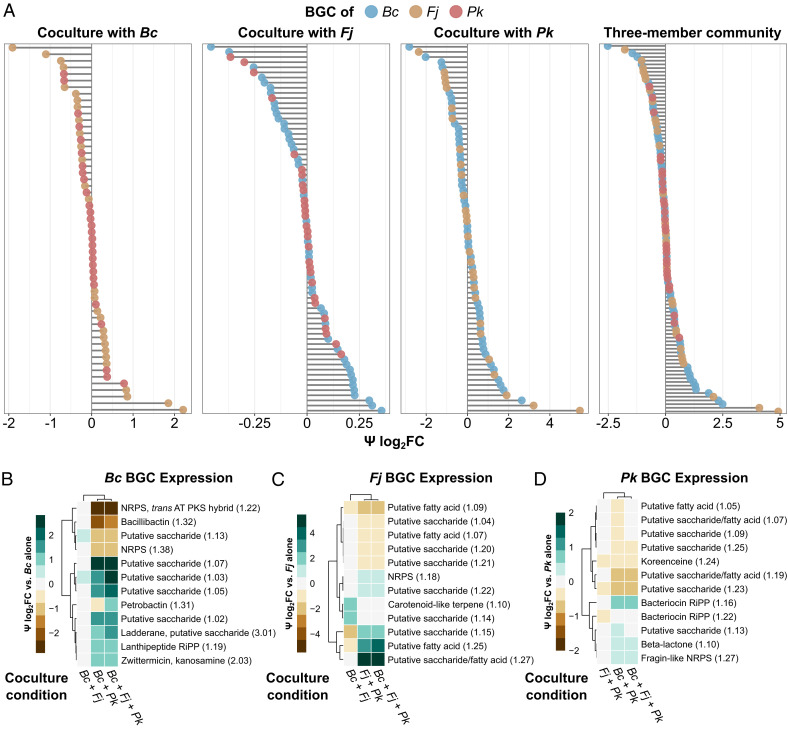
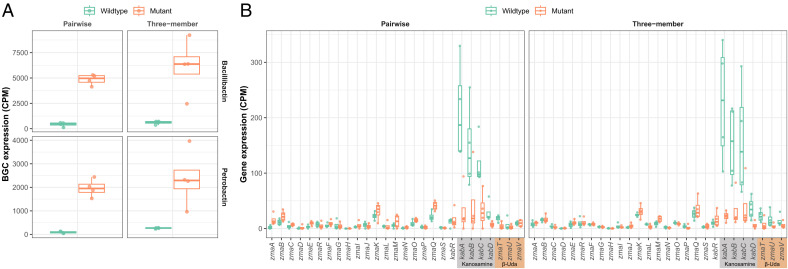
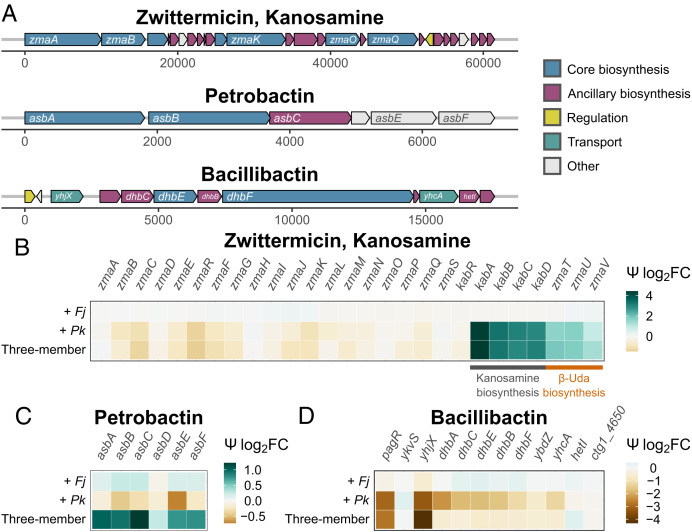
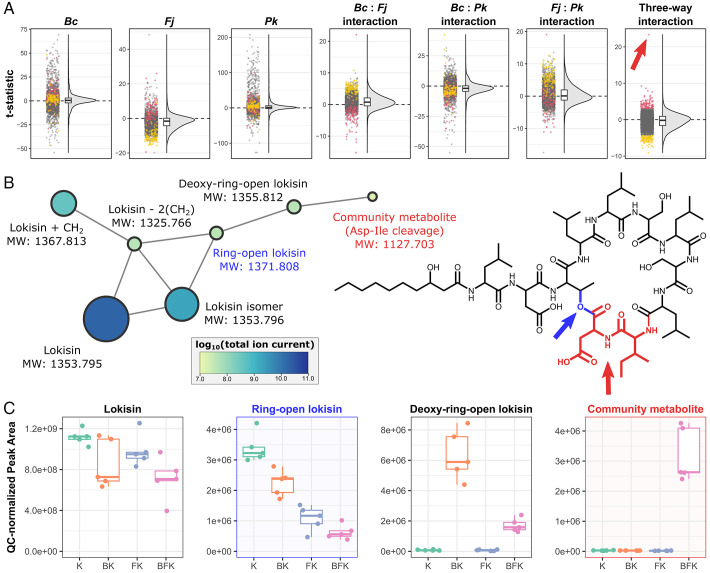
Bacterial secondary metabolites are a major source of antibiotics and other bioactive compounds. In microbial communities, these molecules can mediate interspecies interactions and responses to environmental change. Despite the importance of secondary metabolites in human health and microbial ecology, little is known about their roles and regulation in the context of multispecies communities. In a simplified model of the rhizosphere composed of , , and , we show that the dynamics of secondary metabolism depend on community species composition and interspecies interactions. Comparative metatranscriptomics and metametabolomics reveal that the abundance of transcripts of biosynthetic gene clusters (BGCs) and metabolomic molecular features differ between monocultures or dual cultures and a tripartite community. In both two- and three-member cocultures, modified expression of BGCs for zwittermicin, petrobactin, and other secondary metabolites in and whereas the BGC transcriptional response to the community in itself was minimal. Pairwise and tripartite cocultures with displayed unique molecular features that appear to be derivatives of lokisin, suggesting metabolic handoffs between species. Deleting the BGC for koreenceine, another metabolite, altered transcript and metabolite profiles across the community, including substantial up-regulation of the petrobactin and bacillibactin BGCs in , suggesting that koreenceine represses siderophore production. Results from this model community show that bacterial BGC expression and chemical output depend on the identity and biosynthetic capacity of coculture partners, suggesting community composition and microbiome interactions may shape the regulation of secondary metabolism in nature.
细菌次生代谢物是抗生素和其他生物活性化合物的主要来源。在微生物群落中,这些分子可以介导种间相互作用和对环境变化的响应。尽管次生代谢物在人类健康和微生物生态学中具有重要意义,但对于它们在多物种群落中的作用和调节机制知之甚少。在由 、 、 和 组成的简化根际模型中,我们表明次生代谢的动态取决于群落的物种组成和种间相互作用。比较宏转录组学和代谢组学揭示了生物合成基因簇(BGCs)的转录物丰度和代谢组分子特征在单培养物或双培养物和三元群落之间存在差异。在两成员和三成员共培养物中, 分别修饰了 和 中 zwittermicin、petrobactin 和其他次生代谢物的 BGC 表达,而 BGC 对 自身群落的转录响应则最小。与 进行的两两和三元共培养显示出独特的分子特征,这些特征似乎是 lokisin 的衍生物,表明物种之间存在代谢转移。删除另一种 代谢产物 koreenceine 的 BGC 会改变整个群落的转录物和代谢物图谱,包括 在 petrobactin 和 bacillibactin BGC 中的大量上调,表明 koreenceine 抑制了铁载体的产生。该模型群落的结果表明,细菌 BGC 的表达和化学产物输出取决于共培养伙伴的身份和生物合成能力,这表明群落组成和微生物组相互作用可能会影响次生代谢的调控。