Experimental Center of Clinical Research, The First Affiliated Hospital of Anhui University of Chinese Medicine, Hefei, Anhui 230031, P.R. China.
Department of Pharmacy, Anhui Provincial Hospital, Hefei, Anhui 230001, P.R. China.
Int J Mol Med. 2019 Oct;44(4):1344-1356. doi: 10.3892/ijmm.2019.4281. Epub 2019 Jul 22.
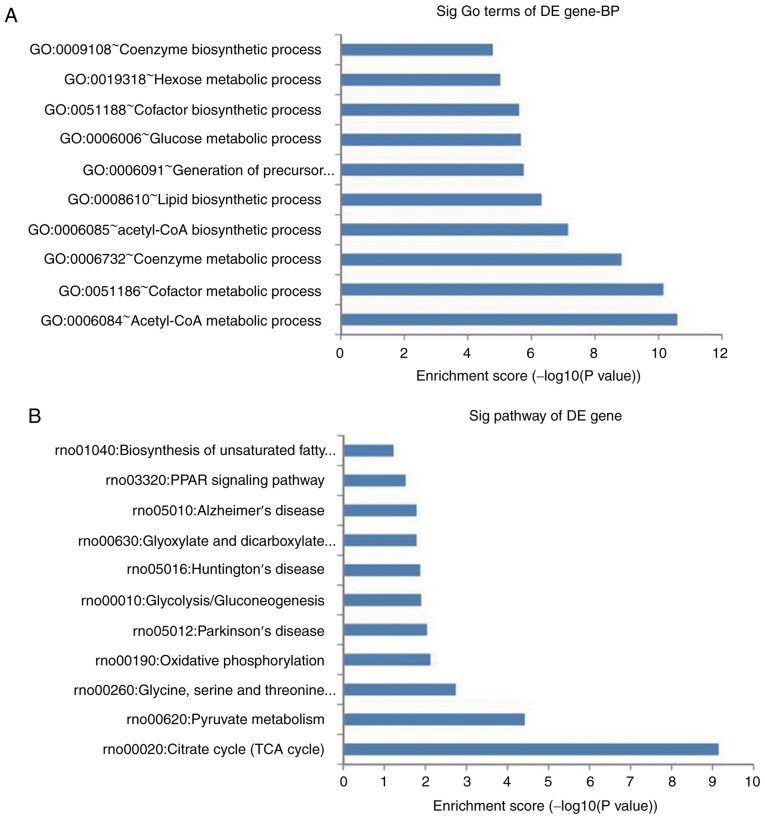
Rheumatoid arthritis (RA) is an autoimmune disease of unknown etiology, which occurs in ~1.0% of the general population. Increasing studies have suggested that long non‑coding RNAs (lncRNAs) may serve important roles in various biological processes and may be associated with the pathogenesis of different types of disease, including RA. Astragalosides (AST) has been used as a traditional Chinese medicine for the treatment of RA. However, the mechanism underlying its therapeutic effect has remained unclear to date. Thus, there is an urgent need to elucidate the possible mechanism of AST in the treatment of RA from the perspective of lncRNAs. In the present study, the lncRNAs and mRNAs of a vehicle group, animal model group and AST treatment (control) group were determined by Arraystar Rat lncRNA/mRNA microarray. The differentially expressed genes with a fold change >1.5 and P<0.05 were selected and analyzed. Gene Ontology (GO) and pathway analysis was performed using the Database for Annotation, Visualization and Integration Discovery, and the coding‑non‑coding gene co‑expression network was drawn based on the correlation analysis between the differentially expressed lncRNAs and mRNAs. Based on node degree and the correlation between bioinformatics analysis and RA, the critical differentially expressed lncRNAs were selected, analyzed and verified by reverse transcription‑quantitative PCR (RT‑qPCR) analysis. The results showed that, following AST treatment, up to 75 lncRNAs and 247 mRNAs were found to be differentially expressed among the three groups. GO and pathway analysis manifested that 135 GO terms and 17 pathways were enriched by differentially expressed genes. Four lncRNAs (MRAK012530, MRAK132628, MRAK003448 and XR_006457) were selected as the critical lncRNAs and their trend in expression showed consistency between the RT‑qPCR and microarray data. In conclusion, AST had a regulatory effect on differentially expressed lncRNAs during the development of RA, and four lncRNAs could be selected as critical therapeutic targets of AST.
类风湿关节炎(RA)是一种病因不明的自身免疫性疾病,在普通人群中的发病率约为 1.0%。越来越多的研究表明,长链非编码 RNA(lncRNA)可能在各种生物学过程中发挥重要作用,并可能与包括 RA 在内的不同类型疾病的发病机制有关。黄芪甲苷(AST)已被用作治疗 RA 的中药。然而,其治疗效果的确切机制迄今仍不清楚。因此,迫切需要从 lncRNA 的角度阐明 AST 治疗 RA 的可能机制。在本研究中,通过 Arraystar Rat lncRNA/mRNA 微阵列检测了载体组、动物模型组和 AST 治疗(对照)组的 lncRNAs 和 mRNAs。选择差异表达基因倍数变化>1.5且 P<0.05,进行分析。采用数据库进行基因本体(GO)和通路分析,可视化和整合发现,并根据差异表达 lncRNA 和 mRNAs 之间的相关性绘制编码-非编码基因共表达网络。基于节点度和生物信息学分析与 RA 的相关性,选择关键差异表达 lncRNA 进行分析和验证,采用逆转录-定量 PCR(RT-qPCR)分析。结果表明,AST 治疗后,三组间差异表达的 lncRNA 多达 75 个,mRNA 多达 247 个。GO 和通路分析表明,差异表达基因富集了 135 个 GO 术语和 17 个通路。选择了 4 个 lncRNA(MRAK012530、MRAK132628、MRAK003448 和 XR_006457)作为关键 lncRNA,其表达趋势与 RT-qPCR 和微阵列数据一致。综上所述,AST 对 RA 发展过程中差异表达的 lncRNA 具有调节作用,可选择 4 个 lncRNA 作为 AST 的关键治疗靶点。