Lim Se Ra, Lee Do-Hun, Park Seon Young, Lee Seungki, Kim Hyo Yeon, Lee Moo-Seung, Lee Jung Ro, Han Jee Eun, Kim Hye Kwon, Kim Ji Hyung
Infectious Disease Research Center, Korea Research Institute of Bioscience and Biotechnology, Daejeon 34141, Korea.
Department of Biomolecular Science, KRIBB School of Bioscience, Korea University of Science and Technology (UST), Daejeon 34113, Korea.
Microorganisms. 2019 Jul 30;7(8):224. doi: 10.3390/microorganisms7080224.
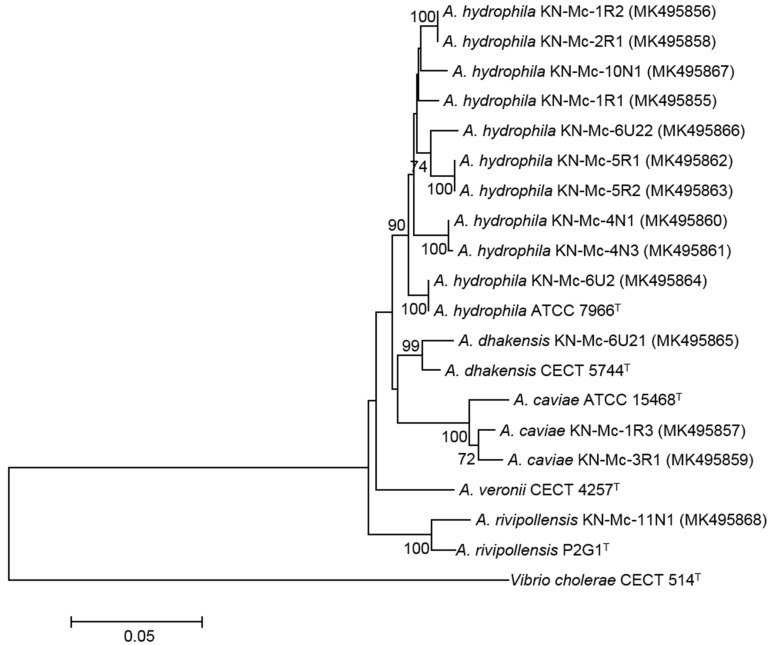
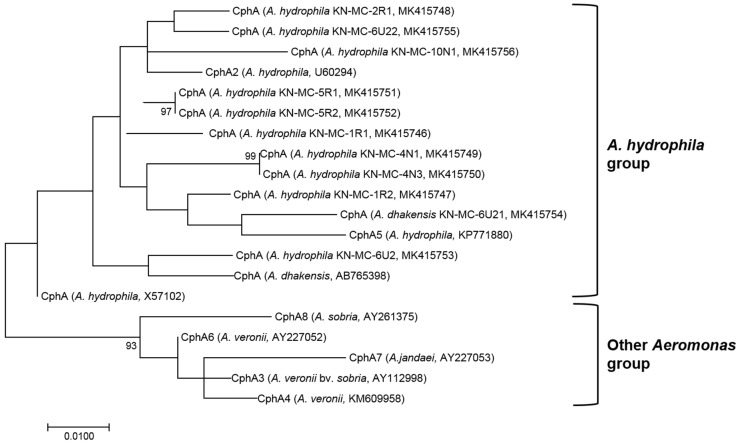
The emergence and spread of antibiotic-resistant spp. is a serious public and animal health concern. Wild animals serve as reservoirs, vectors, and sentinels of these bacteria and can facilitate their transmission to humans and livestock. The nutria (), a semi-aquatic rodent, currently is globally considered an invasive alien species that has harmful impacts on natural ecosystems and carries various zoonotic aquatic pathogens. This study aimed to determine the prevalence of antibiotic-resistant zoonotic spp. in wild invasive nutrias captured in Korea during governmental eradication program. Three potential zoonotic spp. (, , and ) were identified among isolates from nutria. Some strains showed unexpected resistance to fluoroquinolones, third-generation cephalosporins, and carbapenems. In carbapenem-resistant isolates, the gene, which is related to intrinsic resistance of to carbapenems, was identified, and phylogenetic analysis based on this gene revealed the presence of two major groups represented by (including ) and other spp. These results indicate that wild nutrias in Korea are a potential reservoir of zoonotic and antibiotic-resistant spp. that can cause infection and treatment failure in humans. Thus, measures to prevent contact of wild nutrias with livestock and humans are needed.
抗生素耐药性物种的出现和传播是严重的公共卫生和动物健康问题。野生动物是这些细菌的宿主、传播媒介和哨兵,可促使它们传播给人类和牲畜。海狸鼠是一种半水生啮齿动物,目前在全球被视为对自然生态系统有有害影响并携带各种人畜共患水生病原体的外来入侵物种。本研究旨在确定在韩国政府根除计划期间捕获的野生入侵海狸鼠中抗生素耐药性人畜共患病原体的流行情况。在海狸鼠的分离株中鉴定出三种潜在的人畜共患病原体(、和)。一些菌株对氟喹诺酮类、第三代头孢菌素和碳青霉烯类药物表现出意外的耐药性。在耐碳青霉烯类分离株中,鉴定出与对碳青霉烯类药物固有耐药性相关的基因,基于该基因的系统发育分析揭示了以(包括)和其他物种为代表的两个主要群体的存在。这些结果表明,韩国的野生海狸鼠是可能导致人类感染和治疗失败的人畜共患病原体和抗生素耐药性物种的潜在宿主。因此,需要采取措施防止野生海狸鼠与牲畜和人类接触。