Center of Clinical Laboratory, Beijing Friendship Hospital, Capital Medical University, Beijing, 100050, China.
Beijing Center for Disease Prevention and Control, Beijing, 100013, China.
BMC Infect Dis. 2019 Feb 14;19(1):158. doi: 10.1186/s12879-019-3766-0.
Clinical characteristics (taxonomy, virulence genes and antimicrobial resistance ) of Aeromonas in isolated from extra-intestinal and intestinal infections were investigated to describe epidemiology, associated virulence factors and optimal therapy options.
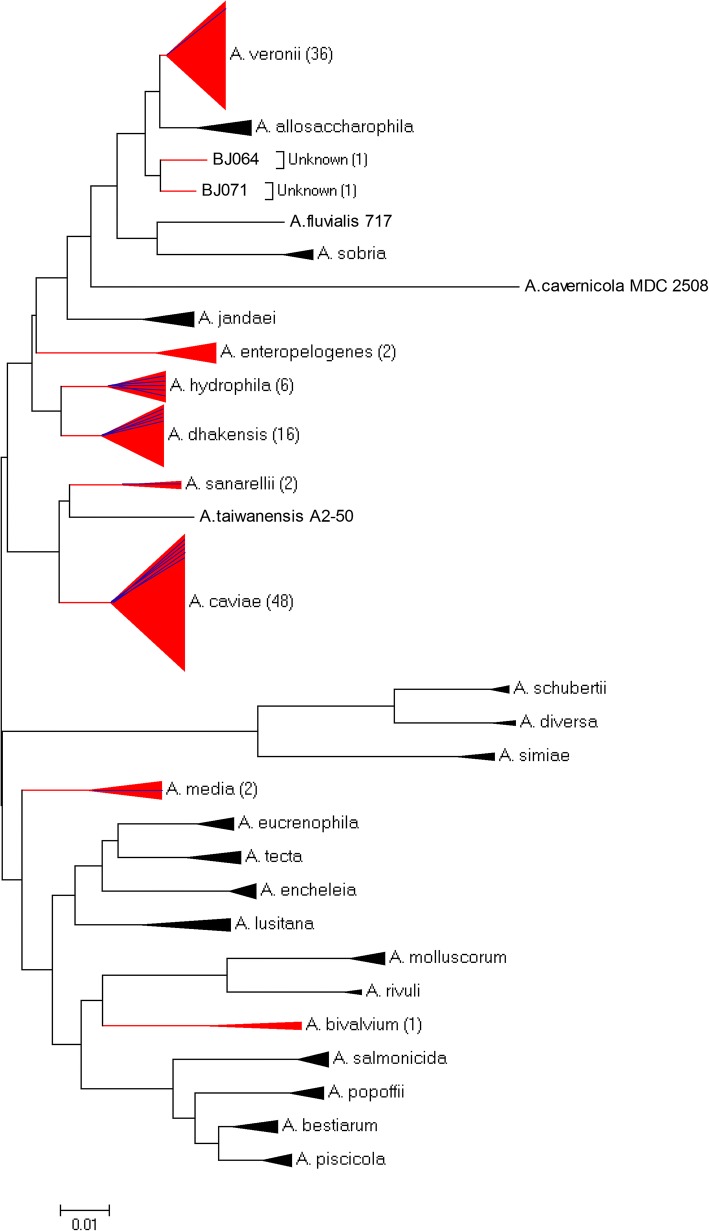
Clinical samples (n = 115) of Aeromonas were collected from a general hospital in Beijing between the period 2015 and 2017. Taxonomy was investigate by Multilocus phylogenetic analysis (MLPA), 10 putative virulence factors by use of polymerase chain reaction (PCR) and antimicrobial resistance to 15 antibiotics by use of the microbroth dilution method.
The most common species of Aeromonas detected in samples of intestinal tract included; A. caviae (43.9%), A. veronii (35.7%), and A. dhakensis (12.2%). Prevalent species of Aeromonas collected from extra-intestinal infections included; A. hydrophila (29.4%), A. caviae (29.4%), and A. dhakensis (23.5%). A. hydrophila were detected in 1% of stool samples and 29.4% (5/17) of extra-intestinal infections. A. hydrophila strains in extra-intestinal infections were related to malignancy. The most common medical conditions among patients with Aeromonas infections included malignancy and liver-transplant related cholecystitis. Multiple drug resistance (MDR) was prevalent in extra-intestinal isolates (82.3%, 14/17) and was greater than the prevalence in intestinal isolates (30.6%, 30/98) (P < 0.05). Resistant rates of extra-intestinal isolates were 70.6, 35.3, 23.5 and 5.9% for ceftriaxone, ciprofloxacin, gentamicin and imipenem, respectively, and were higher than found in previous studies. Despite differences in the number and type of virulence genes among samples of Aeromonas, no significant correlation was found between invasion and virulent genes in intestinal or extra-intestinal infections.
Overall results of this study support a role for Aeromonas spp. as a potential causative infectious agent of gastroenteritis, and malignancy, liver cirrhosis, post liver transplantation in immunocompromised patients. A. hydrophila was more prevalent in samples of extra-intestinal infections when compared to samples of intestinal infections, and was especially prominent in samples of patients presenting with malignancy. Aeromonas isolates from extra-intestinal samples had high rates of drug resistance but 3rd generation cephalosporins, fluoroquinolones and aminoglycosides remain as options to treat severe diarrhea. However, increasing MDR of extra-intestinal infection samples warrants monitoring.
本研究旨在调查从肠道外和肠道感染分离的气单胞菌的临床特征(分类、毒力基因和抗菌药物耐药性),以描述其流行病学、相关毒力因子和最佳治疗选择。
2015 年至 2017 年期间,我们从北京的一家综合医院收集了 115 份气单胞菌临床样本。通过多位点系统发育分析(MLPA)鉴定分类,使用聚合酶链反应(PCR)检测 10 种潜在的毒力因子,使用微量肉汤稀释法检测 15 种抗生素的抗菌药物耐药性。
从肠道样本中检测到的最常见气单胞菌包括;豚鼠气单胞菌(43.9%)、维隆气单胞菌(35.7%)和达克阿克森气单胞菌(12.2%)。从肠道外感染样本中分离到的流行气单胞菌包括;嗜水气单胞菌(29.4%)、豚鼠气单胞菌(29.4%)和达克阿克森气单胞菌(23.5%)。嗜水气单胞菌在 1%的粪便样本和 29.4%(5/17)的肠道外感染中被检出。肠道外感染中的嗜水气单胞菌与恶性肿瘤有关。气单胞菌感染患者最常见的医疗条件包括恶性肿瘤和与肝移植相关的胆囊炎。肠道外分离株的多重耐药(MDR)发生率较高(82.3%,14/17),高于肠道分离株(30.6%,30/98)(P<0.05)。肠道外分离株的耐药率分别为头孢曲松 70.6%、环丙沙星 35.3%、庆大霉素 23.5%和亚胺培南 5.9%,高于以往研究。尽管气单胞菌样本中侵袭性和毒力基因的数量和类型存在差异,但在肠道或肠道外感染中未发现侵袭性和毒力基因之间存在显著相关性。
本研究的总体结果支持气单胞菌作为潜在的胃肠道感染病原体的作用,与恶性肿瘤、肝硬化、免疫功能低下的肝移植后患者有关。与肠道感染样本相比,嗜水气单胞菌在肠道外感染样本中更为常见,尤其在患有恶性肿瘤的患者样本中更为突出。肠道外样本分离株的耐药率较高,但第三代头孢菌素、氟喹诺酮类和氨基糖苷类仍可作为严重腹泻的治疗选择。然而,肠道外感染样本中不断增加的 MDR 值得监测。