School of Chinese Medicine, China Medical University, Taichung, 40402, Taiwan, Republic of China.
Virol J. 2019 Jul 31;16(1):94. doi: 10.1186/s12985-019-1203-z.
Although enterovirus 71 (EV71) is an important public health threat, especially in the Asia-Pacific region, there are still no effective drugs or vaccines to treat and prevent EV71 infection. Therefore, it is critical to develop prophylactic and therapeutic agents against EV71. Rosmarinic acid (RA), a phytochemical, has been discovered to possess a broad spectrum of biological activities.
The virucidal effects of RA on EV71 were determined by MTT, western blot, median cell culture infectious dose, apoptosis detection, plaque reduction, semi-quantitative real-time polymerase chain reaction, immunofluorescence detection, molecular docking analysis, and mouse protection assay.
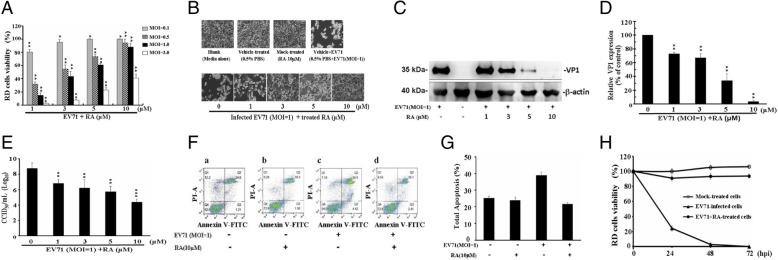
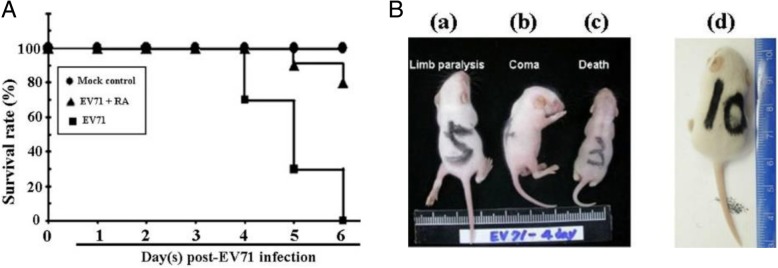
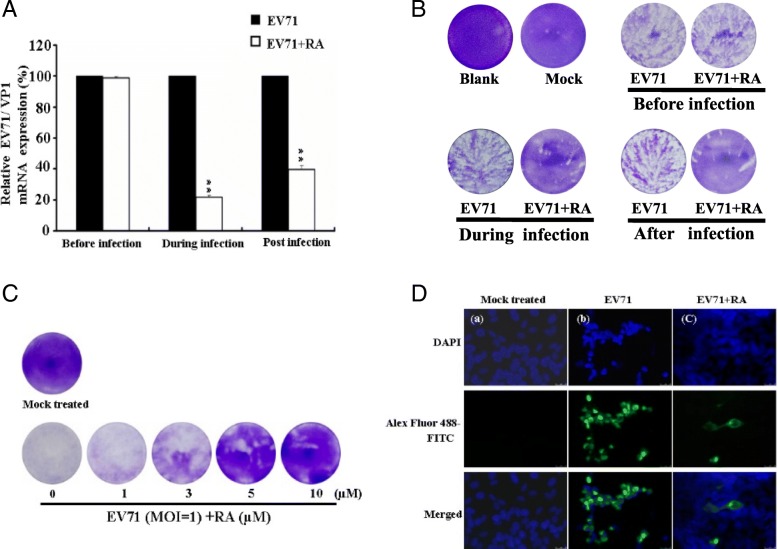
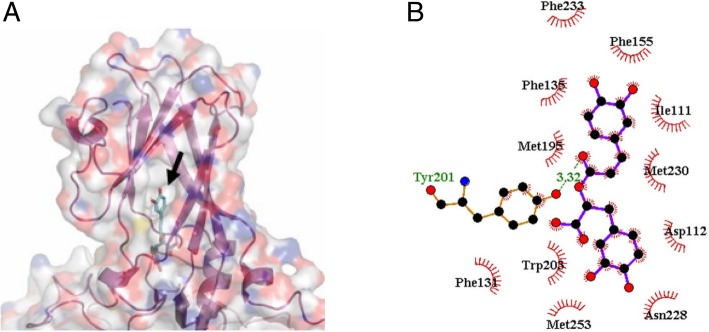
RA showed a strong protective effect against EV71 infection in human rhabdomyosarcoma cells when the multiplicity of infection was 1, with a low IC value (4.33 ± 0.18 μM) and high therapeutic index (340). RA not only protected cells from EV71-induced cytopathic effects, but also from EV71-induced apoptosis. The results of time-of-addition analysis demonstrated that the inhibitory activity of RA was highest at the early stage of viral infection. Consistent with this, the infectivity of EV71 in the early stage of viral infection also was observed to be limited in neonatal mice treated with RA. Further, molecular docking predicts that RA could replace the natural pocket factor within the VP1 capsid-binding hydrophobic pocket.
This study suggests that RA has the potential to be developed as an antiviral agent against initial EV71 infection to prevent or reduce EV71-induced pathogenesis and complications, since RA can effectively reduce EV71 infection in the early stages of viral infection.
肠道病毒 71 型(EV71)是一种重要的公共卫生威胁,尤其是在亚太地区,但目前尚无有效的药物或疫苗来治疗和预防 EV71 感染。因此,开发针对 EV71 的预防和治疗药物至关重要。迷迭香酸(RA)是一种植物化学物质,已被发现具有广泛的生物活性。
通过 MTT、western blot、半数细胞培养感染剂量、凋亡检测、蚀斑减少、半定量实时聚合酶链反应、免疫荧光检测、分子对接分析和小鼠保护试验来确定 RA 对 EV71 的病毒杀灭作用。
RA 在感染复数为 1 时对人横纹肌肉瘤细胞中的 EV71 感染表现出很强的保护作用,IC 值低(4.33±0.18 μM),治疗指数高(340)。RA 不仅能保护细胞免受 EV71 诱导的细胞病变效应,还能保护细胞免受 EV71 诱导的凋亡。加药时间分析结果表明,RA 的抑制活性在病毒感染的早期阶段最高。与此一致的是,RA 处理的新生小鼠中,早期病毒感染阶段的 EV71 感染性也受到限制。进一步的分子对接预测,RA 可以替代 VP1 衣壳结合疏水性口袋中的天然口袋因子。
本研究表明,RA 具有作为抗初始 EV71 感染的抗病毒药物开发潜力,以预防或减少 EV71 引起的发病机制和并发症,因为 RA 可以在病毒感染的早期阶段有效减少 EV71 感染。