Department of Plant Sciences, University of Oxford, South Parks Road, Oxford, OX1 3RB, UK.
Sainsbury Laboratory, University of Cambridge, Bateman Street, Cambridge, CB2 1LR, UK.
Nat Commun. 2019 Jul 31;10(1):3430. doi: 10.1038/s41467-019-10882-x.
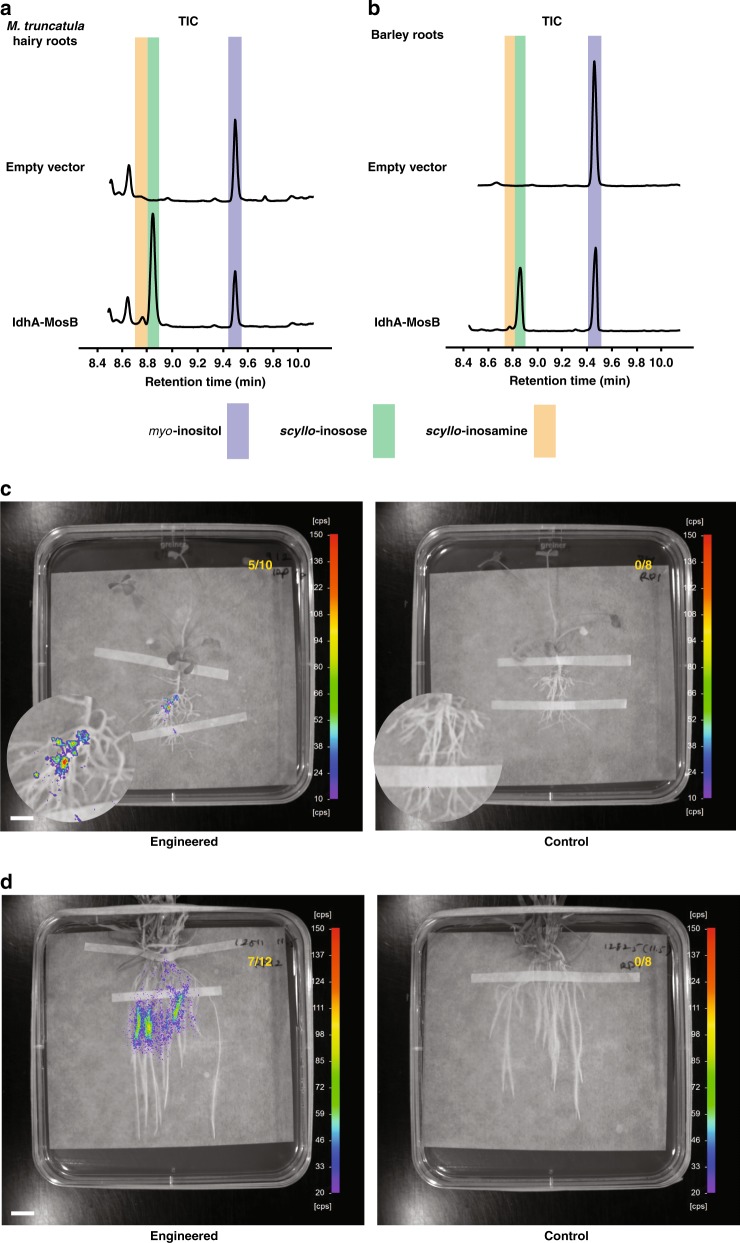
The root microbiota is critical for agricultural yield, with growth-promoting bacteria able to solubilise phosphate, produce plant growth hormones, antagonise pathogens and fix N. Plants control the microorganisms in their immediate environment and this is at least in part through direct selection, the immune system, and interactions with other microorganisms. Considering the importance of the root microbiota for crop yields it is attractive to artificially regulate this environment to optimise agricultural productivity. Towards this aim we express a synthetic pathway for the production of the rhizopine scyllo-inosamine in plants. We demonstrate the production of this bacterial derived signal in both Medicago truncatula and barley and show its perception by rhizosphere bacteria, containing bioluminescent and fluorescent biosensors. This study lays the groundwork for synthetic signalling networks between plants and bacteria, allowing the targeted regulation of bacterial gene expression in the rhizosphere for delivery of useful functions to plants.
根际微生物群落对农业产量至关重要,因为促生长细菌能够溶解磷酸盐、产生植物生长激素、拮抗病原体和固氮。植物控制其直接环境中的微生物,这至少部分是通过直接选择、免疫系统和与其他微生物的相互作用来实现的。考虑到根际微生物群落对作物产量的重要性,人为调节这种环境以优化农业生产力是很有吸引力的。为此,我们在植物中表达了用于生产 scyllo-肌醇六磷酸的合成途径。我们证明了这种细菌衍生信号在苜蓿和大麦中的产生,并通过含有生物发光和荧光生物传感器的根际细菌证明了其感知。这项研究为植物和细菌之间的合成信号网络奠定了基础,允许在根际靶向调节细菌基因表达,以向植物传递有用的功能。