Turner Anastasia, Zhao Linlu, Gauthier Paul, Chen Suzan, Roffey Darren M, Wai Eugene K
Faculty of Medicine, University of Ottawa, 451 Smyth Road, Ottawa, ON K1H8L1, Canada.
Ottawa Spine Collaborative Analytics Network, The Ottawa Hospital, Ottawa, ON, Canada.
Ther Adv Infect Dis. 2019 Jul 19;6:2049936119863940. doi: 10.1177/2049936119863940. eCollection 2019 Jan-Dec.
Cervical spinal epidural abscess (CSEA) is a localized infection between the thecal sac and cervical spinal column which may result in neurological deficit and death if inadequately treated. Two treatment options exist: medical management and surgical intervention. Our objective was to analyze CSEA patient outcomes in order to determine the optimal method of treatment.
An electronic literature search for relevant case series and retrospective reviews was conducted through June 2016. Data abstraction and study quality assessment were performed by two independent reviewers. A lack of available data led to a post hoc decision not to perform meta-analysis of the results; study findings were synthesized qualitatively.
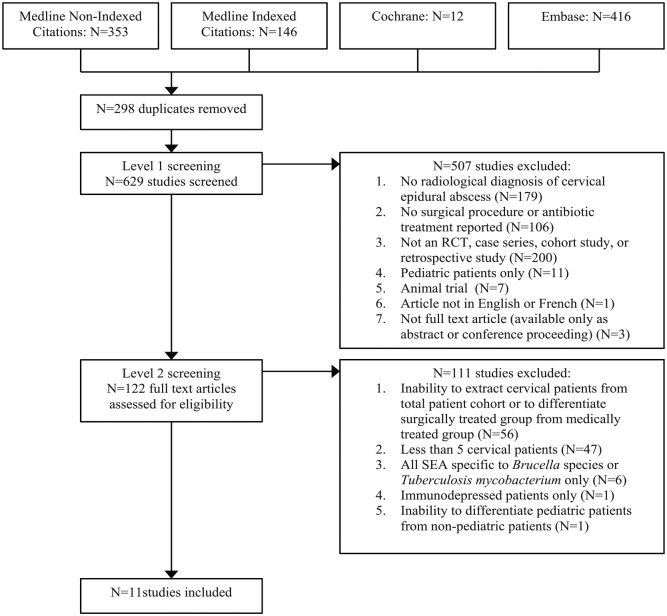
927 studies were identified, of which 11 were included. Four studies were ranked as good quality, and seven ranked as fair quality. In total, data from 173 patients were included. Mean age was 55 years; 61.3% were male. Intravenous drug use was the most common risk factor for CSEA development. was the most commonly cultured pathogen. 140 patients underwent initial surgery, an additional 18 patients were surgically treated upon failure of medical management, and 15 patients were treated with antibiotics alone.
The rates of medical management failure described in our review were much higher than those reported in the literature for thoracolumbar spinal epidural abscess patients, suggesting that CSEA patients may be at a greater risk for poor outcomes following nonoperative treatment. Thus, early surgery appears most viable for optimizing CSEA patient outcomes. Further research is needed in order to corroborate these recommendations.
颈椎硬膜外脓肿(CSEA)是硬脊膜囊与颈椎柱之间的局部感染,如果治疗不当可能导致神经功能缺损和死亡。存在两种治疗选择:药物治疗和手术干预。我们的目的是分析CSEA患者的预后,以确定最佳治疗方法。
通过检索截至2016年6月的电子文献,查找相关病例系列和回顾性研究。由两名独立的审阅者进行数据提取和研究质量评估。由于缺乏可用数据,事后决定不对结果进行荟萃分析;对研究结果进行定性综合。
共识别出927项研究,其中11项被纳入。4项研究被评为高质量,7项被评为中等质量。总共纳入了173例患者的数据。平均年龄为55岁;61.3%为男性。静脉吸毒是CSEA发生最常见的危险因素。 是最常培养出的病原体。140例患者接受了初次手术,另外18例患者在药物治疗失败后接受了手术治疗,15例患者仅接受了抗生素治疗。
我们的综述中描述的药物治疗失败率远高于文献中报道的胸腰椎硬膜外脓肿患者的失败率,这表明CSEA患者非手术治疗后预后不良的风险可能更高。因此,早期手术似乎是优化CSEA患者预后的最可行方法。需要进一步研究以证实这些建议。