Connell Alistair, Black Georgia, Montgomery Hugh, Martin Peter, Nightingale Claire, King Dominic, Karthikesalingam Alan, Hughes Cían, Back Trevor, Ayoub Kareem, Suleyman Mustafa, Jones Gareth, Cross Jennifer, Stanley Sarah, Emerson Mary, Merrick Charles, Rees Geraint, Laing Christopher, Raine Rosalind
Centre for Human Health and Performance, University College London, London, United Kingdom.
DeepMind Health, London, United Kingdom.
J Med Internet Res. 2019 Jul 15;21(7):e13143. doi: 10.2196/13143.
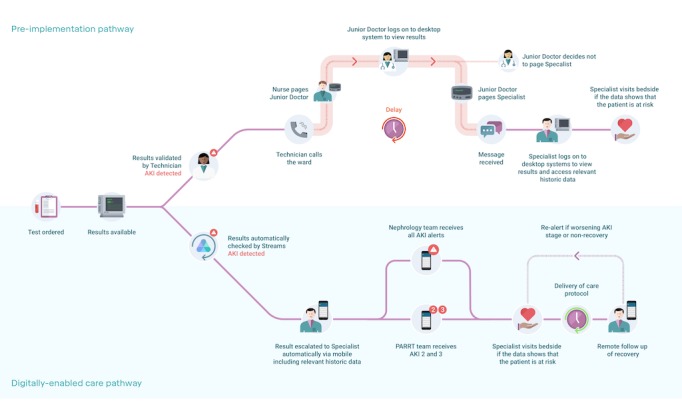
One reason for the introduction of digital technologies into health care has been to try to improve safety and patient outcomes by providing real-time access to patient data and enhancing communication among health care professionals. However, the adoption of such technologies into clinical pathways has been less examined, and the impacts on users and the broader health system are poorly understood. We sought to address this by studying the impacts of introducing a digitally enabled care pathway for patients with acute kidney injury (AKI) at a tertiary referral hospital in the United Kingdom. A dedicated clinical response team-comprising existing nephrology and patient-at-risk and resuscitation teams-received AKI alerts in real time via Streams, a mobile app. Here, we present a qualitative evaluation of the experiences of users and other health care professionals whose work was affected by the implementation of the care pathway.
The aim of this study was to qualitatively evaluate the impact of mobile results viewing and automated alerting as part of a digitally enabled care pathway on the working practices of users and their interprofessional relationships.
A total of 19 semistructured interviews were conducted with members of the AKI response team and clinicians with whom they interacted across the hospital. Interviews were analyzed using inductive and deductive thematic analysis.
The digitally enabled care pathway improved access to patient information and expedited early specialist care. Opportunities were identified for more constructive planning of end-of-life care due to the earlier detection and alerting of deterioration. However, the shift toward early detection also highlighted resource constraints and some clinical uncertainty about the value of intervening at this stage. The real-time availability of information altered communication flows within and between clinical teams and across professional groups.
Digital technologies allow early detection of adverse events and of patients at risk of deterioration, with the potential to improve outcomes. They may also increase the efficiency of health care professionals' working practices. However, when planning and implementing digital information innovations in health care, the following factors should also be considered: the provision of clinical training to effectively manage early detection, resources to cope with additional workload, support to manage perceived information overload, and the optimization of algorithms to minimize unnecessary alerts.
将数字技术引入医疗保健的一个原因是试图通过提供对患者数据的实时访问以及加强医疗保健专业人员之间的沟通来提高安全性和改善患者预后。然而,此类技术在临床路径中的应用较少受到审视,其对用户和更广泛医疗系统的影响也知之甚少。我们试图通过研究在英国一家三级转诊医院为急性肾损伤(AKI)患者引入数字化护理路径的影响来解决这一问题。一个由现有的肾脏病学、高危患者和复苏团队组成的专门临床反应团队通过一款名为Streams的移动应用程序实时接收AKI警报。在此,我们对受护理路径实施影响的用户和其他医疗保健专业人员的体验进行了定性评估。
本研究的目的是定性评估作为数字化护理路径一部分的移动结果查看和自动警报对用户工作实践及其跨专业关系的影响。
对AKI反应团队成员以及他们在医院内与之互动的临床医生进行了总共19次半结构化访谈。使用归纳和演绎主题分析法对访谈进行分析。
数字化护理路径改善了患者信息的获取并加快了早期专科护理。由于更早地检测到病情恶化并发出警报,为临终护理的更具建设性的规划创造了机会。然而,向早期检测的转变也凸显了资源限制以及在此阶段进行干预的价值存在一些临床不确定性。信息的实时可用性改变了临床团队内部、之间以及不同专业群体之间的沟通流程。
数字技术能够早期检测不良事件和有病情恶化风险的患者,有可能改善预后。它们还可能提高医疗保健专业人员的工作效率。然而,在规划和实施医疗保健中的数字信息创新时,还应考虑以下因素:提供临床培训以有效管理早期检测、应对额外工作量的资源、管理感知到的信息过载的支持,以及优化算法以尽量减少不必要的警报。