Department of Neurology, Clinic for Rehabilitation Münster, Münster, Austria.
Karl Landsteiner Institut für Interdisziplinäre Forschung am Reha Zentrum Münster, Münster, Austria.
PLoS One. 2019 Aug 1;14(8):e0220613. doi: 10.1371/journal.pone.0220613. eCollection 2019.
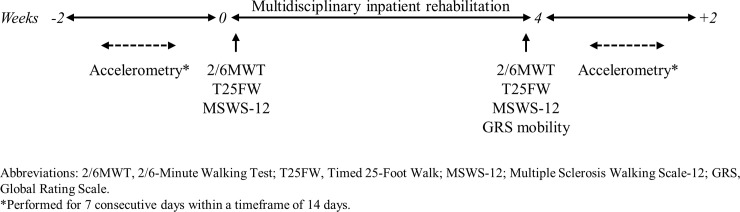
Walking capacity tests are commonly used to evaluate interventions aiming at reducing walking impairment in people with multiple sclerosis (pwMS). However, their ecological validity has recently been questioned. The aim of the present study was to investigate the ecological validity of the 2- and 6-minutes walking tests (2MWT and 6MWT) and the timed 25-foot walk (T25FW) after 28 days of multidisciplinary inpatient rehabilitation (MIR) in pwMS using accelerometry.
PwMS wore an accelerometer on 7 consecutive days within a 14-day period prior to MIR, performed 2/6MWT and T25FW at the beginning and at the end of MIR, followed by another 7 consecutive days of accelerometry.
Significant improvements in 2/6MWT and T25FW after MIR in a cohort of 76 pwMS (mean age = 47.9, SD 8.3 years) were overall correlated to a significant gain in everyday life mobility (total steps/day). However, the correlation was strongly dependent on pre-existing walking disability defined by EDSS and only pwMS with "mild" walking impairment (EDSS 2-3.5) were able to transfer benefits measurable by walking capacity tests into improved everyday life mobility, while pwMS with "moderate to severe" walking disability (EDSS 4-6.5) were not.
Ecological validity of changes in walking capacity tests following MIR is strongly dependent on pre-existing walking impairment.
步行能力测试常用于评估旨在减少多发性硬化症(pwMS)患者步行障碍的干预措施。然而,它们的生态有效性最近受到了质疑。本研究的目的是使用加速度计调查 2 分钟和 6 分钟步行测试(2MWT 和 6MWT)以及定时 25 英尺步行(T25FW)在多发性硬化症患者 28 天多学科住院康复(MIR)后的生态有效性。
pwMS 在 MIR 前 14 天的 7 天内连续佩戴加速度计,在 MIR 前后进行 2/6MWT 和 T25FW,然后再进行 7 天连续佩戴加速度计。
在 MIR 后,76 名 pwMS(平均年龄=47.9,SD 8.3 岁)的 2/6MWT 和 T25FW 均有显著改善,与日常生活活动中移动性(总步数/天)的显著提高总体相关。然而,这种相关性强烈依赖于 EDSS 定义的先前存在的步行障碍,只有“轻度”步行障碍(EDSS 2-3.5)的 pwMS 能够将可测量步行能力测试的获益转化为日常生活活动中移动性的改善,而“中度至重度”步行障碍(EDSS 4-6.5)的 pwMS 则不能。
MIR 后步行能力测试变化的生态有效性强烈依赖于先前存在的步行障碍。