Department of Sport Science and Sport, Friedrich-Alexander University Erlangen-Nürnberg, 91058 Erlangen, Germany.
Department of Education, University of Regensburg, 93040 Regensburg, Germany.
Int J Environ Res Public Health. 2020 Dec 4;17(23):9044. doi: 10.3390/ijerph17239044.
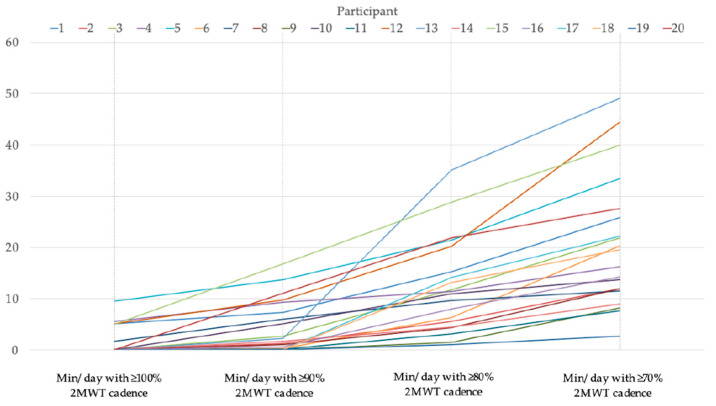
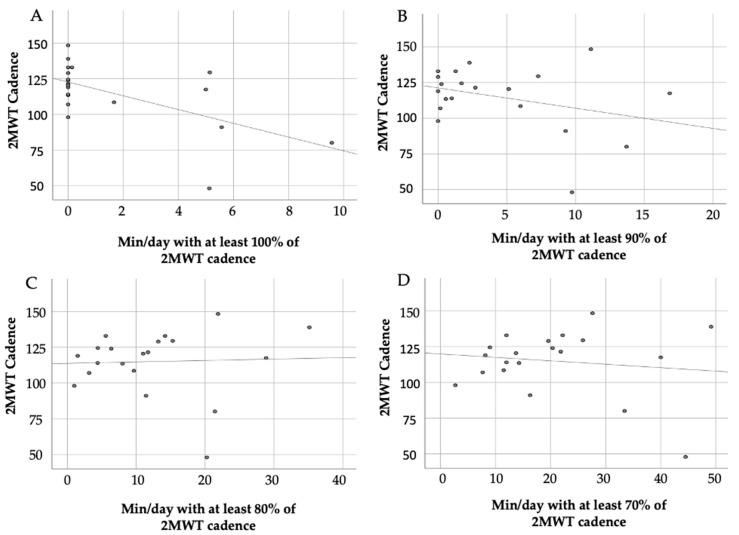
The two-minute walk test (2MWT) is a frequently used walking capacity test in persons with multiple sclerosis (pwMS). However, less is known about its relevance with regards to walking capacity during free-living walking performance. Therefore, the ecological validity of the 2MWT was tested by 1. computing free-living minutes with the same intensity (cadence) as during the 2MWT and 2. investigating the relationship between 2MWT cadence and minutes with the same cadence during free-living walking. 20 pwMS aged 44.2 ± 12.2 (Expanded Disability Status Scale (EDSS) score of 3.1 ± 1.4) performed a 2MWT and wore an accelerometer for seven days. The number of pwMS reaching 100%, 90%, 80% or 70% of 2MWT cadence for at least one minute a day and minutes/day with at least 100%, 90%, 80% and 70% of 2MWT cadence during free-living walking was calculated. Six participants reached 100% of the 2MWT cadence for at least one minute/day during free-living walking. A total of 80% 2MWT cadence was the first intensity category that was reached by all participants during free-living walking. No significant correlation was found between cadence in the 2MWT and minutes in which this cadence was reached during free-living walking. Ecological validity with regard to walking intensity could not be confirmed in our study sample.
两分钟步行测试(2MWT)是多发性硬化症患者(pwMS)常用的步行能力测试。然而,对于其与自由行走时步行能力的相关性知之甚少。因此,通过以下两种方式来测试 2MWT 的生态有效性:1. 计算与 2MWT 相同强度(步频)的自由行走分钟数;2. 研究 2MWT 步频与自由行走时相同步频的分钟数之间的关系。20 名年龄 44.2 ± 12.2 岁(扩展残疾状况量表(EDSS)评分为 3.1 ± 1.4)的 pwMS 进行了 2MWT 测试,并佩戴加速度计进行了七天的测试。计算每天至少有一分钟达到 2MWT 步频的 100%、90%、80%或 70%的 pwMS 数量,以及每天至少有 100%、90%、80%和 70%的 2MWT 步频的分钟数。在自由行走期间,有 6 名参与者达到了 100%的 2MWT 步频,每天至少有一分钟。2MWT 步频的 80%是所有参与者在自由行走期间首次达到的强度类别。在 2MWT 中发现的步频与在此期间达到的分钟数之间没有显著相关性。在我们的研究样本中,无法确认步行强度的生态有效性。