Balasubramanyam Shashank, Shirazi Mahdi, Bloodgood Matthew A, Wu Longfei, Verheijen Marcel A, Vandalon Vincent, Kessels Wilhelmus M M, Hofmann Jan P, Bol Ageeth A
Department of Applied Physics and Laboratory for Inorganic Materials and Catalysis, Department of Chemical Engineering and Chemistry, Eindhoven University of Technology, 5600 MB Eindhoven, The Netherlands.
Eurofins Materials Science Netherlands B.V., High Tech Campus 11, 5656 AE Eindhoven, The Netherlands.
Chem Mater. 2019 Jul 23;31(14):5104-5115. doi: 10.1021/acs.chemmater.9b01008. Epub 2019 Jun 25.
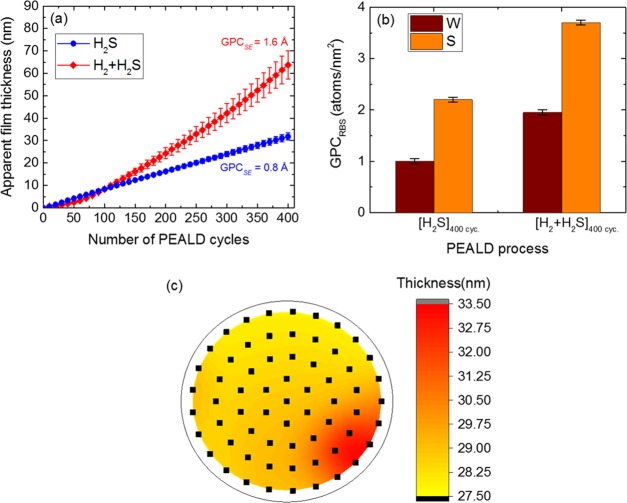
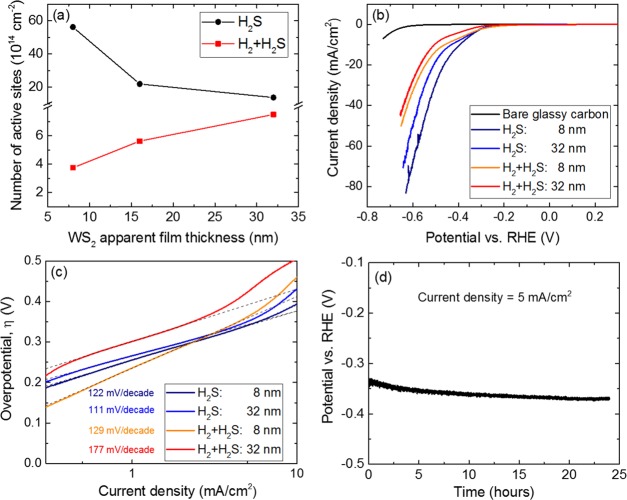
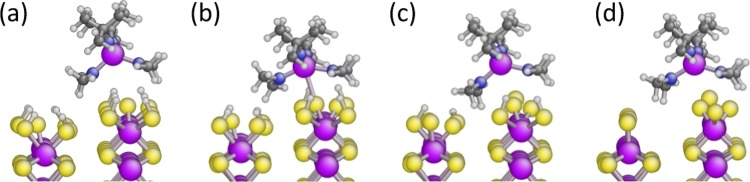
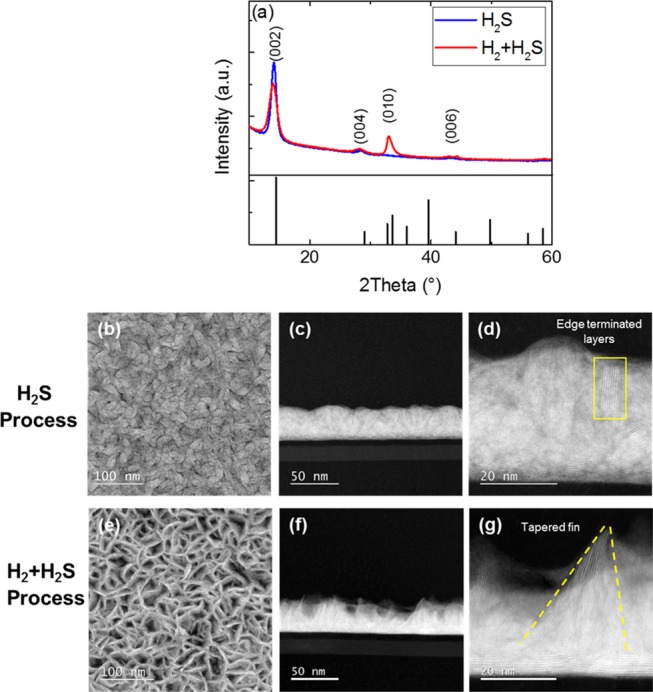
Edge-enriched transition metal dichalcogenides, such as WS, are promising electrocatalysts for sustainable production of H through the electrochemical hydrogen evolution reaction (HER). The reliable and controlled growth of such edge-enriched electrocatalysts at low temperatures has, however, remained elusive. In this work, we demonstrate how plasma-enhanced atomic layer deposition (PEALD) can be used as a new approach to nanoengineer and enhance the HER performance of WS by maximizing the density of reactive edge sites at a low temperature of 300 °C. By altering the plasma gas composition from HS to H + HS during PEALD, we could precisely control the morphology and composition and, consequently, the edge-site density as well as chemistry in our WS films. The precise control over edge-site density was verified by evaluating the number of exposed edge sites using electrochemical copper underpotential depositions. Subsequently, we demonstrate the HER performance of the edge-enriched WS electrocatalyst, and a clear correlation among plasma conditions, edge-site density, and the HER performance is obtained. Additionally, using density functional theory calculations we provide insights and explain how the addition of H to the HS plasma impacts the PEALD growth behavior and, consequently, the material properties, when compared to only HS plasma.
富含边缘的过渡金属二硫属化物,如WS,是通过电化学析氢反应(HER)可持续生产氢气的有前景的电催化剂。然而,在低温下可靠且可控地生长这种富含边缘的电催化剂仍然难以实现。在这项工作中,我们展示了如何利用等离子体增强原子层沉积(PEALD)作为一种新方法,通过在300°C的低温下最大化活性边缘位点的密度来对WS进行纳米工程设计并提高其HER性能。通过在PEALD过程中将等离子体气体成分从HS改变为H + HS,我们能够精确控制WS薄膜的形态和成分,进而控制边缘位点密度以及化学性质。通过使用电化学铜欠电位沉积评估暴露边缘位点的数量,验证了对边缘位点密度的精确控制。随后,我们展示了富含边缘的WS电催化剂的HER性能,并获得了等离子体条件、边缘位点密度和HER性能之间的明确相关性。此外,与仅使用HS等离子体相比,通过密度泛函理论计算,我们提供了见解并解释了向HS等离子体中添加H如何影响PEALD生长行为,进而影响材料性能。