Afrisham Reza, Paknejad Maliheh, Soliemanifar Omid, Sadegh-Nejadi Sahar, Meshkani Reza, Ashtary-Larky Damoon
Department of Clinical Biochemistry, Faculty of Medicine, Tehran University of Medical Sciences, Tehran, Iran.
General Department of Education in Khuzestan Province, Department of Education in the City of Khorramshahr, Khorramshahr, Iran.
Int J Endocrinol Metab. 2019 Apr 20;17(2):e67400. doi: 10.5812/ijem.67400. eCollection 2019 Apr.
Psychological stress can be considered a risk factor for the initiation and progression of many pathological conditions, including type 1 and 2 diabetes mellitus and cancer.
The aim of this review article was to evaluate the molecular and cellular mechanisms linking psychological stress to the onset and progression of diabetes and cancer.
The current review was conducted to survey and analyze studies related to the effects of psychological stress on diabetes and cancer.
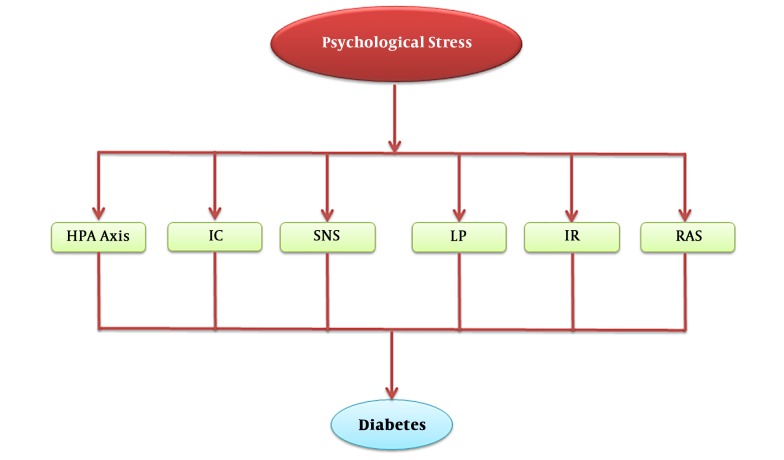
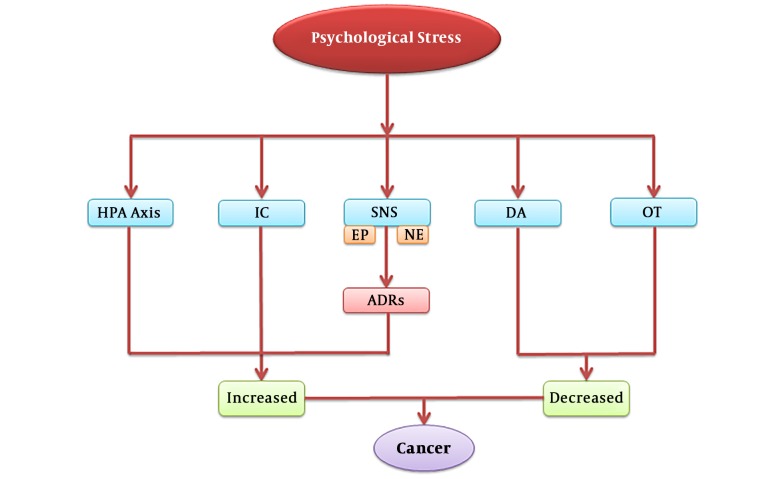
Psychological stress may make individuals prone to the development of diabetes through the impairment of the hypothalamic-pituitary-adrenal (HPA) axis function, sympathetic nerves system (SNS), lipid profile, cytokines balance, renin-angiotensin system (RAS), and insulin signaling pathway. Additionally, psychological stress can contribute to the development of cancer through the perturbation in the HPA axis, SNS function, and cytokines balance. Psychological stress is also capable of decreasing the levels of oxytocin and dopamine, leading to an increased risk of cancer in susceptible individuals.
It seems that psychological stress plays a significant role in the onset and progression of diabetes and cancer. The identification of the pathways triggered by psychological stress would open up a new avenue for the understanding of molecular mechanisms by which diabetes and cancer could be managed or even prevented.
心理压力可被视为包括1型和2型糖尿病以及癌症在内的许多病理状况发生和发展的一个风险因素。
这篇综述文章的目的是评估将心理压力与糖尿病和癌症的发生及发展联系起来的分子和细胞机制。
进行当前综述是为了调查和分析与心理压力对糖尿病和癌症影响相关的研究。
心理压力可能通过下丘脑-垂体-肾上腺(HPA)轴功能、交感神经系统(SNS)、血脂状况、细胞因子平衡、肾素-血管紧张素系统(RAS)和胰岛素信号通路的损害,使个体易于患糖尿病。此外,心理压力可通过HPA轴、SNS功能和细胞因子平衡的紊乱促进癌症的发展。心理压力还能够降低催产素和多巴胺水平,导致易感个体患癌症的风险增加。
心理压力似乎在糖尿病和癌症的发生及发展中起重要作用。确定由心理压力触发的途径将为理解可管理甚至预防糖尿病和癌症的分子机制开辟一条新途径。