Cotechini Valentina, Belli Alberto, Palma Lorenzo, Morettini Micaela, Burattini Laura, Pierleoni Paola
Department of Information Engineering, Università Politecnica delle Marche, Ancona, Italy.
Data Brief. 2019 Mar 15;23:103839. doi: 10.1016/j.dib.2019.103839. eCollection 2019 Apr.
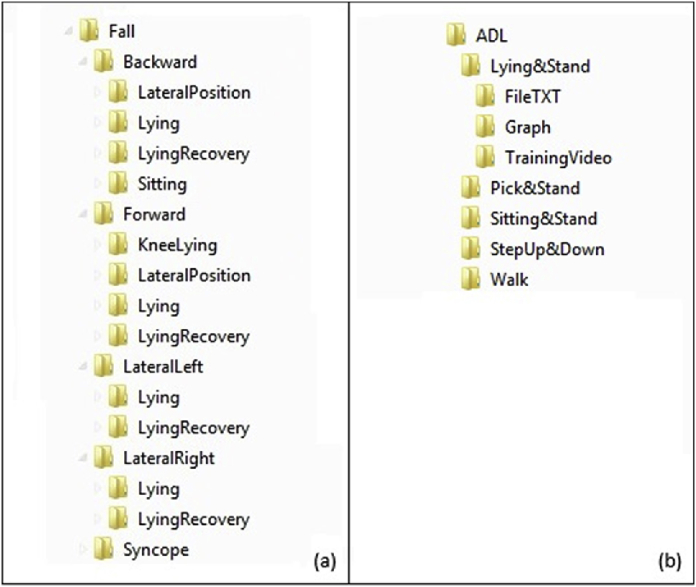
This paper describes a dataset acquired on 8 subjects while simulating 13 types of falls and 5 types of Activities of Daily Living (ADL), each repeated 3 times. In details, data includes 4 simulated falls forward (falling on knees ending up lying, ending in lateral position, ending up lying, ending up lying with recovery), 4 backward (falling sitting ending up lying, ending in lateral position, ending up lying, ending up lying with recovery), 2 lateral right (ending up lying, ending up lying with recovery), 2 lateral left (ending up lying, ending up lying with recovery), and 1 syncope. Simulated ADL are: lying on a bed then standing; walking a few meters; sitting on a chair then standing; go up or down three steps; and standing after picking something. Data were acquired using a MARG sensor, a wearable multisensory device tied to the subject's waist, that recorded time-variations of the subject's acceleration and orientation (expressed through the yaw, pitch and roll angles). These data can be useful in the development and test of algorithms to automatically identify and classify fall events. Fall detection systems are particularly useful when a subject is alone and not able to stand up after a fall, since an automatic alarm can be sent remotely to receive proper help.
本文描述了一个数据集,该数据集是在8名受试者身上获取的,模拟了13种跌倒类型和5种日常生活活动(ADL),每种情况重复3次。具体而言,数据包括4次向前跌倒(跪地后躺下、侧卧、躺下、恢复后躺下)、4次向后跌倒(坐倒后躺下、侧卧、躺下、恢复后躺下)、2次右侧横向跌倒(躺下、恢复后躺下)、2次左侧横向跌倒(躺下、恢复后躺下)以及1次晕厥。模拟的ADL包括:躺在床上然后站立;走几米;坐在椅子上然后站立;上或下三级台阶;捡起东西后站立。数据是使用MARG传感器采集的,这是一种系在受试者腰部的可穿戴多传感器设备,它记录了受试者加速度和方向随时间的变化(通过偏航、俯仰和滚动角度表示)。这些数据在开发和测试自动识别和分类跌倒事件的算法时可能会很有用。当受试者独自一人且跌倒后无法站起来时,跌倒检测系统特别有用,因为可以远程发送自动警报以获得适当的帮助。